5.8.06
In Crocodilopolis
A plane passes into the empyrean, turning red-gold as it goes behind the steeple and climbs towards the light of the sun that has set here but blazes still over the western plains. A cloud like a crocodile, trailing the extravagant curlicues of a sea horse, drifts slowly northwards, eating the wind. Astral Weeks on the stereo, its nostalgic accents becoming ever more unbearable as they fade and fade but never reach vanishing point. I am beset by phantoms. Some have names and shapes, others, more inchoate and more dangerous, do not, or not yet. Are these future hauntings that I hurry towards? They are all succubi, and if I name and shape them, as I so easily could do, will they only possess me further, sooner? What to do with these seductive almost-presences? I do not know ... recall how on that terrible night two years ago, the precognition of this place where now I live came: I knew, wherever it was, it looked west, as the places I lived at the beach, east facing all, did not. Was that the tilting of some kind of fulcrum, did the see-saw shift irrevocably then? The smoke I suck in, the alcohol I gulp, are they hastening my death, my west? No need to search for an answer to that one. Jupiter now hangs yellow in the sky. The moon waxes. The proofs lie on the table in the next room, but what do they prove? Enterprise? Or folly ... the Master has approved my delusion, it is beguiling enough for him to have been moved generously to words, all eighteen of them. People disappear every day, Maria said. Every time they walk out of a room, was the incontrovertible reply. Shall I walk out the door? Yes, but not yet. Those future ghosts, those almost-presences, are they the importunate dead, beckoning? Houri? Or do they call to another kind of rendezvous, in some genizah where I will find the damaged, the discarded, the heretical? That which cannot be proofed or proved? Sebek, crocodile, horse of breath, sea, see, repair, the broken bodies of the dead ...

4.8.06
Recall reading, years ago now, in the wonderfully titled Psychic Discoveries Behind the Iron Curtain that the subjects of Russian experiments in precognition and clairvoyance performed better in fine clear weather than they did when it was cloudy or rainy; and that electrical storms threw all but the strongest mediums off completely. This recall prompted by the weather today: a dark grey cloud has descended over the City and it has been raining incessantly since before dawn. I'm trying to do the final read through of the proofs of Luca Antara, but have had to pause because I feel that thick grey cloud is not just out there in the world but has also invaded my head, raining softly, not unpleasantly, pearled obscurities across the synapses of my brain. So I will go out instead and watch Antonioni's The Passenger, a new print and new edit of which is showing in Paddington. I will emerge later from the cinema, after dark, wearing a new identity, hurrying anonymous through the crowds with my umbrella raised, looking for Maria Schneider among the belles of Oxford Street.
2.8.06
Aphrodisiac Junction
I don't know what's happening to me. When I drive, I hardly sleep and what sleep I do have is more like wakefulness. Yet strangely interpenetrated with dreams. Very early this morning, before the one fugitive kookaburra that lives around here started chortling, I saw before me a page of prose in which there was mention of a couple of places in a part of Sydney that doesn't exist, or doesn't exist yet. The first of these was Burke's Aphrodisiac; the second, Aphrodisiac Junction. I quite often dream in print, sometimes even in verse, which I generally see before me the way it might appear in a book; but it's usually all gone by the time I wake, apart from, as on this occasion, the odd word or two. As far as I can tell, Burke's Aphrodisiac is a small beach place, a little cove on the coastal outskirts of the Metropolis. Probably squatted in the Depression, with title given the squatters later, as happened at a number of places round here. The Junction is up on the hill above the beach, where there's a few shops, where you turn off to go down to the water. Burke might have come from the street name, in which case it should be Bourke; yet I seem to recall it was spelled only with the U, in which case it must refer to the Burke who went with Wills. This must have ended up in the dream because I rang a friend the other day to ask him the name of the German watercolourist who went with, and died on, that doomed expedition (Ludwig Becker). That's it; that's all I know. Apart from one other thing: this seems to belong in the story of Jakob Oort, whose name also came to me in a dream. Now I want to go and live there.
1.8.06
today is the horse's birthday
Q: What's Australian for William Shakespeare?
A: Willy Waggadagger.
An Australian, an Irishman and an Englishman walk into a bar. The barman says: Is this some kind of joke?
A horse walks into a bar. The barman asks: Why the long face?
A: Willy Waggadagger.
An Australian, an Irishman and an Englishman walk into a bar. The barman says: Is this some kind of joke?
A horse walks into a bar. The barman asks: Why the long face?
31.7.06
As if I didn't have enough to distract me, a few weeks ago I went and started another blog. Perhaps because I can foresee a time when I'll either retire Luca Antara or use it only to post material directly related to the book of the same name, which will be out in a couple of month's - three, actually - time. The link's over there on the right, but I might was well put it here as well: White City. There's not much there yet and what there is seems fugitive, a bit mysterious, ontologically imprecise but trying to focus that imprecision, that ontology. We shall see; or we shan't.
l'amour
Hmmmm ... or, hummmm ... just sent my essays off to the publisher, always a good feeling to get another obsession off the desktop. Strange how fixated you can become on something like this. As if, somehow, every one of the 80,000 or whatever word-number it is has to be logged in order in the mind, their configuration understood, their cross-references, their repetitions. The fact that this is more or less impossible does not seem to be a disincentive to trying to make it so. Is it artefact or artifact? World War Two or the Second World War? Delusion or illusion? Here's how I described my preoccupations in the afterword: ... surrealism and expressionism; psychedelics and the nature of perception; landscape, with its intimations of paradise lost or found; the City; the far reaches of spacetime and the means used to probe it; above all, the workings of memory and what it can tell us of time, mind and world. Is that all, I'm thinking now? Is that everything? Am I missing something? What about love?
26.7.06
getting & spending
I have been remiss; I have not contributed to, or even visited, the blogosphere for weeks. My excuse, if an excuse is needed, is that I have in effect been working at two jobs. Beginning to drive again set off a welter of activity as I attempted to devise strategies that would perhaps bring the money I need to live without driving. These proposals are done and gone now, although who knows if they will be successful or not? Yet I have found, I think, both a book and a film I would like to write ... given the time. And also, unexpectedly, I decided to try gathering up bits and pieces of prose written here and there over the last thirty years or so to see if I could make a book out of them. This too is done, or almost, though it's not yet gone. Like drawing a line under the present, so that the past is truly past. If such a thing can be. Now I feel like I'm beached on some further shore, which is neither present nor past. Nor quite the future either. Some limboland, some littoral that, when I have the strength, I'll get up and start to explore.
13.7.06
It came to me in a dream
... must be one of the weariest tropes in our culture. I have never quite believed it myself, until Sunday night that is. Or should I say Monday morning? A friend had reminded me, serendipitously, of the due date for a certain grant application to be in. I was about to go back driving, imminently (I started that Blue Monday) and was feeling a sort of mild desperation about my prospects: what an earth could I contrive that might save me from the phantasmagoria? I had no new book to write, nothing I could legitimately ask for money to do.
During the night, while I slept, a name came to me. It loomed in my dreaming consciousness, crossing from vision to vision with enigmatic insistence. No particular narrative was associated with this name, nor did I see the person it belongs to. What there was, came down to this: Mr Oort, Master of Illusion.
Well, I love to dream and I particularly like dreaming enigmas. They are gifts that can entertain my usually scattered and fractious thoughts for a long time. When I woke, with this title and phrase intact in my mind, I began to wonder who he was and what it meant? Within a very short time, perhaps an hour or two, answers began to flow through my synapses - a first name, Jakob, a history, a mystery, a calling, a disappearance, a quest. It was an extraordinary feeling, to see, as it were without agency, this plot, or plat, constitute itself before me. The projection seemed not to require anything of me except that I witness it.
And the writing down, of course. The application I'm going to make insists that you produce a sample of the proposed work, an idiotic requirement I feel - as if with a brick you could show the house you are to build - but there we are. With equal parts anxiety and wonder, I started tapping out the first ten pages of my tale. There they are, floating like a tracery of dark threads on the blue pool of my screen. They may not earn me the grant, but I no longer care about that. There will be a way.
6.7.06
Very Sturdy Rogues
... so Louise Varèse translates the first sentence of Rimbaud's Parade - Des drôles très solides. Been thinking about this word, sturdy, because there was a category of miscreants in Elizabethan England who went by the name of sturdie beggars, viz:
... all Fencers, Bearwards, Common Players in Enterludes & Minstrels not belonging to any Baron of this Realm ... all Jugglers, Pedlars, Tinkers and Petty Chapmen, and have not Licence ... shall be taken and adjudged to be deemed Rogues, Vagabonds and Sturdie Beggars ...
This is an excerpt from a statute that was used to prevent travelling players travelling and playing ... but why were those beggars sturdy? Turns out that behind a modern, if rare usage - vigorous and determined - is an older meaning - reckless and violent - from the French verb, estourdir, to stun or daze; and behind that is a Latin word ex + turdus, thrush, used to describe a kind of drunkenness, that is, presumably, drunk as a thrush.
But what I always think about is a pop star hero of my youth, the lead singer in a band called Larry's Rebels, whom I once saw live at a dance in a country hall out the back of Morrinsville when I was about 16. Well, Larry went down a few years later for selling LSD to a policeman and part of the demystification process, I guess, was the revelation that his real name was Larry Sturdee. Not a Rebel after all but a Very Sturdy Rogue, perhaps.
30.6.06
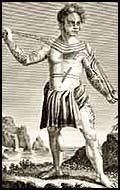
This week the first proofs - as they used to be known - of Luca Antara arrived. In the interim it has grown a subtitle - Passages in search of Australia - about which I was initially dubious. However, anyone I've spoken to who is involved with selling books, thinks it's a good idea so I'm feeling better about it now. Meanwhile the book itself is shaping up really nicely. A very strong, graphic cover, lots of ornamental flourishes in the titles and half-titles inside, reminscent of the writing on old maps, a nice clear face for the body of the text, and an image to introduce each of the four sections. Don't have permission for all of these yet so I won't say what they are. Except for this one, which is about 200 years old and thus out of copyright:

29.6.06
... as a glow brings out a haze ...
A couple of weeks ago I picked up, second hand, a copy of Dr Johnson & Mr Savage, by Richard Holmes. The book is a meticulous and fascinating account of the friendship between the young Samuel Johnson and the aging Richard Savage, during the year 1738. At this point Johnson, just arrived in London, was virtually unknown while Savage was, if anything, too well known. He was, says the back cover blurb ... a poet, playwright and convicted murderer who roamed the brothels and society salons of Augustan England creating a legend of poetic injustice ... Savage, an extravagant and fantastical man, with elaborate manners and radically unpredictable sympathies, died in prison in Bristol in 1744, more or less reconciled to his fate. Johnson then wrote his life and the drift of Holmes' thesis is that in that act of composition Johnson also invented the form of literary biography as it is practised today. It's a convincing enough argument but the chief joy of the book for me was its evocation of Savage himself as a talented but always disenchanted literary malcontent of a type I have occasionally known myself, both here in Sydney and in my youth in New Zealand. Then there is its picture of the milieu, Grub Street, with its manifold follies and complexities. When Alexander Pope, who generously supported Savage in his decline, so long as he stayed away from London, was writing The Dunciad, a great deal of the obscure and malign gossip it contains was given him directly by Savage, who seems to have had a quite extraordinarily compendious memory, especially for the faults and failings of his fellows. Savage's murder was committed in a tavern or brothel, late one night, when he and two others, after hours of roistering around town, burst impatiently into a private room which was just about to be vacated by those who had been drinking there. An argument ensued, swords were drawn and Savage stabbed a man in the belly ...
This tavern or brothel fight, with its strange concatenation of the pen and the sword, put me in mind of the death of Christopher Marlowe, and the book, recently republished, that Charles Nicholl wrote about it, called The Reckoning: The Murder of Christopher Marlowe. I'd seen a copy of it in Abbey's bookshop a few months ago, it was still there, so I bought and read it next. Not, unfortunately, as good as the Holmes. Like so many books these days, it needed a good edit. And there is too much in it of supposition that, through repetition and subtle changes of phrasing, masquerades as fact. And yet ... it does reveal a world as strange and as fascinating in its own way as does the Holmes, in this case the Elizabethan underworld of spies, utterers, projectors and the like. I suppose where this fascination is most acute for me is the area of 'projection', the laying of 'plats', whereby what is essentially a fiction, or an invention, is advanced into the world as a possibility that might then be made true by subsequent events. Marlowe's death, in so far as it can be understood, seems to have been a result of one of these projections, perhaps an attempt to bring down Walter Raleigh: he and the three men who killed him had spent the best part of a day together - from ten a.m. until after six in the evening - mostly in conversation, about what we do not know. Perhaps Marlowe was required to act in some way that he refused to do and was killed as a result; perhaps his death had been mooted before the meeting but was not decided upon until the discussions had reached a point of futility. Nicholl doesn't say this but it seemed clear to me that two men - Skeres and Pooley - held him, either side, by the arms, while Ingram Frizier drove the twelvepenny dagger in above his right eye, probably severing the carotid artery. This was thought to be a desirable blow in the arcana of Elizabethan sword fighting but always difficult to bring off; Marlowe would probably have to be held for it to have been accomplished. As to the further gruesome details - that his brains came out after the knife was withdrawn, that he died cursing - these seem to have been made up, or just possibily circulated by word of mouth, after he was buried, next day, in an unmarked grave in a Deptford churchyard.
But his name, as they say, lives on ... whatever name that was. Contemporary spelling was so fluid that it appears as Marly, Morly, Marley, Marlin, Merlin, Morlow and other versions as well as the one that has come down to us. But that name has gained extra associations, with Joseph Conrad's decision to give it - the surname alone, without the terminal 'e' - to the narrator of his Heart of Darkness as well as several other tales; while Raymond Chandler's reprise in his hero, Philip Marlowe, took it into another realm altogether. I even hear it faintly chiming inside the reggae beats of Bob Marley, as the name of a plantation owner from the 16th or 17th century, growing sugar or tobacco and running slaves under the hot Caribbean sun ... it was Conrad's Marlow who thought, appositely, that the meaning of an episode was outside, enveloping the tale which brought it out only as a glow brings out a haze ...
27.6.06
21.6.06
Sent my book, White City, to my agent today. It's the solstice, & all that, & seemed like a good time ... couldn't do any more with it save wreck, perhaps, its fragile coherence. Last time I read it through, over last Sunday and Monday, it seemed more like a set of themes & variations than a story as such. I mean, it has a narrative, events unfold sequentially through time, but the writing has a tendency to riff around certain perennial preoccupations - mine & others - rather than gallop to an end. I guess that's okay. Guess it's fine. It just ... surprised me.
20.6.06
Parchment Farm
... ah, yes, Joe Strummer. Wrote a song for Johnny Cash & sent it to him, sometime in the 1980s or the 1990s, I don't know exactly when. Johnny didn't record The Road to Rock 'n' Roll, but when the two finally met, not so very long before their several deaths, he told Joe that the song had always bothered him & that throughout the intervening period he'd been trying to figure out what it meant. Meanwhile Joe did record it, with his band the Mescaleros, on their 1999 album Rock Art & the X Ray Style. It's got some lines that intrigued me too:
On the road to rock 'n' roll
Everybody carries a good luck charm
Said to spook the highway wind
Blowing off old Parchman Farm
... Parchman Farm, often written Parchment Farm (& why not), is another name for the Mississippi State Penitentiary, located near Parchman, Mississippi, where a number of famous old bluesmen were jailed and which turns up in some classic songs, including Bukka White's Parchman Farm Blues ... is this what spooked Johnny?
Wish I knew how to link to music here but, instead, the full text of the lyrics is here.
Now I'm gonna take the mirror in my soul & turn it to the sky ...
18.6.06

Atlantis ... & beyond
Usually when I add a link to the sidebar, I do so silently ... but today I want to point to The Imaginary Museum, not just because Jack's a friend but also because his blog is brand new and so won't be much known about yet.
15.6.06
But memory images are being thrown up all the time ...
So wrote my sister towards the end of the last of her diaries which, more than ten years ago now, I transcribed, all three volumes. She wrote a full, though not continuous, account of her life from the time just before she left home at the beginning of 1972 until three years later, in 1975, breaking off about four months before her death in June of that year. I had some vague and as it turned out misplaced ideas about trying to publish an edited version of these diaries, vetoed by the rest of the family, but I'm still glad I did the transcription, which had the unanticipated effect of incorporating some of her perceptions, insights, usually in the actual phrases or sentences, into my functional memory so that she is, in fragmentary and unpredictable ways, always with me.
Anyway, here's another memory image thrown up: I'm eleven or twelve, and I'm doing my paper run, cycling up the unsealed, dusty and gravelly surface of Mole Street, along which there was just one house and thus one delivery, about halfway down, a letter box at the start of a long drive up to a wooden house on a slight hill. The rest of the street was paddocks and orchards, so far as I remember - with a particularly splendid apple orchard at one end, the one I was biking towards, on the corner of Wood Street. The woman who lives in the house is waiting by the gate for the paper, as many of the perhaps lonely old people on my run used to do. At this point, the sequence of events is a trifle vague, but either just before or just after I give her that day's Wairarapa Times Age, the hotted up Austen 7 belonging to a local hood by the name of Frog Hayes drives along Mole Street at speed, spewing vast quantities of fine white powdery dust in its wake. It swirls chokingly into my eyes and nose and mouth. I stick my tongue out at him.
Again my recollection is vague, but I know that either before or after this tongue-poking-out folly, Frog Hayes has words with the woman whose paper I've just delivered. Then he comes after me. I'm leaning from my partly upright bike, poking folded newspapers into the slots of the four or five mailboxes clustered at the corner of Wood and Mole when he drives up, not bothering to get out of his car, just pulling up next to me and snarling through the wound-down window. Somehow, through that vast dust cloud, he's seen my poked-out tongue in the rearview mirror and come to tell me that he's got his eye on me, he knows who I am, and if I tell anyone anything about the events of the afternoon he'll throw me into one of the blackberry bushes that grow in the vacant paddocks opposite the orchard. Then he drives off in another cloud of dust.
I was so scared. Only a few days previously, I'd witnessed Frog Hayes - he was probably only about 17, a skinny, mean little guy with a wizened face that had somehow led to him being given the name Frog - in an altercation with another local hoon outside Gilbert's Dairy on Main Street. The other guy had offered his hand for Frog to shake, to settle whatever their problem was, but Frog, characteristically, swore and knocked the hand away, an unheard of piece of malign derring-do in terms of the codes we lived by then. I was impressed and appalled in about equal measure. Now he was after me.
That evening the local cop rang up. My father took the call. He came off the phone to ask me if anything untoward had happened on my paper run that day? I said no. Dad talked to the cop for a few more minutes then hung up. I was even more terrified now, I'd lied to my father and, albeit by proxy, to the police as well.
I can't remember now how long it was before Constable Fraser - his daughter Marie, pronounced Maaari, was my sister's age and reputed to be the town bike - came round to our place but I do recall that I was out on the back lawn when he spoke to me. He said: You lied before, didn't you? Yes, I said. Something did happen on your paper run, didn't it? and Yes, I said again.
Well, then I had to tell him the whole sorry tale, about poking my tongue out at Frog Hayes and the threat he'd made and him driving too fast down Mole Street and having words with the woman, the one I'd given the paper to, the one who'd made the complaint, the one who'd helpfully put me forward as a possible witness ... it all came out in such a way that, by the end of it, I was so terrified I almost felt my life was as good as over, despite the fact that Constable Fraser reassured me that nothing would happen to me but that something bad would definitely happen to Frog Hayes.
How did it all end up? I really don't know. Perhaps Frog Hayes went to court and then to prison, perhaps they took his licence or his car off him. He certainly never crossed my path again, though I know I went in fear of him for weeks afterwards. One thing I never told the cop nor anyone else, perhaps not until this day, was that when he said he was going to throw me in the blackberry bush I pissed my pants.
13.6.06
Positive Contact
When my sons come to stay for the weekend, the elder one, who's nine, sleeps in here, in the study. When he was younger he always had trouble getting - though not staying - asleep; now, he seems to drop off more easily though he doesn't appear to need as much sleep as I expect, able to get by on eight or nine hours a night. He usually reads for a bit before asking for the light to be turned out but sometimes likes to listen to music instead. He selects a few songs from his folder on iTunes, turns the visualizer on and drifts off to something alarming (to me) like Outkast's Bombs over Bagdad ... or anything by Simple Plan, Good Charlotte, Green Day and such like.
Saturday night, he was settled, I thought, listening to the first of his nominated tracks, Positive Contact by Deltron 3030 aka Del the Funky Homosapien, when he suddenly reappeared in the sitting room saying he didn't want to listen to music after all. We turned the electronics off and I sat with him for a while, talking about what was wrong. He said he'd suddenly had the recurrence of a thought that scared him. The gist of it was that he would end up having done everything that could be done, thought everything that could be thought, experienced everything ... and yet still be alive. It was a vision of decrepit age without the relief of death.
It felt strange to be reassuring him that he would, in fact, die but that's what I did. He was relieved but still not entirely untroubled, saying that while he was glad he'd die and not have to remember everything, still ... I'm not quite sure how we arrived at the notion of reincarnation but, when we did, he felt much better. You mean, he said, I could have a whole new life, a whole new body and no memory of who I'd been before? Yeah, I said. That's fantastic! he replied. I might have lived millions of lives without knowing it! Thanks, Dad! He was asleep in minutes.
Next day I went through the conversation with him again, wondering what the song had to to do with it? Turned out that the first time he'd had the thought was while listening to that song the previous (= Friday) evening, and hearing it again had brought it back. I told him that some people claim to be able to remember their past lives but he didn't seem to find that thought very interesting. It was the notion of a new life, unaffected by the old, that intrigued him, and pointing out that you wouldn't know it was a new life unless you recalled the old left him unphased.
It's well known that children don't experience intimations of mortality before about age seven at the earliest but I find this particular take on it fascinating: it was aging and the loss of his powers that frightened him, without the benison of death; immortality struck him as a fearsome concept (which it is); but reincarnation solved all ontological problems at a stroke. I guess what impressed me most was that it was the persistence of ego that bothered him, not its evanescence.
9.6.06
Just now, coming up Smith Street, passing Rick Rack Retro, a shop selling fascinating and eclectically glamorous artefacts from the 1950s and 60s and even 70s, as well as a fine selection of second hand books, I saw in the window a hardback about German short-haired pointers and it triggered a memory. Alex ... I had to search for the surname ... Ward, with his blond hair and gappy teeth, my friend in Huntly, had a dog of that breed which he was training to go duck shooting with him. The duck shooting season began in May, the first I believe, and only went for a couple of weeks. People would set out for the lakes and swamps of the northern Waikato, the river marshes and the ox-bow bends, with their dogs and their shotguns to blast the ducks and the black swans out of the sky or off the dreaming waters ...
One day late in April, Alex and me and a couple of others - David Cowan? Roger Mackay? - were out on the vastly deserted playing fields of Huntly College, kicking a football around. Where was everyone else? In class, I suppose, and why we were not I don't remember. I was chasing a loose ball and, as Alex bent to scoop it up off the ground, I aimed a kick at it, missing the ball with my foot but collecting Alex on the temple, not hard, with my knee. He fell to the ground and then, as he started to get up, saying, not angrily, You bastard, Edmond ... jerked suddenly back and fell to earth again. His face turned grey and his skinny body started to spasm. His teeth were clenched hard together and a grinding sound came from his throat. He started foaming at the mouth. None of us had every seen anything like it before.
But I, even at fourteen an inveterate reader of the sporting pages of newspapers, had recently become fascinated by the story of a rugby player who'd swallowed his tongue, clenching his jaws so tight together someone had to use one of the poles - iron sheathed in plastic, ours were - that held the corner flag to force his teeth apart and retrieve the errant organ. This was what had happened to Alex I decided and, as his face turned from grey to blackish and the jolting of his body started to lessen, I kneeled down to try to clear his airways.
He was the most gat-toothed person I've ever known, so it wasn't difficult to get a purchase upon his incisors with my fingers and start to open that rictus up. But it was hard, harder than I would ever have imagined, to actually do it; I was convinced he was dying and that must have given me strength, for at last I did manage to get upper and lower jaw wide enough to reach my hand down into his maw for the swallowed tongue. I remember my astonishment at finding that, rather than being turned back and down his throat, it was merely stuck to the roof of his mouth in such a way as to block both throat and nasal passage. As soon as I depressed it, he went limp; and breathed again.
I don't know what the others were doing. With Alex lying still and pale and curled up on the ground, I turned and ran as fast as I could for the nearest classroom. It was a maths class, Mr. O'Brien, Sticky we called him. I remember as I gasped out my tale, looking down at my hands and seeing that the skin along the backs of my fingers and over my knuckles was torn and bleeding and covered with bits of Alex's saliva.
He survived, but they took him to hospital for observation and he missed the start of the duck shooting season, which really pissed him off. As for me, the wounds along the backs of my hand became infected and festered for a week or two before finally healing up again. There are no scars I can detect. Our friendship survived this peculiar hiccup without any deficit at all; but, since my family moved away from Huntly a couple of years later, I haven't seen Alex again. I heard he became a Quantity Surveyor. He had a sister called Merlene. His girlfriend's name was Jill Nightingale. He'd be 55 now if he's still alive.
6.6.06
smashing the atom / atomising the smash
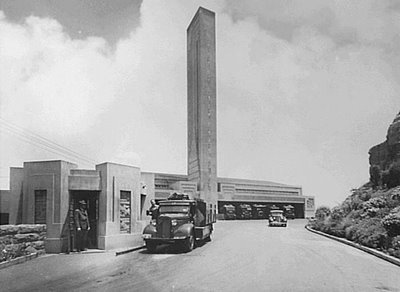
An email from a friend yesterday asking if I had any photos of the old Pyrmont Incinerator, designed by Walter Burley Griffin, built in the 1930s, demolished in the 1990s. Its death knell came with the unauthorised and clandestine toppling of the stack one weekend in the 1970s, which consigned the building to the oblivion it met a decade or two later. I never saw it with the stack but I explored the ruin many times in the late 1980s when I lived on the shores of Blackwattle Bay and, later, on the peninsular itself. I have quite a few photographs of it, but they're prints and negs and I lack the means to get them onto my hard disc at present. However, there are a few images available on the net. The two here are, first, what it looked like in its prime:
Second is a view of how it was in its derelict state, like something translated from Meso-America to the shores of Sydney Harbour:
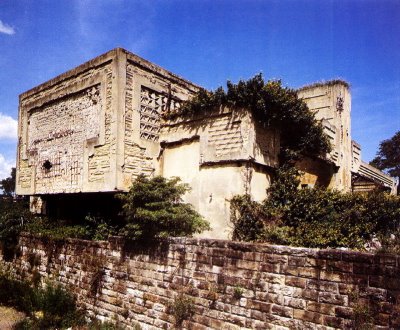
The photographs are taken from a similar point of view. When I knew the place, the small, chunky building at the entrance, seen on the left in the first photo, was still standing, although full of junk. The second photo is taken from a point a little to the west of the first, so that the entrance building, just out of frame to the right, does not obscure the incinerator proper.
The relief tiles on the incinerator were heavily symbolic, they symbolised, among other things, the solar system, the sun, the moon and the earth. Their designer, Marion Mahony, Griffin's wife, later wrote that the building records the basic fact of 19th century civilization later emphasised by the smashing of the atom.
Guess it's weirdly apt that it got smashed up in its turn. There's an apartment building there now.

Second is a view of how it was in its derelict state, like something translated from Meso-America to the shores of Sydney Harbour:

The photographs are taken from a similar point of view. When I knew the place, the small, chunky building at the entrance, seen on the left in the first photo, was still standing, although full of junk. The second photo is taken from a point a little to the west of the first, so that the entrance building, just out of frame to the right, does not obscure the incinerator proper.
The relief tiles on the incinerator were heavily symbolic, they symbolised, among other things, the solar system, the sun, the moon and the earth. Their designer, Marion Mahony, Griffin's wife, later wrote that the building records the basic fact of 19th century civilization later emphasised by the smashing of the atom.
Guess it's weirdly apt that it got smashed up in its turn. There's an apartment building there now.
2.6.06
On Trains
Don't say I never warned you
When your train gets lost
- Bob Dylan
1
Memory is a palimpsest, recent theory speculates. When we remember, we revisit and in that process revise a site we have been to before. In other words, we don’t go back to the unrecoverable original trace, but to our most recent remembrance of it. If this is so, each enactment becomes a re-enactment, each indulgence a re-indulgence, iteration piled upon iteration, past repletion, in a dizzying maze of revisions and reversions that makes a shape as repetitive, redundant and baroque as the Mandelbrot Set.
A memory is like a treasure box, then, full of objects that have been handled so often they are as if varnished with age. In the Tanimbar Islands in eastern Indonesia, this image is made literal: treasure boxes are taken, on special occasions, down from the rafters of the house, opened, the precious things within unwrapped and under the sightless eye sockets of the skulls of the ancestors, passed from hand to hand while their stories are re-told, after which both they and those who have handled them are ceremonially oiled before the taonga are re-stowed in the rafters.
My earliest memory is of a bull calf, Sooky; or rather, it is a memory of my solo visit to the bull calf’s paddock; but, curiously, this memory includes within it reference to an earlier occasion which, while it surely happened, I do not in fact recall. In this strange concatenation an opening appears, or seems to appear, into the dark backward that is childhood before memory traces are made, as in the testimony of those who claim to recall the unrecallable, their rupture from the womb.
I am walking down a path towards a gate. I am so small, and the grass on either side so tall, that the seed heads bend above me, making an arch. Cocksfoot, browntop, featherhead, rye. I am scared but determined. Scared because Sooky the bull calf lives in the paddock behind the gate and, although I have been this way before with my sisters (this is the recall inside the memory), I have never come alone. To come this way alone is also the root of my determination. I reach the end of the path and climb up the wooden slats of the gate set into a hedge, which is in fact more fence than gate, since I don’t know how, or even if, it opened. And I look at Sooky the black bull calf, who looks back at me with drool looping off his muzzle. Exultant and afraid, heart hammering, trembling …
That was when we rented the Farm House at Ohakune Junction off Mr McCullough, the Headmaster of the District High where my father taught. I am less then three years old because I was born while we lived in that house and we only stayed there three years before buying and moving into our own place in Burns Street. The Farm House had a long hilly drive down to the road and a cottage on the left near the bottom where another family lived. It was very close to the Main Trunk Line and we must have heard the trains passing daily and nightly, as they did in those days and perhaps still do.
Many years later, or ago, I tried to persuade myself I remembered the pattern on the linoleum floors of the corridors of Raetihi Hospital, where I came into the world, but this was either a recall of subsequent visits or a fiction. As a matter of fact, I was a large baby and in giving birth to me, my mother suffered a tearing of her abdominal muscles that necessitated an operation about six months later to repair the damage. In her autobiography she remarks that when Dr Jordan came to speak with her beforehand, he asked, as if he were God and she Eve, did she want a navel? Yes, she said, but ever after her belly was lumpy and wrinkled and on the few occasions I saw it, I felt a pang because I knew I had, albeit inadvertently, done that to her.
We were breastfed babies so I went back to the hospital with her for the op, but that is still too early for memories of linoleum. Nevertheless, when I consider that pre-conscious life, the one we all have and all forget, I sometimes imagine myself at her breast in the dead of night while the Limited Express passes up or down the island, its chuff-chuff-chuffa and hiss of steam, its whistle coming into or pulling out of the station—not a memory as such but a pre-memory, something lodged in the senses which would be reprised again and again, through just about every night of my childhood until I was ten years old, becoming a part of me, like mother’s milk.
Of course these nightly visitations mostly happened while I was sleeping and so must have been more like dreams; but there were many times when I woke in the Burns Street house and heard the north bound train labouring as it pulled across the face of Te Rangakaika, the range of bush covered hills before Ruapehu, just a mile or two away across the Mangwhero river and the Waimarino plain from where we lived. The enormous banshee-wail of the train whistle would echo off the flank of the mountain and ghost across the dark and otherwise silent land like a loneliness too awful for words, and it would be a comfort to snuggle back down under the covers and listen to the sound of the metal wheels dying along the rails.
2
I don’t know when the books of the Rev. W. Awdry entered my life but it must have been early. I still have some of the old hardback copies from my childhood; the sadly disintegrated one open on the desk beside me as I write is Railway Series No. 1, the very first, published in May 1945 by Edmund Ward of 16 New Street, Leicester, and reprinted twelve times before this impression, from October 1952, when I was just nine months old. It’s called The Three Railway Engines and has beautiful colour plate illustrations by C. Reginald Dalby.
The three engines are Gordon the Big Engine, Henry the Green Engine and Edward the Blue Engine and the picture on the first page shows six engines in one railway shed, none of which is Thomas the Tank Engine, with whom the series has since become indelibly associated. I’m not quite sure now who all the six engines in the picture actually are but I do know that, when young, I tended to conflate the children in our family with the Rev. W. Awdry’s engines. We were, in descending order of seniority, Gordon, Henry, James, Edward, Percy and Thomas. In this strange simulacrum of myself and my siblings, which transgendered all of my five sisters, I was James the Red Engine, a disagreeable character, vain and self-important, who suffers a calamitous fall. These original stories are in fact all quite disagreeable (one of their favoured words) in themselves, since, like the contemporary Snakes and Ladders, they attempt to narrate virtue rewarded and vice punished in a fairly hamfisted manner.
This didn’t bother me as a child because I didn’t really rate the morality tale ahead of the actual trials and tribulations of the engines themselves, their humiliations and heroisms, their failures and triumphs. Now when I open the books, it is the pictures that bring back those long ago emotions, for example the claustrophobic terror I felt and still feel at the sight of Henry the Green Engine being bricked up in a tunnel because he refused to allow his new coat of paint to get wet in the rain. In this instance, the moral failed to bite, since I could never see that anything done or not done by Henry justified such an horrific punishment.
Another peculiarity of these stories was that the clean, brightly coloured and personable engines, with their lips and eyes and noses, bore little resemblance to the heaving black oily steam-wreathed monsters that pulled the real trains we saw, more or less on a daily basis. The school I went to, Ohakune Primary, had running behind it a branch line connecting Raetihi and the Junction, and it was a favourite sport of ours, during or after school, to go up the back where the macrocarpas grew and watch the train go by.
It was a small engine, with perhaps a couple of trucks and one carriage for passengers, plus Guard’s Van, but tremendous for all that, with its hissing of steam and thundering of wheels. Sometimes we placed pennies on the track and marvelled at the way they returned elongated and skinny and bowed from being squeezed between wheel and rail. Sometimes, too, we indulged a fantasy that too close an encounter with a train would lead to you being sucked under the engine or the carriages, and so, having come as near as we dared, we clutched onto trackside bracken or scrub for support in an ecstasy of pretended fear for our lives.
The fatality of trains was real enough, however, as attested by the Tangiwai Disaster which, while it occurred when I was not quite two years old, loomed balefully over the rest of our lives in that place. For a long time you could see in the river bed the ruined carriages lying alongside the tumbled pillars of the bridge swept away by the combined weight of the north bound train and the lahar flooding out of Ruapehu’s crater lake; and everybody in that small community had a tale to tell, usually of loss and grief, though not always: Barry Reynolds, who lived a few doors up from us in Burns Street, coming home for Christmas, caught the train in Taihape and, because he rode in the almost empty first carriage which, with the engine, made it across before the bridge fell, survived the wreck.
And then there was the fatality of the Whangaehu (wan-guy-hoo, we said, not fanga-ehu) itself, the turbid stream, with its sulphurous smell and cloudy yellow waters, as if it was a river out of hell, whose malignity, it seemed to me, was a cause of the taking of the train and the death, among so many others, of laughing Clare Kennedy who had lived, with her sister Gay and her many Irish brothers, on a farm out at Karioi where we were lucky enough sometimes to go.
3
I never really understood why the railway station at Greytown, the place we moved to after leaving Ohakune, stood at Woodside, five miles from the town. It seemed unaccountable, given the flatness of the terrain, especially since all the other places on that line—Featherston, Carterton, Masterton, Eketahuna, Pahiatua, Mangatainoka, Woodville—had stations where they belonged, in or at least on the outskirts of town.
On the other hand, that railway line was in itself a kind of boy’s paradise we would ride to on our bikes at the weekend or in the holidays, to ramble untrammelled through the long dusty afternoons down the hot rails all the way to the river bridge where we swam in deep pools beneath the piles and sometimes heard the thrilling sound of a train going over above, shaking the world to its implacable core. Or perhaps it would be a jigger, those odd engineless vehicles that were worked up and down the rails by men, usually in pairs, operating levers.
Parallel to the train tracks on the further side there was a grassy step about a dozen feet high that marked the fault line of the 1855 earthquake, the same one that raised the shelf of land upon which the Hutt Road leading into Wellington runs. It was strange to contemplate the extreme regularity of this upthrust, suggesting as it did that somewhere beneath the chaos of appearances there was another, more arcane, geological order to things.
It was near this prodigy, in one of those mysterious gravel pits you find next to railway lines, that a group of us stripped off one day and compared our rapidly burgeoning private parts, searching out and counting the black pubic hairs just beginning to grow down there: he who had the most somehow thereby gained the highest status among us. I remember my own modest total, seventeen, but little else beyond the peculiarity of Douglas Workman’s cock, which, when erect, bent alarmingly to one side like a banana. And that Grant Batty, the future All Black, whom we called Butch, had the smallest one any of us had ever seen.
Further away, up in the wilds of the Rimutakas, were the remains of a railway worked, like the line in Awdry’s Mountain Engines, by trains that hooked onto a third chain-rail running along the centre between the other two. On a tramp up there one time I saw a stretch of this defunct track culminating in a tunnel that brought to mind the only one of Enid Blyton’s Famous Five stories to have left a trace in my memory, about a ghost train that ran ferociously out of just such a derelict tunnel in the black of night towards some fatal destination. I have forgotten the probably mundane explanation for this phenomenon—smuggling perhaps—while retaining the image of the driverless engine hurtling on forever in all its terror and beauty.
If you were going to Wellington from Greytown, you went either by road over the windy Rimutakas or to Woodside to catch the railcar through the tunnel under them, coming out at Maymorn and traversing the evocatively named stations on that route: Brown Owl, Upper Hutt, Trentham, Silverstream, Taita, Naenae, Waterloo, Ava, Petone and then on through Ngauranga and Kaiwharawhara to the vastness of Wellington Railway Station, forever associated in my mind with the rolling stock full of rotting meat and oranges my father remembered seeing there during the Depression.
Woodside is in fact linked for me with my father in his aged state, because he retired to Greytown and sometimes after my visits to him he would drive me out to the station and I would leave by train. At one of these partings, on a bleak winter morning with the grey horizontal rain blowing off the Tararuas, as if negating my youthful priapism just down the line, he confided that he had not had an erection for years and furthermore that it was ‘a relief’. This was one of the side effects of the pills he took for his depression and his panic attacks.
After that dismal occasion, or another, I remember being at Woodville Station waiting for a train and, to get out of the cold, sheltering in the providentially open waiting room. For some reason I left the room for a moment, perhaps to go to the toilet, and the mean wind slammed the door shut behind me, locking my luggage inside. For those ten minutes or so, alone on the deserted platform, my habitual melancholy took on cosmic proportions and I utterly despaired, until a battered Vauxhall Velox made its uncertain way into the station carpark and a glum railwayman unlocked the waiting room door.
Those waiting rooms, in earlier days and on the Main Trunk Line, stayed open all night with a coal fire burning in the grate, a radio playing and some cheerful blokes sitting over it with mugs of railway tea and packets of Greys or Park Drive or Pocket Edition tobacco; I recall once at Taihape spending a few feet-warming hours in one of these listening, improbably, to rock ‘n’ roll records playing on a Sydney, Australia station they had somehow picked up.
4
We moved again, to Huntly, where our house at 5 Dudley Avenue on the derisively named Nob Hill overlooked a hillside of clay and gorse, the rugby league ground where Test matches were sometimes played, and the shunting yards that worked all night long as trucks of coal from the mines arrived and were assembled into trains by hard working diesel engines. By this time—but when did it happen?—steam engines were a curiosity you hardly ever encountered.
Branch lines served the mines both west and east of the town: Kimihia, Rotowaro, Glen Afton, Pukemiro, where little cottages clung to steep hillsides and in winter hardly saw the sun. At Trevor McLeish’s Glen Afton house, tiny as it was, the front room was never used unless there was a wedding or a funeral and the furniture in there lay silent and still under white covers while everyone crowded around the coal range in the kitchen, like an engine itself with its hot black iron and red and yellow lights, its hissing, steaming wetback.
Those nights at Dudley Avenue, especially Thursday nights, I would lie awake in my Education Department built prefabricated room away from the main house, in form not unlike a railway hut, listening to that incessant revving and clanging and crashing, wondering at the infernal energy that drove men to work around the clock; yet never once questioned the utility of the wagons of gleaming black coal because in all the years of my growing up we were never without a fire, sustained by lumps of coal that glowed on long after the wood had gone to powdery grey ash.
Huntly was on the Main Trunk Line as well but the Limited came through early in the evening, from Auckland, and then early the next morning, from Wellington, and the line was so busy that it seemed without the enormous significance it had in ‘Kune: just another train. Whereas the shunting yard has stayed with me and every time Red Alert, the rock ‘n’ roll band I went to America with, played their cover of Warren Zevon’s Nighttime in the Switching Yard I was back there in the wee small hours hearing that sound like industrial teeth grinding.
Later still, when we had moved from Huntly to Heretaunga, and my father suffered his first breakdown and my mother announced herself as a poet, it came to be time for me to leave home and I did so on the Limited Express. Though only notionally together by now, both parents saw me off, with my three younger sisters in tow, at the Wellington Railway Station and I rode the length of the Main Trunk Line to Auckland alone and for the very first time.
It was a memorable trip, not just because I was leaving home: early on, myself and another stray youth teamed up with two girls travelling together and, sitting in pairs opposite each other, with a tartan blanket over our knees (my mother had sewed my surname on one corner of it), we played cards for most of the night. I have forgotten the girl’s name but can still remember the delicious feeling of our legs entwined together under the blanket, though it seems strange to me now that that’s all we did. She wore tartan as well and was prettier than her friend, or so I thought at the time.
All through my University years we travelled home and away by train, stopping for refreshments at Frankton (Hamilton), Taihape and Palmerston North. You’d go to buy your pie or sandwich or cake and cup of tea in the station cafeteria and take the heavy crockery plate and cup and saucer, with their blue NZR monograms, back to your seat and afterwards leave them on the floor to be collected later by a railwayman with a wheeled wooden trolley that clunked up the aisle. They seemed unbreakable, even when one cut loose and rolled up and down or from side to side in the carriage. You could smoke on the train as well, and drink, though I don’t recall doing that.
Mostly you’d try to sleep against the two big white pillows hired on the platform before the journey began, surfacing at each stop to see the blurred shapes of people joining or leaving the train, their breath steaming in the cold night air, huddled into coats as they went to their cars. I always tried to stay awake through the King Country, say from National Park to Taihape if I was going south, because I loved seeing the white or dark outline of Ruapehu on the skyline, the romance of viaducts over bush-filled gorges, the to me intensely evocative huddle of railway houses at Ohakune Junction where all the loneliness in the world seemed domiciled and where I imagined for years my own estranged soul wandered with the ghosts of trees.
One summer in those University years—it must have been 1971-2—I spent travelling both islands doing casual agricultural work here and there, and ended up, at the fag end of January, as a farm hand on a Lands and Survey block out the back of Stratford, Taranaki, at a place called Pohokura. Our boss, a genial man with the improbable name of Herbie Blank, surpervised half a dozen Borstal boys and me about the daily tasks that are to be done running sheep and cattle on a fairly rugged back country farm.
Fridays, we’d go down to the railway line at the bottom of the drive and catch a ride on a train going to Whangamomona just a few miles east. We’d drink at the pub until closing time, when the same train, consisting of an engine, a couple of carriages and a guard’s van, trundled back to—Stratford I suppose. It’d let us off at the cattle stop on Herbie Blank’s drive and we’d roll up the hill to the shearers’ quarters and roll ourselves into our single wire frame beds to sleep it off till crack of dawn when the farm work started up again.
The New Plymouth to Taumarunui railcar went through on that line too and you could also hitch a ride on that if you wanted to. One morning I got up at 4 a.m. and went down the drive in a darkness so intense I literally could not see my hand in front of my face. When I saw the faint glow of the railcar’s headlight beam in the west, I stood out on the track waving my arms above my head, then leapt clear as the train approached. Somewhat to my surprise, it stopped; even more surprising, there wasn’t another passenger aboard, so I rode up front with the driver and the guard, whose sport was counting the possums sitting out on the rails that we squashed as we rocketed through the bush into the dawn.
I don’t remember what train I caught to Auckland but I do recall in intense lysergic assisted detail the Rolling Stones concert at Western Springs stadium that was my reason for going there. The moment Mick Jagger stepped to the microphone to sing the words of the old Robert Johnston song Love in Vain—
When the traaaaiiiiiiin come in the staaaaaation ….
seemed to last forever and I can replay it in my mind any time I want. At the end of the concert, the huge black man who’d spent most of his time on stage slowly bouncing a big coloured ball, came forward with a bowl of rose petals with which Mick showered the audience—or at least those few within reach of the stage.
Next day, coming down again, I caught the train back to Pohokura. And not long after that, but I don’t know how long, trains ceased to be the first choice of travel among us and we began to go about by road, either hitch-hiking or driving in old cars we had somehow acquired.
5
When, a few years down the track, in Wellington, I wrote one of the first pieces of work I can still feel the magic of, it was a set of variations on a theme by W. B. Yeats, entitled Stations. The Yeats’ poem is called Hound Voice and begins: Because we love bare hills and stunted trees / And were the last to choose the settled ground / … Our voices carry; which for some reason reminded me of growing up in Ohakune. The work is in three parts and each part is named after a railway station: Horopito, The Junction, Tangiwai; all of them attempt to dramatise the moment of departure, a young man leaving on a train from a place he will never forget but won’t return to either. Romantic as that but I was young, just twenty-four at the time.
The work took its theme from Yeats but, formally, it was based upon a poem by Charles Olson, his Variations done for Gerald Van De Wiele, which includes three versions of the Rimbaud lyric from Une Saison en Enfer, the one that begins: O saisons, ô châteaux! / Quelle âme est sans défauts! // J’ai fait la magique étude / Du bonheur, qu’aucun n’élude. Olson translates: What soul / is without fault // Nobody studies / happiness … in the first of his versions.
Stations, which has not been published, was dedicated to my father and I sewed the few pieces of paper it consisted of between manila cards and bound them with a red ribbon to give to him. The booklet returned to me after his death but I don’t recall what comment he made about it, if indeed he made any. This was in strict contrast to my mother who, on the rare occasions I showed her any of my writing, usually had too much to say. It’s odd in retrospect to think that I hung on every word my father did not utter while largely discounting the admirably enthusiastic and informative commentary my mother lavished upon me. Praise can be harder to bear than silence.
These days, after seven biblical years beside the sea, I am once again living near a railway line—the Western Line, that goes from Sydney’s Central Station all the way across the continent to Perth. Sometimes I see the Indian Pacific pass through Summer Hill station in the mid afternoon; other times, usually on a Sunday, I hear the unmistakable chuff-chuff-chuffa and whooo-hooo! of a steam train going by and know it is the 3801, a restored Australian-built 1940s locomotive that does nostalgia runs up to Newcastle and back, one of which I went on, with my sons, for old time’s sake a few years ago.
But mostly what I hear, in the early morning hours, is the sounds of west-bound suburban trains that, by a quirk of architecture, rebound off the brick wall of the next door apartment building straight in my bedroom window. Then, half asleep, I am as if transported back to my childhood in that wooden villa in Burns Street under the spectral mountain, when our family was all one, unbroken, as we liked to imagine we would always be.
If I wake fully, as I often do, I might think about my parents, sundered in life and also in death, buried as they are on opposite sides of the tracks, as well as either side of the Rimutakas, he at Greytown, she in Akatarawa; but together then, during our King Country years. And this thought somehow leads on to a re-visioning of three images co-mingled and set together: the black bull calf Sooky bawling in the home paddock, the babe I was unconscious, milk-drunk at my mother’s breast, and the lonely sound of a train whistle blowing and the great steel wheels rushing by under the dark, bush covered hills of Te Rangakaika.
In all of this, where is my father? Practically speaking he was probably sleeping the sleep of the just as he prepared for another day’s teaching English and Physical Education to the pupils of Ohakune District High School. But in truth he is absent, or perhaps dispersed, partaking of both bull calf and steam train while fully inhabiting neither. While my mother remains the still point and unwobbling pivot of this ideal and quite possibly misbegotten fantasy.
Even so, if it is true that memory is a palimpsest, then this is one I write over again and again in search of the magic combination of letters that will set me free of it; though I know that such freedom is impossible and, even if it were possible, I would not really want it, because those images are me and I them and, like parents and children, without each other we would not exist. This is the strangeness of memory, that we indefatigably attempt to recapture, time after time, what cannot be recaptured.
Here in Summer Hill, after an early morning train passes, there’s always a silence more intense for the noise that has just been. If it’s too soon for the magpies to begin their carolling in the jacaranda tree, and there isn’t another sound to be heard, then my thought shifts away from birth and towards death, going west into the silence … and I wonder why so much melancholy, drama and romance is bound up in trains, why what is just a means of transport continues to have such intense metaphoric resonance for us.
And if I am unable to drop back off to sleep again, I might imagine that this resonance is because a life is indeed like a railway line, with a terminus at either end, and that my birth more than half a century ago in amongst those old cold hills will inevitably, after many stations and much various and variously enjoyed experience, end in death, perhaps in the midst of this thicket of streets and strangers, perhaps somewhere else. I might even remember the concluding lines from Stations and say them over softly, as if talking in my sleep, with a peculiar awareness that words once purporting to describe a young man stepping optimistically forth into the world might now be read as a kind of memento mori:
The station master says
the train will be along on time
any minute now
He puts some coal on the fire
he turns up the radio
The waiting room stays
open till the sun
shines in along the floor.
31.5.06
ain't nothin' but a stranger in this world
... or a stranger in cyberspace, perhaps. Can't think of a thing to say. It's because I've been on other jags. Like downloading as much of the Joe Strummer song catalogue as I can find on LimeWire (quite a lot). Or tracking the emerging field of Medical Humanities aka Artistic Medicine. Or imagining in forensic detail the progress of rust on my sadly disintegrating car. Or ...
When I was in NZ last month, I was reminded of the Landfall Essay Competition by an editor of the University press that publishes the magazine. Why I thought of a piece On Trains I cannot now remember. But I wrote it. Then, just as it was being finished I got an email from another University press about The Gift Book, a publication to celebrate the inaugural Book Month over there. It was the five grand per selection that caught my eye, so off I sent the just completed essay.
Then, in my delusive state I thought, what will I submit to Landfall if and when The Gift Book takes my trains? I must have had a head of steam up, I sat down and wrote a second essay, this one called On Film. The two are not dissimilar, they are autobiographical, memorious, evocative (I hope) rather than nostalgic. Almost a diptych. I enjoyed writing both immensely.
Well, last week, when The Gift Book let me know I hadn't made the short list, I was far more disappointed than I would have been if I hadn't stupidly allowed myself to hope ... and now I've got two essays and only one competition. So I thought, how would it be if I sent the one on film to the essay comp. and posted the other here, in stages, perhaps five, because it'll be too long otherwise and long things don't look well in cyberspace?
That way I could restore some life to this site and also allay the disappointment I felt about that particular train missing its station, as it were.
... thinking about it anyway. I may start tomorrow.
23.5.06
hoo dat?
In Cormac McCarthy's Blood Meridian or The Evening Redness in the West he's called the Judge and at the end of the book, after he has murdered the Kid in an outhouse jakes, it is written: His feet are light and nimble. He never sleeps. He says that he will never die. He dances in light and in shadow and he is a great favourite. He never sleeps, the judge. He is dancing, dancing. He says that he will never die.
In Tom Waits' Black Wings he has no name, only attributes and a history: He once killed a man with a guitar string / He's been seen at the table with kings / He once saved a baby from drownding / There are those who say beneath his coat there are wings ... One look in his eyes / Everyone denies / Ever having met him ...
Same guy turns up in Talking Heads' Swamp: How many people do you think I am / Pretend I am somebody else / You can pretend I'm an old millionaire / A millionaire washing his hands / Rattle them bones, dreams that stick out / A medical chart on the wall / Soft violins, hands touch your throat / Everyone wants to explode ...
He's in a Dylan song too: Somebody seen him hanging around / At the old dance hall on the outskirts of town / He looked into her eyes when she stopped to ask / If he wanted to dance, he had a face like a mask / Somebody said from the Bible he'd quote / There was dust on the man / In the long black coat.
I walked forty seven miles of barbed wire, Bo Diddley sang. I use a cobra snake for a necktie / Got a brand new house by the roadside / Made out of rattlesnake hide / Got a brand new chimney set on top / Made out of a human skull / Now come on Baby take a walk with me / And tell me who do you love?
Who is that man?
18.5.06
Today it's 25 years since I first came to Australia. I was thinking of working up a statement of what this might mean but somehow, in the event, the anniversary seems without any significance at all. Oh, well.
* * * * *
Meanwhile, this amused me. It's from a review, in Overland, of Chronicle of the Unsung (2004):
Imagine W. G. Sebald turned vagabond hippy.
* * * * *
I've always counted myself lucky that I didn't read Sebald until after I'd written The Resurrection of Philip Clairmont(1999), particularly the first section of that book. It meant I could recognise an affinity rather than fall under the spell of a (possibly overpowering) influence.
* * * * *
It was The Rings of Saturn, still, in my opinion, the best of his books, that I read, in a Harvill edition translated by Michael Hulse, with a cover that is a detail of a Whistler painting: Harmony in Blue and Silver, Trouville. At first it seemed strange to me, that choice of cover image, but not any more.
* * * * *
This book was published in 1998 but I don't remember when I bought it - 1999? 2000? - although I do remember where: at Clay's Bookshop in Potts Point. The German edition (1995), I found out recently, has a sub-title - English pilgrimage - omitted from the translation. I don't know why.
* * * * *
It was raining hard, the City looked grey and unappealing. It kept on raining for two solid weeks while I squelched back and forth from the Springfield Lodge in Kings Cross to the Combined Services taxi depot in Glenmore Road, Paddington, learning how to do that.
* * * * *
One day the sun came out and there, across the road from the hotel, was an old friend, Vic Filmer, sitting on a bench, talking to himself, as he is wont to do. I hadn't seen Vic for years. Come to thnk of it, I haven't seen Vic for years. I should give him a call.
* * * * *
Meanwhile, this amused me. It's from a review, in Overland, of Chronicle of the Unsung (2004):
Imagine W. G. Sebald turned vagabond hippy.
* * * * *
I've always counted myself lucky that I didn't read Sebald until after I'd written The Resurrection of Philip Clairmont(1999), particularly the first section of that book. It meant I could recognise an affinity rather than fall under the spell of a (possibly overpowering) influence.
* * * * *
It was The Rings of Saturn, still, in my opinion, the best of his books, that I read, in a Harvill edition translated by Michael Hulse, with a cover that is a detail of a Whistler painting: Harmony in Blue and Silver, Trouville. At first it seemed strange to me, that choice of cover image, but not any more.
* * * * *
This book was published in 1998 but I don't remember when I bought it - 1999? 2000? - although I do remember where: at Clay's Bookshop in Potts Point. The German edition (1995), I found out recently, has a sub-title - English pilgrimage - omitted from the translation. I don't know why.
* * * * *
It was raining hard, the City looked grey and unappealing. It kept on raining for two solid weeks while I squelched back and forth from the Springfield Lodge in Kings Cross to the Combined Services taxi depot in Glenmore Road, Paddington, learning how to do that.
* * * * *
One day the sun came out and there, across the road from the hotel, was an old friend, Vic Filmer, sitting on a bench, talking to himself, as he is wont to do. I hadn't seen Vic for years. Come to thnk of it, I haven't seen Vic for years. I should give him a call.
16.5.06
So I did track down the image of the Bradshaw dancer today. It's reproduced in :
The Art of the Wandjina : Aboriginal cave paintings in the Kimberley, Western Australia; I. M. Crawford; Melbourne : OUP in association with the Western Australia museum, 1968
where it is captioned:
‘A Bradshaw figure at Kalumburu Mission’
Kalumburu is a remote community in North West Kimberley, at the head of Napier Broome Bay, about as far away from anywhere else as you can get in Australia - but also, one of the closest points to Indonesia, specifically the island of Roti, just south and west of Timor, about 600 kilometres away across the sea.
I'm pleased about this, because in my storied voyage, I have the ship making landfall at Bigge Island, not so very far to the south in the Bonaparte Archipelago, and then heading north a ways before coming ashore on the mainland coast. Then there is an epic cross country trip to the north and the east, that ends where Darwin now is ... it is during this trek that the figure of the dancer, along with other Bradshaws, is seen on a cave wall.
One curious thing - 'authorities' deny that the Bradshaw figures show any sexual differentiation but I cannot see this particular figure as anything other than female - because of the elbows especially. I've never seen a bloke whose elbows go like that.
11.5.06
Many years ago, but I don't know how many - Fifteen? More? - I came across this image:
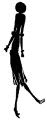
Nor can I remember exactly where I found it, obviously in some book or other because I still have a copy of the xerox I took. It's a graphic translation, by an unknown hand, of one of the so-called Bradshaw Figures, rock art of the Kimberley region in north west Australia.
The Bradshaws - named after a Joseph Bradshaw who first 'discovered' them in 1891 - are an enigma. They haven't been reliably dated and no-one has yet advanced a convincing explanation of who made them. They are very different stylistically from the wondjina tradition of painting that still survives up there.
To my eye, and this has of course been noted by others, they have affinities with figurative rock art tradtions in other parts of the world, particularly Africa. There have been more or less scholarly attempts to compare the Bradshaws with similar figures from both southern and northern (Algeria) African traditions.
This figure of a dancer, so graceful, insoucient, and free, was in many ways the original inspiration for Luca Antara, the book, she makes a brief appearance in it and I'm just now in discussions with the publisher which may lead to the inclusion of her image in the book as well. This would please me very much if it happens.
Some recent dates for the Bradshaws suggest they are about 17,000 years old, that is, they were made around the time of the last glacial maximum. It is a matter of fact that a great deal of land off the western and northern coasts of Australia was submerged as the ice melted and the ocean came flooding back. Large parts of what is now Indonesia also disappeared.
I've never been able to dismiss the possibility that the Bradshaws are the art of a culture and tradition that was more or less wiped out by the rising seas sometime in the last 10,000 years or so. I'm aware that there are various certifiable crackpots who have elaborated vast, fanciful dream towers about this thematic and I deny that I'm one of them.
But somebody made the Bradshaws and they show a sophistication which, while it certainly can't be used to support the idea of some Atlantis type lost civilisation, may still represent a flowering of a culture whose other artefacts and achievments now lie under the Timor Sea. This is likely to have been an indigenous Australian - ie Aboriginal - culture with strong ties to those of nearby Sundaland.
Some more images:
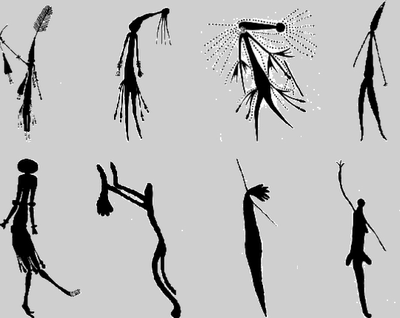

Nor can I remember exactly where I found it, obviously in some book or other because I still have a copy of the xerox I took. It's a graphic translation, by an unknown hand, of one of the so-called Bradshaw Figures, rock art of the Kimberley region in north west Australia.
The Bradshaws - named after a Joseph Bradshaw who first 'discovered' them in 1891 - are an enigma. They haven't been reliably dated and no-one has yet advanced a convincing explanation of who made them. They are very different stylistically from the wondjina tradition of painting that still survives up there.
To my eye, and this has of course been noted by others, they have affinities with figurative rock art tradtions in other parts of the world, particularly Africa. There have been more or less scholarly attempts to compare the Bradshaws with similar figures from both southern and northern (Algeria) African traditions.
This figure of a dancer, so graceful, insoucient, and free, was in many ways the original inspiration for Luca Antara, the book, she makes a brief appearance in it and I'm just now in discussions with the publisher which may lead to the inclusion of her image in the book as well. This would please me very much if it happens.
Some recent dates for the Bradshaws suggest they are about 17,000 years old, that is, they were made around the time of the last glacial maximum. It is a matter of fact that a great deal of land off the western and northern coasts of Australia was submerged as the ice melted and the ocean came flooding back. Large parts of what is now Indonesia also disappeared.
I've never been able to dismiss the possibility that the Bradshaws are the art of a culture and tradition that was more or less wiped out by the rising seas sometime in the last 10,000 years or so. I'm aware that there are various certifiable crackpots who have elaborated vast, fanciful dream towers about this thematic and I deny that I'm one of them.
But somebody made the Bradshaws and they show a sophistication which, while it certainly can't be used to support the idea of some Atlantis type lost civilisation, may still represent a flowering of a culture whose other artefacts and achievments now lie under the Timor Sea. This is likely to have been an indigenous Australian - ie Aboriginal - culture with strong ties to those of nearby Sundaland.
Some more images:

5.5.06

Among the many wonderful things seen, heard and done at Bluff / Rakiura, there are some that keep recurring in my mind's eye. Monday was a day off, we were in Oban and our time was our own. I decided to walk over to Maori Beach, a little to the north of Half Moon Bay, where I had been on my only previous visit to the island. It was a longer walk than I remembered, a good four hours there and back, the first part of it down sealed or metal roads where houses were and people lived. Then you went into bush, climbing through a link in a massive sculpture of an anchor chain coming out of the sea below. This because in Aotearoan mythology the North Island is a Te Ika a Maui, the fish pulled up from the ocean by Maui, the South Island is the waka or canoe he was sailing in and Rakiura, or Stewart Island, the anchor stone of that canoe. There were small birds waiting at the gate to welcome or to guide: a miromiro or tomtit:

and another I could not identify. The track undulated along the shore line, running down to small wild sandy beaches then climbing to the saddles of intervening headlands. On one of these saddles I was summoned by the sound of a tui:

singing close by and stopped to listen. The bird, a male, was sitting on a branch only a couple of metres away and, silhouetted as it was against the pale green underside of the leaves of forest trees, with glimpses of blue sea beyond, I could see it clearly both in the round and in profile. The tui is a mimic and I could hear in its song the calls of various other birds but the most extraordinary thing was that I could also see its tongue. It's a honey-eater, so its tongue is adapted for insertion into the cups of flowers with a brush like tip for gathering the nectar ... but from this vantage it was black and lithe and changeable, thinning and elongating beyond the tip of the beak to a dark rapier-like point then retracting and thickening to make the more guttural, throaty sounds, the clicks and clucks and churks. The bird was calling to another across the valley, so that after each aria it would pause and cock its head, waiting for the reply; and then reprise; and so on. I don't know how long I watched and listened, a long time, until it finished and flew away, with a flash of superb blue-green, in the direction of its rival or fellow. Later, at Maori Beach itself, wandering in soft muddy sand up the river bed at its further end, I saw a flurry in the shallows and scooped out of the water a baby flounder, hardly bigger than a fifty cent piece, which lay quite still in the palm of my hand until I re-immersed it in the inch deep water and it slid away and before my very eyes, as they say, turned itself into a piece of ribbed sea sand, almost imperceptible even though I'd watched it perform its act of camouflage; had I not, I'm certain I would not have been able to see it at all. There's a swing bridge over that river, leading on into the wilderness but, as it was last time, I didn't have time to go any further ...

4.5.06
A Found Text (found in the street in Bluff)
They had driven us out of the Bay View by playing Highway to Hell at max volume. The Anchorage, or is it the Golden Age, was closed. The lights were on in the Eagle but there was nobody home. The others turned back but I kept stupidly on up the stark unlovely midnight street. At the corner of Liffey and Gorre I was hailed by a shadow, blacker than the night behind it.
O farewell you streets of sorrow, it sang. O farewell you streets of pain.
Who are you? I asked.
Doncha know? the Shadow said. I’m Shane MacGowan’s Last Tooth.
And what might you be doing here?
Waiting for the Tooth Fairy.
You’ll be waiting a long time.
I’ve already been waiting a long time, said Shane MacGowan’s Last Tooth, but I can wait a little longer yet; and told me his tale:
When the time came for me to fall from Shane’s poor carious mouth and be gathered up and exchanged for silver, the Tooth Fairy swore she’d never seen such a specimen as me and would go to the ends of the earth before she’d lay her delicate fairy fingers upon it. ‘Alright then yer mouldy bitch,’ I said, ‘I’ll see you there.’ ‘I’d rather see you in hell,’ the Tooth Fairy said and disappeared in a puff of green smoke.
His story seemed lacking in a few essentials.
Is that it? I asked.
What more d’you want? he snarled, and I caught the unmistakeable stench of decay upon the clean night air. I’ve come all this way, to the ends of the earth, and I’m waiting for the Tooth Fairy to come herself and claim me for her own. Aw, Christ, it’s cold down here at the Bluff, and the pubs are all closed and the graveyards empty as well …
How do you pass the time? I asked, friendly as you like.
By singin’ songs and lookin’ at the girls, he replied, how do you think? There’s the two sisters, pretty as pictures, and I told one there was none more beauteous in the world than her, not even her sister; and then I told her sister the same. There’s the maiden of light and the maiden of dark. There’s the kelp woman who comes from the deep and wraps her salty self around me on nights when I’m lonesome …
Just then a black stretch limo drove past us down Gorre Street, heading for the signpost at the end of the world. Shane MacGowan’s Last Tooth looked after it and swore.
That skivey git Joe Strummer, he said. Givin’ himself airs again.
What, I said, Joe’s down here too?
Aw, he only comes for the oysters. You’d think a dead man would have more respect than that but there you go, he was a diplomat’s brat all along.
There was nothing to be seen behind the limo’s tinted windows. I looked again at my interlocutor, trying to make out features or at the very least a shape in the sodium glare.
Why, I said, a moment later, you’re not really there at all, are you? You’re all cavity!
And what in hell did you expect? said Shane MacGowan’s Last Tooth. Some kind of pearlie from the oyster? Some ivory for your mam’s brush to tickle? Some flossy Colgate fantasy?
A bright white light descended then, not before time, I thought it was the limo coming back, or maybe the police, who’d been cruising up and down Gorre Street all that long and boozy evening.
Lord be praised, it’s her at last, I felt rather than saw or heard the stench gape beside me. She’s gone and come for me at last.
The light formed a halo around that black shape, like an embrace, like enamel, like pulp in a jar.
Before the light re-ascended, I saw something I’ve not seen before and never wish to again: gangrene-black, mucous-green, pus-yellow and white as the jiggers a midnight drunk sees in his delirium tremens. This was not the tooth, mind, this was the Tooth Fairy herself, or who or whatever it was came to take him away:
You're a bum / You're a punk / You're an old slut on junk
Living there almost dead on a drip / In that bed
You scum bag / You maggot / You cheap lousy faggot
Happy Christmas your arse / I pray God / It's our last …
Shane MacGowan’s Last Tooth sang.
3.5.06
te rau aroha
... have been a very long way away - & it was good - & part of me - does not want to come back ...
19.4.06
bluffing
So I'm off to Bluff tomorrow. Fly to Christchurch, then to Invercargill then shuttle to Bluff where we are convening, in the first instance, at a pub called the Anchorage / Golden Age. Staying the first three nights on a marae, Te Rau Aroha, thence to Rakiura / Stewart Island, for the next two. I haven't stayed on a marae since the 1970s. We'll be sleeping all together in rows on mattresses on the floor around the walls of the whare nui I imagine, though there might not be too much sleeping going on ... very excited about re-visiting Rakiura, it was a fabled place for me from when I was young, my father used to tell me about how beautiful it was and promised that, one day, he would take me there. For various reasons he never did but, not long after he died, I went there with / without him ... and found it as wonderful as he had said. And ... I really do need to get completely away from here, what with the book finished, the screenplay all but done, the Luca edit within a whisker of completion ... I feel ... dislocated ... like ... bluffing ...
(details of the event can be found here, just click on Bluff O6)
(details of the event can be found here, just click on Bluff O6)
a note on the below
There's something immensely cheering about a film, made by an Australian born director, Roger Donaldson, that shows such active and intimate affection both for New Zealanders and Americans.
18.4.06
hick tears
Because I'm about to go to the deep south of the South Island for a weekend ... because I am so sick of sunny hot blue days ... because it was Easter Monday and I was hung over ... or just because ...
I went to see The World's Fastest Indian yesterday afternoon. It was disconcerting suddenly to find myself back in New Zealand in the 1960s. Or, a depiction of same. I can remember how, when someone had been away and came back, their loved ones would meet them and, instead of hugging or kissing or whatever, would stand around looking pleased and embarrassed. Blushing. The early sequences of the movie are like that: everyone pleased and embarrassed, with the exception of Anthony Hopkins who plays the lead: eccentric, bloody-minded, beneficent, obsessed Burt Munro.
Later Burt goes to the States with his bike and has adventures. These sequences put me painfully and nostalgically in mind of the time, in the late 1970s, when I went with a group of Kiwi musos to Los Angeles and San Francisco. With all of the naive optimism and good-hearted simple-minded fantaticism of Burt Munro. We were treated with great kindness, not unmixed with amusement, too. By most people. Though some did steal from us, not that that was very hard to do.
Burt makes it and then comes home again, where everyone stands around looking even more pleased and only slightly less embarrassed than they did before he went away.
It's a very sentimental film and I cried here and there involuntarily, like a kid, sometimes almost angrily wiping away the tears I did not want to be shedding.
In that part of New Zealand, there's a regional accent, people burr and roll their rrrrs; Anthony Hopkins got the burr alright but to my ear did not quite get the rest: those flat vowels that are reluctantly spoken, as if people were unwilling to let the sounds go out of their mouths. A minor point of verisimilitude perhaps: most reviews have praised his accent.
The film's been a huge hit in New Zealand, natch, the way Crocodile Dundee was here and for similar reasons; but it lacks the Croc's macho edge and flash, smart-arse stunts. Burt Munro's too much of a charmer, a sweetheart, ever to try to put one across anyone. The only time he gets angry it's very funny and there could perhaps have been more of that characteristic deadpan wickedly oblique abuse. Even when he races, he only races himself. Not only is he immune to embarrassment but the film, with great decency and tact, avoids the many opportunities there are to put one across him: a rarity these days, perhaps.
So I guess my tears were hick tears after all: embarrassment and recognition, all mixed up with love of home.
16.4.06

Well I did finish drafting my book, which for the mo' I'm calling White City, yesterday. I was somewhat alarmed, when I did the stats, to find that it's 75,000 words long, including the prologue I wrote late last year. Took about three months to assemble the rest, from late Jan. to mid-April. Worked every weekday bar Australia Day and one other mid-week Wednesday when I had a crisis and couldn't. But what is it? I don't know. And may not for quite a while yet. If it was all a big waste of time, that wouldn't be a first. I've got three other unpublished books to my 'credit'. One is just awful and must be destroyed sometime, though I have extracted from it a novella that I think might be okay. Another involves intimate family matters and my sisters and my mother, who was still alive then, in a rare act of unanimity, nixed it. The third I probably could publish somewhere if I really tried but lack the enthusiasm; it isn't bad, it just isn't very good.
A White City by the way is an amusement park. The term originated in 1893 as a name for the World's Columbian Exposition and Fair in Chicago, because of the predominantly white buildings there. Curiously, this Fair had an influence upon Walter Burley Griffin's winning design for the (very off white) City of Canberra. There was and is a White City in Sydney, it's behind Rushcutters Bay in the eastern suburbs, where the NSW Lawn Tennis Association has its HQ; before Luna Park was built at Milsons Point there was an earlier version here and the name has stuck. Taxi drivers still use it and it appears on some maps as the name of a tennis club. I picked it up from driving years ago but it wasn't until I read Laurie Duggan's Ghost Nation: Imagined Space and Australian Visual Culture, 1901-1939 just recently that I understood the provenance. So, yes, a facade which I hope is tacky and colourful enough to beguile readers into entering the mirk labyrinth I've tried to construct behind ... like a ride on the Ghost Train? Or a sojourn in Giggle Palace? Or a trip to the Crazy House perhaps ...
14.4.06
a small essay
Have been looking at Sidney Nolan:

who said that without Ern Malley:

there would have been no Ned Kelly:

but before Ned there was:

Catani Gardens.
(all paintings by Sidney Nolan: Self Portrait, 1943; Ern Malley, 1974; Ned Kelly, 1946; Catani Gardens, 1945)

who said that without Ern Malley:

there would have been no Ned Kelly:

but before Ned there was:

Catani Gardens.
(all paintings by Sidney Nolan: Self Portrait, 1943; Ern Malley, 1974; Ned Kelly, 1946; Catani Gardens, 1945)
12.4.06
The last few days temperatures have been in the high 20s and early 30s. Clear blue skies with streams of cirrus. Mornings and evenings are cooler. Can't remember when it last rained. Right now, a big golden moon, only slightly dented, one night away from full, is rising over the City while in the west the blue fades down to a pale lemon colour that is almost white, with the church steeple standing black against it. I'm very tired. Not physically, mentally. Almost exhausted - I have to make one more effort, or perhaps two, and then I will be at the end of my book. Not book, draft of book, because I can see already how much more there is to do; but at least I will have a whole to do it to or with, a complete thing: even if it's not the wondrous shining shape I thought of making, it has some shape, some kind of reality, it exists ... today, in the afternoon, I was going over the editing notes on Luca Antara, section 3, which has interpolated into it a long account of a voyage which I pretend is real, or at least derived from a real document, but is in fact a fiction. And I remembered how false it seemed to me at the time of writing - perhaps not false so much as implausible, I didn't believe anyone would believe it, without remembering that we don't only read to believe, sometimes we do it to travel, to forget, to dream, to change. So then I wondered if what I'm doing now, which seems just as false, implausible, unbelievable, might in a year's time seem ... I don't know, I'll settle for anything really so long as it is different from this feeling I have now: exhaustion, futility, loss, as if all those long strings of words were just like the streams of cirrus that appear in the sky sometimes and then, next time you look, they're gone. So I look out the window and the sky is green, there's a plane flying west and Orion, who lies on his side at this latitude and is seen by Polynesians as a waka or canoe, is setting sail into the black south land.
7.4.06
The Total Library
It has been a very great pleasure this week to have by my side The Total Library: Non-Fiction, 1922-1986 by Jorge Luis Borges. For any number of reasons, most of which I won't go into now. Best of all, perhaps, has been the fortuitous intersections that have occurred with things I've been working on, which simply would not have turned out the same did I not have Borges to stay (it is, of course, a library book). Most of the week, I was struggling with the edit of one of the more intractable parts of Luca Antara, wherein I tried to summarise the beliefs of certain Gnostic sects from Alexandria early in the first millenium CE. Not easy, not easy at all. However, I managed to improve (I think) upon what I had and sent the section back to the editor for her comments yesterday. This morning I read a luminous essay Borges wrote in 1932 called A Defense of Basilides the False, which covers some of the same ground I was attempting to mark out, with an elegance and an erudition I can't claim, and yet - and this is another reason to love Borges - reading it did not make me think less of what I had done, nor did it make me think more of it; rather it allowed, perhaps, another viewpoint from which to contemplate it. The essay concludes:
In the first centuries of our era, the Gnostics disputed with the Christians. They were annihilated, but we can imagine their possible victory. Had Alexandria triumphed and not Rome, the bizarre and confusing stories that I have summarized would be coherent, majestic and ordinary. Lines such as Novalis' "Life is a sickness of the spirit," or Rimbaud's despairing "True life is absent; we are not in the world," would fulminate from the canonical books. Speculations, such as Richter's discarded theory about the stellar origins of life and its chance dissemintation on this planet, would know the unconditional approval of pious laboratories. In any case, what better gift can we hope for than to be insignificant? What greater glory for a God than to be absolved of the world?
In the first centuries of our era, the Gnostics disputed with the Christians. They were annihilated, but we can imagine their possible victory. Had Alexandria triumphed and not Rome, the bizarre and confusing stories that I have summarized would be coherent, majestic and ordinary. Lines such as Novalis' "Life is a sickness of the spirit," or Rimbaud's despairing "True life is absent; we are not in the world," would fulminate from the canonical books. Speculations, such as Richter's discarded theory about the stellar origins of life and its chance dissemintation on this planet, would know the unconditional approval of pious laboratories. In any case, what better gift can we hope for than to be insignificant? What greater glory for a God than to be absolved of the world?
4.4.06
The Profumo Scandal
In today's paper, an obituary (from the London Telegraph) of John Profumo who died, aged 91, some weeks ago. He is described as Politician, charity worker, because after the 1963 scandal that destroyed his parliamentary career, he devoted the rest of his life to Toynbee Hall, a charity based in London's East End; one of his co-workers there said We think he's a bloody saint. I can never see his name without a quickening of excitement.
I had just turned eleven when the scandal broke in London. I'd recently started a paper run, taking over from a boy who was fired for selling the papers he was meant to be delivering to random strangers and pocketing the money. His name was John Cole and he reckoned he was going to beat me up for taking his job but he never did. His father was the local taxi driver, with a fleet of two pink Ford Zephyrs; later he was to hang himself in his garage over some murky business involving his wife, John's mother, and another man.
Every afternoon but Sunday I'd ride my bike down to the local newsagency where, in a small back room that smelled of ink and newsprint, I'd count out eighty copies of the Wairarapa Times Age, just delivered by truck from Masterton. I'd put them in my paper bag, forty each side, then sling the bag over the bar of my bike and set out on my five mile run ... West Street, Kuratawhiti Street, Udy Street, Mole Street, Wood Street, Kempton Street, West Street again. Hawke Street aka Lover's Lane, was on my route, as were several apple orchards and berry fruit farms, so there were lots of opportunities to get up to mischief and I either took them or didn't depending on the day and the company.
But then, the Profumo Scandal broke, and I forgot everything else in breathless contemplation of the strange new world it uncovered. Every day, in the Times Age, below the fold on the front page, there would be a report of the latest revelations. Often, too, there would be photos of svelte, dark Christine Keeler or blond brazen Mandy Rice-Davies, both of whom I was head over heels in love with. Or of a ratty looking Stephen Ward, or Russian attache Ivanov, or of Profumo himself, the War Minister, with his domed head and sombre expression.
I'd cycle away from the shop with my load, deliver the first few papers, then lean my bike on a fence somewhere, fold a copy of the paper over the handlebars and read the latest about the salacious goings on in London - people whipping each other! swimming naked in Lord Astor's pool! having weird sex! in threesomes! - then spend the rest of my run in dizzy contemplation of these things. Much of it I didn't understand, and much that I thought I did I was probably wrong about, but that wasn't really the point. Here was a portal opening into an adult world I knew nothing about, that was enticing, wicked, sexy, wild and free.
It's odd now to reflect that many of the things that were going on a world away were also happening, literally behind the curtains of the houses to which I delivered newspapers, albeit without great wealth or power politics being engaged; the art teacher at the college, for instance, whose house was on my run, was engaged in a sexual intrigue with another member of staff, not his wife, who also taught (home economics I think) there, and was herself having it off with the Physed teacher. Or John Cole's father, whose wife's infidelity drove him to suicide. Or any number of other local scandals that unfolded during the four years we spent in that town.
I was what was called a late developer; perhaps I still am; I hadn't really started adolescing at age 11. Which suggests, I don't know, that my frisson of excitement at the scandal was emotional and intellectual rather than purely sexual. I don't recall being erotically excited by it, I think I was too young. But I sure was fascinated. Probably I learned more from that particular episode than I did either from the talk that went on among boys at school or the primly diagrammatic sexual education book, with green covers, that my mother wordlessly handed me some time after the scandal, to my great regret, passed from the news.
1.4.06
Just before making a morning cup of coffee I remember a book I saw yesterday but for some reason did not buy, even though it was both affordable and desirable. I walk around the corner to the shop to see if it's still there: they've tidied the shelves but yes, it is, at the end of the row on the top. I buy it and bring it home: Hoaxes, by Curtis D. MacDougall, a 1958 Dover reprint of a book originally published by Macmillan in 1940. The Cardiff Giant ... the curse of King Tut ... the invasion from Mars ... the letter of Pontius Pilate ... Keely's perpetual motion ... the Loch Ness Monster ... the Jersey Devil ... and scores of other hoaxes ... written on the cover. It's only later, when I'm reading in the Sydney Morning Herald about a property dispute that's been before a court in Kolkata, India since 1833, that I look up and see today's date at the head of the page. And wonder, not for the first time, who is fooling whom?
Subscribe to:
Posts (Atom)

