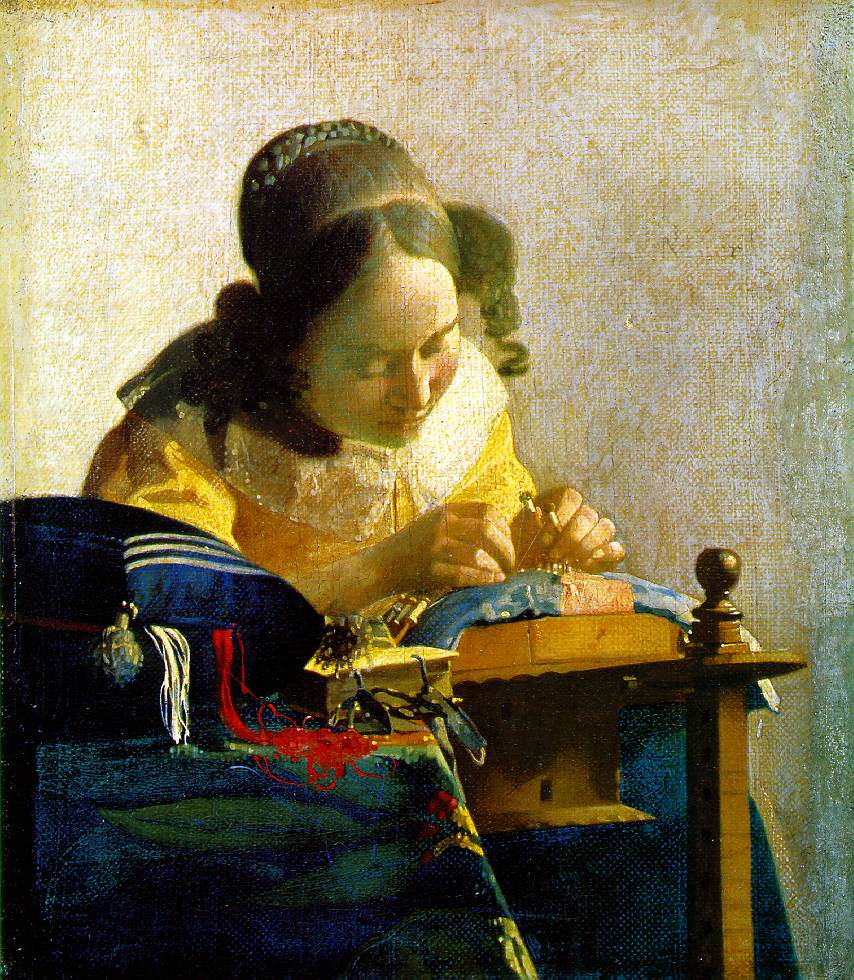
Andrew Motion's Keats is 578 pages long. It seems we know just about everything he did, thought or wrote in his 24 years. It's a slow read of a quick life and sometimes I don't think I'll make it through. And then, on p. 290, there is this:
It seemed a small decision, compared to many others Keats had taken in recent weeks, but it turned out to be crucial. Sailing by ferry from Oban on the island of Kerrara, and then on to Mull 'in forty minutes with a fine Breeze', Keats embarked on the most demanding part of his tour. During the next two days he trudged thirty-seven miles, was saturated by rain, exhausted from stumbling through bogs, chilled by sleeping in bleak huts, drained by the effort of merely continuing. Within hours of returning to the mainland he began worryinig about his health more anxiously than ever before; within days he started contemplating an early departure for London. When he finally reached Hampstead he immediately began nursing his brother, exposing himself to a highly infectious illness. Previously, when he had cared for Tom, he had been robust enough to keep his own good health. This autumn he could not remain immune so easily. It was on Mull that his short life started to end, and his slow death began.

6.3.06
it was called saudade : extract from a future diary
After I finished the badman post over at dérives yesterday (even though it's not really a dérive), I literally found myself writing something else, about a situation I've been in for a while now and will be for a while longer. One of those life-changing predicaments that you don't know how to resolve, or rather, how they will be resolved, since full control isn't necessarily implied. It was a relief to write it all down more or less as it seems at the moment and I was feeling happy about it as I went out to see a movie - Girl With A Pearl Earring, which, despite some faults, is still like spending an hour and a half inside a Vermeer, which is not a bad place to be. Afterwards, though, I didn't feel so pleased about what I'd written that morning. Specifically, I felt I'd written it between two registers. It wasn't exactly a diary entry, but on the other hand, it wasn't exactly public speaking either. Not clear if I was addressing myself or the notional readers of this weblog, say. When I came home, I re-wrote it into two versions, which correspond to the two options in the previous sentence. That felt better - the diary-entry version is clearer on a several points I'd fudged or elided, whereas the weblog version, which I cast into a different tense, as if it pertained to an indeterminate period in the past, evolved into what I felt was quite a good piece of writing. And I did post it here. But then. A doubt. It may have been 'good' but it was no longer true. It suggested the dilemma had passed or been resolved, which it hasn't and isn't. There were other considerations - how much of what's personal to me do I want to disclose, what might the effect be on others who are involved in the (perhaps unlikely) event they were to read it - but it was the distortion of the real that bothered me more. I pulled it. Now I'm sort of half wondering how long it was up here for (can't remember), whether anyone did actually read it and if some after shadow persists in cyberspace? Not that it matters ... much ....
4.3.06
... just gearing up to do the edit on Luca Antara. And, have received from the publishers the schedule. My next obligation, by the 30th of this month, is to supply them with a book list to go in the back. We discussed this briefly last year but I hadn't done anything about it because it seems like a task best accomplished as the editor and I trawl through the manuscript. But there are complications. LA, the book, is to some extent a book about other books. It begins in an antiquarian bookshop and the external travels it maps are echoed and reiterated in accounts of the internal travelling that is reading. When a book comes up in the text, I've included, bracketed, the date and place of publication, viz: The Rubaiyat of Omar Khayyam (New York, 1942). However, not all the books encountered along the way are germane to the story, insofar as there is a story, while others are intrinsic to it. What to do ... I don't want to elide the (New York, 1942)s because I like the way they act as pause points in a fairly dense text and also because I think they help orient the reader to my reading; but it seems redundant to list them all again in the back. Maybe, I thought the other day, what I should do is provide, rather than a simple bibliography, a discussion of sources? And, having thought that, I suddenly felt excited at the prospect. I love those kinds of appendices to books and I'm really looking forward now to writing one. That will mean LA will have a subtitle, an author's note, a table of contents, three epigraphs and then, following, a discussion of sources ... more and more its starting to resemble one of those 19th century travel chronicles I used to read so many of, a form I always wanted at once to emulate and undermine.
2.3.06
Ern Malley Not The Only Famous Writer To Work As Mechanic
After finishing the course, I worked for two years as a mechanic at a car repair shop. By that time I had already started to frequent, in its evening opening hours, a public library in Lisbon. And it was there, with no help or guidance except curiosity and the will to learn, that my taste for reading developed and was refined.
1.3.06
cold longing
Today, in the weirdly formalised and displaced seasonal calendar we use, is the first day of Autumn. In fact there has been a slight chill in the morning air for about a week now, a coolness that seems to have its own scent, as well as bearing the other scents - frangi pani, or the sweet rottenness of berries fallen off the palms, or the lemony small of gum leaves if it's rained in the night. But this chill doesn't last, even on cloudy or windy days, usually by mid-morning, which is what it is now, the humid heat will be gathering. This January was the hottest on record in Sydney. It was also quite wet, like Januaries used to be in the 1980s. The figures aren't in yet for February, but this has been a hot and humid month too. I can't tell if it's getting hotter or if my tolerance of heat is decreasing but the result is the same: I long for cooler weather, even cold weather. It may be so all over the globe. A recent Granta included short contributions in the back from, I think, nine writers in different parts of the world. Margaret Atwood wrote about the melting Arctic, Tom Keneally about blazing Australia, there were contributions from Central America, India, Sri Lanka (an American caught in the tsunami), Holland, Spain ... all of them felt the world was getting hotter, the seasons changing, but by the same token few of them were prepared to abandon doubt as a kind of hedge against heat inflation. Because the truth is, even as we know, we don't know. Especially, we don't know how bad it's going to get. Today's paper says the Intergovernmental Panel on Climate Change's next report to the UN will stress that no reliable upper limit can be put upon how quickly the world will warm; the same article suggests that the rise in temperature may be as much as 11 (!) degrees, not the 1.5-4.5 degrees previously predicted. I do not expect to be alone in my cold longing.
28.2.06
The Fitzgerald
Dave Harding, our bass player, was down in Baja, Mexico and he met this guy from Wyoming, an expatriate of sorts, a guy who had found a large bail of cocaine and hid it out in the desert. He and Dave became friends, his name was Richmond Fontaine. Then Dave went over to his place one night and the man was gone. All his stuff still there, but no one saw him again. No one knew anything ... more
27.2.06
optimism
Last night, while trying my best, as a dinky-di auzzie, to be optimistic about the Past (I've more or less given up on the future and the present is so beguiling in itself I don't ever want to ask the half empty/half full question here) I realised that the glass paper weight on one of the two cd racks that was propping up the Vincent van Gogh self-portrait that came as an insert in Saturday's Sydney Morning Herald would look better on top of the other (taller) cd rack. Somehow as I was making the switch the paper weight slid through my fingers and fell onto the low table below, the one that held the cd player, cd racks, loose cds, mp3 player, a few books, a few other bits and pieces. It was a glass-topped table and the glass table top ... exploded. It sounded like a gun going off. Slivers of glass embedded themselves in me, one in a finger, another in a toe but I didn't notice that immediately, because the cd player had unaccountably started playing Richmond Fontaine's The Warehouse Life - "broken, blond 'n' lost 'n' blue" - and also, the Ralph Hotere/Bill Manhire collaboration Pine, which I'd just received as a review copy, was among the debris ... this fine printing of 16 images/poems retails for $300.00 unsigned ($800.00 signed) and although I don't think I'll ever sell it, I did feel like rescuing such a notionally valuable work (same price as The Times Atlas of the World) from the wreckage ... that was when I saw the blood. Well, the wounds are not too bad and the carpet's pretty stained already and the book was marked on the cover when I got it, now it's even more marked and has a Past as well which I will continue to try to be optimistic about; besides, I decided I like Richmond Fontaine a lot more than I thought I did and have been playing them/him all day today as I extract shards from the carpet and re-arrange the furniture and, yes, it's true, I didn't need that extra table after all. Now if I could just get the haunted look off Vincent's face ...


24.2.06
23.2.06
Der Turm der blauen Pferde
This:
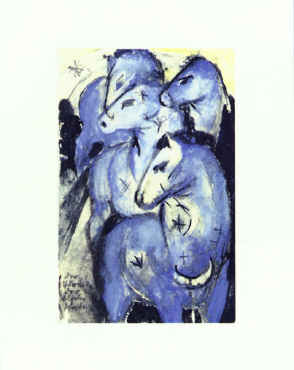
I would guess is a study for this:
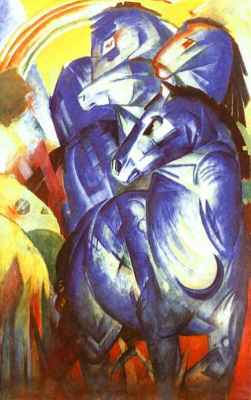
which, not having seen it before today, I am desolated to learn, was already lost and gone before I was born, being one of those works, part of Entartete Kunst, that did not survive WW2.
A favourite, evidently, of Oz poet James McAuley, one of Ern Malley's dads.
As for the study ... don't know.
Franz Marc was killed in 1916, in WWI, three years after he made The Tower of Blue Horses.
I would guess is a study for this:

which, not having seen it before today, I am desolated to learn, was already lost and gone before I was born, being one of those works, part of Entartete Kunst, that did not survive WW2.
A favourite, evidently, of Oz poet James McAuley, one of Ern Malley's dads.
As for the study ... don't know.
Franz Marc was killed in 1916, in WWI, three years after he made The Tower of Blue Horses.
21.2.06
... falling on my head like a new emotion ...
Michael P. Stevens at Pedestrian Happiness offers a link to an article about saudade that is valuable for a few reasons: it makes a plausible distinction between saudade and nostalgia - saudade longs for a future, impossible though it might be; suggests a possible historical context for the genesis of this feeling; explores cognate terms in other languages like Basque, Spanish & Brazilian ... most of all, perhaps, encourages speculation upon the notion that we do evolve emotionally, that there are new feelings that in time will be named ...
20.2.06
I took my troubles down to Madam Ruth
Thing is, growing up where and when I did, was one of the last of the pre-TV people. Didn't even see a TV set until I was about 12 and we had to move from a remote mountain village to a rather less remote small rural town before that could happen ... was in the window of an electrical goods shop and there were half a dozen people, adults and kids, standing round looking at this thing in the window. The first program I remember seeing was a drama about river boat gamblers on a Mississippi paddle-steamer. In black and white, natch. What we had before that was the movies (every Saturday), the radio and a piano. A record player too, but it was hardly ever used and the only two records I remember my parents owning were My Fair Lady with Rex Harrison, Audrey Hepburn and/or Julie Andrews and Stanley Holloway and an album of William Clausen, live. (He was some kind of Scandinanvian lounge lizard who did folk-and-novelty-songs plus what passed for witty commentary in between.) The radio wasn't for music, it was for news, current events, sports and drama - the weekly serials that we sat around on chairs listening to in the evening. For music, there was the piano, which was played just about every night when I was a small child and was also the centre of every party, of which there were quite a few in our house in the 1950s, less and less in later years. So, music on the radio and TV, which arrived in my life more or less simultaneously, were truly revelatory, not least because they were beaming out at us kids, not our parents. At the time when I started listening, the sister next up from me in years was a fully fledged Beatles fan (she liked Paul) and the one up from her, the eldest, had a few singles - Trini Lopez, Pat Boone - that she used to play sometimes. I started secondary school in 1965 and one of the highlights, early in the year, was the Gala Day, during which the cafeteria was blacked out and lit with flashing lights and a band played - and that was the second revelation after the radio. Live music. That day, a Saturday, we all crowded into the cafeteria and danced for what seemed liked hours but might not have been. The song they played over and over was Love Potion #9 by Leiber and Stoller that was a hit for The Clovers in 1959, for The Searchers in 1964 and The Ventures in 1965, which might have been the version this Gala Day band, whoever they were, was covering but more likely it was The Searchers'. Still remember staggering out into the bright afternoon light with a sense of absolute astonishment at how wonderful everything was in there and how boring it all looked out here. Clearly, though I didn't know it at the time, this was also my first drug experience.
19.2.06
rock 'n' roll cluedo
... but the song that really set me on the path was Gerry & the Pacemaker's How Do You Do It? I was 12 or 13, and still remember the when, where & with what: Sunday evening, in the bathroom, with the radio. In those days we lived in a rented flat above the Chemist's shop on Main Street, Greytown. The old mantle radio was not in the bathroom, probably one of my sisters was listening to it in her bedroom but somehow that song just came out and claimed me for its own. I heard it perfectly, can hear it now. Haven't yet gone looking for it in the ether. In a way I wish it had been the Rolling Stones' Paint it Black or the Yardbirds' Shapes of Things or even A Whiter Shade of Pale, the first single I bought ... yeah, left it on the back seat of my mother's Hillman Imp, it buckled in the sun, never played it ... but they all came later. Yet, in the anthropology of 60's pop, that song (How Do You Do ... ) has a place. Written by Mitch Murray, it was offered in the first instance to The Beatles, who knocked it back because they wanted to record a song of their own: Please Please Me it was called. Mitch also wrote I'm Telling You Now for Freddy and the Dreamers; Ballad Of Bonnie and Clyde for Georgie Fame and the Blue Flames; and Billy, Don't Be A Hero for Bo Donaldson and the Heywoods.
18.2.06
three songs
As a friend pointed out the other day, LimeWire is perfect for retrieving those old songs you loved way back when, you can just pull them out of the ether without needing to search through bins or buy whole compilation albums full of other stuff ... so in that spirit I went searching yesterday for three faves from the sixties. Intrigued to realise as I looked that, although these songs have been part of my (mental? musical?) life for forty odd years, I'd never owned a recording of two of them and the third I'd bought only belatedly, after the singer (Dusty) died, and lost soon afterwards. Which means, I guess, that my memory of each is formed entirely by radio listening and probably over a relatively short period of time, refreshed intermittently and randomly since. Because they are so clear in my mind ... nor was I in the least bit disappointed when I recovered the originals, they sounded just the same and just as good. The surprises were in the lyrics, which I'd misheard here and there, as you do, or never figured out properly.
Anyway, they are:
Walk Away, Renee - The Left Banke; written by Michael Brown about Renee Fladen, the girlfriend of another band member, bassist Tom Finn (that must have caused tensions in the band room; their next two hits were also by Brown about Fladen) and sung by Steve Martin, a recent migrant to New York from Puerto Rico; released 1966 and subsequently covered by all sorts of people, most famously The Four Tops; but The Left Banke version has a plaintive quality no subsequent renditions quite got, because of Martin's voice I think. The lyric I'd never understood in this is the awkward last four words of:
Now as the rain beats down upon my weary eyes
For me it cries
The First Cut Is the Deepest - PP Arnold; was surprised to learn that this was written by Cat Stevens; released on Andrew Oldam's Immediate label in London in mid-1967; another much covered song of course, but apart from a reggae version by I can't remember who, none of the others comes close to this one; there's a moment in it where you really do hear PP Arnold's voice doubt that it will ever again be possible as she sings but if you want I'll try to love again ... I'd never figured out the terminations to the spendidly twisted last two lines of the chorus, which go:
But when it comes to being lucky he's cursed
When it comes to loving me he's worst
Goin' Back - Dusty Springfield; written by Gerry Goffin and Carole King for Dusty to sing and released also in 1967, this was a song that always made me feel gloriously sad, like the most ancient 15 year old on the planet, lamenting my lost youth when it had barely even begun ... now, a few decades later, when its message might seem more appropriate than it did then, it just makes me feel 15 again. Revelatory lyrics? The first line of this couplet:
Let everyone debate the true reality
I�'d rather see the world the way it used to be
How'd they get away with that?
Anyway, they are:
Walk Away, Renee - The Left Banke; written by Michael Brown about Renee Fladen, the girlfriend of another band member, bassist Tom Finn (that must have caused tensions in the band room; their next two hits were also by Brown about Fladen) and sung by Steve Martin, a recent migrant to New York from Puerto Rico; released 1966 and subsequently covered by all sorts of people, most famously The Four Tops; but The Left Banke version has a plaintive quality no subsequent renditions quite got, because of Martin's voice I think. The lyric I'd never understood in this is the awkward last four words of:
Now as the rain beats down upon my weary eyes
For me it cries
The First Cut Is the Deepest - PP Arnold; was surprised to learn that this was written by Cat Stevens; released on Andrew Oldam's Immediate label in London in mid-1967; another much covered song of course, but apart from a reggae version by I can't remember who, none of the others comes close to this one; there's a moment in it where you really do hear PP Arnold's voice doubt that it will ever again be possible as she sings but if you want I'll try to love again ... I'd never figured out the terminations to the spendidly twisted last two lines of the chorus, which go:
But when it comes to being lucky he's cursed
When it comes to loving me he's worst
Goin' Back - Dusty Springfield; written by Gerry Goffin and Carole King for Dusty to sing and released also in 1967, this was a song that always made me feel gloriously sad, like the most ancient 15 year old on the planet, lamenting my lost youth when it had barely even begun ... now, a few decades later, when its message might seem more appropriate than it did then, it just makes me feel 15 again. Revelatory lyrics? The first line of this couplet:
Let everyone debate the true reality
I�'d rather see the world the way it used to be
How'd they get away with that?
17.2.06
Oh, well, that's the excitement over for the week. 5000 words, give or take a few hundred (I only keep daily tallies). Some of it I like quite a lot, some I'm not sure about, and some I know will need a good going over sooner or later. But that's alright. This is not going to be a long book, only 50, maybe 60 thousand words so I'm well on the way now ... meanwhile the editor's report on Luca Antara came through this week, it begins: This is superb. How about that? Best of all, she thinks the weaknesses are what I think the weaknesses are, which will make working together so much easier. We have a good understanding already, this is the third book we've done although the second one the publisher stood between us so we didn't actually have any direct communication. The numbers ... Luca is 100,000 plus and I want to get it down below that magic figure if it's at all possible, losing maybe 5000 words? Or, to put it another way, a week's work. Happy to let it go ...
15.2.06
lambda

For years now I've been haunted by a heresy. One I can't get out of my mind. It's that I don't believe in the Big Bang. Once, in the audience at a literary festival being addressed by an Eminent Philosopher, I put up my hand in question time and suggested that the Big Bang was an appropriate cosmological metaphor for a civilization that had invented the atomic bomb and was gratified when the Eminent Philosopher's jaw dropped. But only for a moment; she soon consigned the notion to the reject pile of loopy ideas and went on to other things.
Anyway ... have just read an article by Neil DeGrasse Tyson called Gravity in Reverse (in The Best American Science Writing 2004) which gives the clearest explanation I've yet come across of the Cosmological Constant (= lambda), Dark Matter and Dark Energy. I won't (can't) go into the details but the statistics are extraordinary and the (possible) conclusion genuinely uncanny: the cosmos is (they say) 73% Dark Energy, 23% Dark Matter and 4% ordinary stuff. It's the Dark Energy, which appears to arise out of a vacuum, that seems to be driving expansion:
As a consequence, anything not gravitationally bound to the neighbourhood of the Milky Way will move away from us at ever-increasing speed ... Galaxies now visible will disappear beyond an unreachable horizon ... beyond the starry night will lie an endless void, without form ... darkness upon the face of the deep.
So far so good. But what about this -
Dark energy, a fundamental property of the cosmos will, in the end, undermine the ability of later generations to comprehend their universe. Unless contemporary astrophysicists across the galaxy keep remarkable records, or bury an awesome time capsule, future astrophysicists will know nothing of external galaxies - the principal form of organisation for matter in our cosmos. Dark energy will deny them access to entire chapters from the book of the universe.
Here, then, is my recurring nightmare: Are we, too, missing some basic pieces of the universe that once was? What part of our cosmic saga has been erased? What remains absent from our theories and equations that ought to be there, leaving us groping for answers we will never find?
On the other hand, there's nothing here that doesn't accord with our experience of life as she is lived.
(the image is a picture of globular cluster M13)
14.2.06
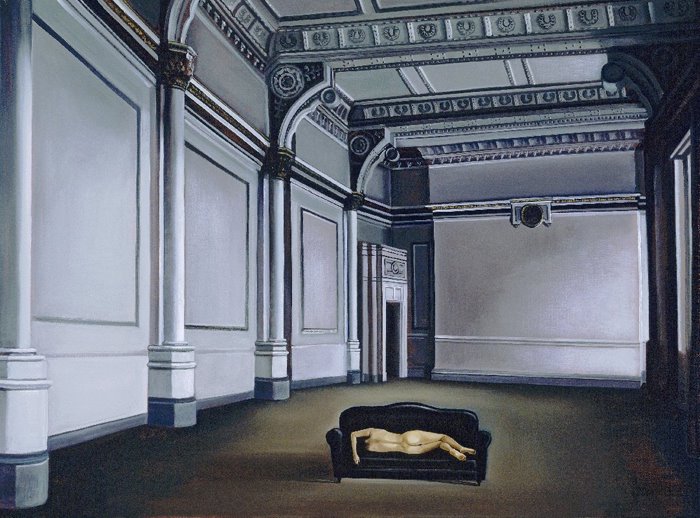
This is a painting by Anne Wallace called Reverie. More of her work can be seen here. Worth a look ...
13.2.06
Counting words, counting laps, can seem like exercises in futility. What, exactly, is being counted? Or rather, when the tally's in, what does the amount signify? Quite often when I'm swimming I lose count of the laps, it's easy to do, the state of mind is meditative, drifting, waterly, if that's a word, wholly antithetical to the harsh progression of numerals. When I do, lose count that is, it's always on an odd lap ... 9, 11, 13, 15 ... which suggests it's on the evens that I mostly drift off. Then I am faced with a dilemma: if this is either 13 or 15, which shall I choose it to be? (I'm only ever out by two.) The Roundhead in me insists on choosing the lower number, while the Cavalier says what the hell, let's just get off and do something that doesn't require effort. Roundhead always wins and for him it's a source of pride that, even if the count is wrong, it's wrong by more not less. While Cavalier says what the fuck, who cares, let's go to the wine shop and see what reds they have on special this week. When it comes to counting words, more proximate and more strange, they more or less agree : Roundhead will accept 964 if that's what it is when I (we) run out of puff, while Cavalier is usually thinking of that odd graceful flourish or complex manouvre which we wouldn't have got if we'd stopped at 703.
10.2.06
Weel May The Keel Row
In the 1930s in Dorrigo, New South Wales, a flute-playing farmer kept a young lyrebird as a pet for several years. In all that time the bird learned to imitate just one small fragment of the farmer's flute-playing ... the farmer released the bird into the forest. Thirty years later, lyrebirds in the adjacent New England National Park were found to have flute-like elements in their song, a sound not heard in other populations of superb lyrebirds. Further analysis of the song showed that the phrase contained elements of two popular tunes of the 1930s, "Mosquito Dance" and "The Keel Row". As lyrebirds can sing two melodies simultaneously, through several generations this population had created its own distinctive territorial song blending the two melodies into a single compressed phrase ... it is now seventy years since the lyrebird learned these fragments, and today the flute song has been heard a hundred kilometres from the original source. A human song is spreading through the lyrebird world ...
from : Why Birds Sing by David Rothenberg, Allen Lane, 2005
from : Why Birds Sing by David Rothenberg, Allen Lane, 2005
8.2.06
shoe box full of grasshoppers
Easy enough to rewrite 'darg' as 'drag' I found myself thinking yesterday evening after coming back from a Writer's Guild function. I never usually go to these things and now remember why : they advertise that they are showing clips from a recently completed feature film but no-one knows how to work the equipment and when they do finally get it going, the quality is truly appalling, light falling on faces is garish pink, shadows are lime green, there are lines through every image; the writer/director barely apologises for this insult, instead, he radiates a kind of svelte boredom, I've made it all on my own and you could too if you were as handsome and talented as I am but, who cares, I'm going off to live in Europe for a while; while his script editor has up a full head of outraged steam, she can't wait to tell the assembled ignoramus writers how disastrous our ordinary day to day assumptions about our craft must be. When questions begin to be asked she has visibly to suppress her exasperation and speak with the kind of controlled simplicity you use for primary school kids; meanwhile the most alarming thing of all is the docility with which the ignoramus writers take it, you begin to suspect that if and when they get their turn on the podium, they too will behave in this manner. We were, I realised part way in, associate members of the guild, so not real writers yet, hence perhaps the obvious contempt we were held in. But why that contempt to begin with? Is it owed by those who have risen precisely because they suffered it before? Or is it a defensive reaction, a holding of the line against those who might also rise? Not clear. I was reminded of something a poet said of his home town, that living in Adelaide was like living in a shoebox full of grasshoppers. I'd rather be a bird, maybe a magpie or a crow.
7.2.06
darg mark
Darg isn't a word you hear in common speech anymore. I only know about it because I once lived in a Darghan Street, in Glebe, and a Scots-born friend suggested, speculatively, that the word was the origin of the street name. It is in the OED however, which says 1. a day's work; 2. a definite amount of work, a task and says it is a contraction of Middle English daywerk or daywark. I'm charmed though to learn that it is still in use in the lingo of Axemen in what seems an entirely appropriate usage: It came to be applied to the marks scratched on almost anything to signify that the person concerned had completed his tally ...
6.2.06
My Darg
So I went looking yesterday for something on the web about Conrad's writing regime, but all I found was a 1971 interview with Graham Greene where he complains that Conrad worked 12 hours a day whereas he can only manage an hour and a half. He also admits to obsessive word counting, making little marks on his day's work at 300, 600 and 900 words and giving up when he tops 1000. Presume he worked on a typewriter or maybe even wrote long hand, either way, that's a lot of time spent counting. Now we have computers to do that for us ... I try to get over the 1000 mark myself and not to think too hard about the quality of those thousand words, many of which are 'and' and 'the' and 'was' and so on. Darg btw is an old convict word, probably originally Scots, it referred to the duties a man or woman had to complete as part of their obligation to the State (usually personified as an individual s/he was bonded to) before they could go off and work for themselves ... or get drunk ... or go for a swim ... or whatever. Which is what, my darg over for today, I'm going to do now.
4.2.06
Often when I'm writing I don't read properly. I don't even browse properly. I pick books up and put them down again or I find myself staring at the same sentence for moments on end, not knowing what it means, or I get to the end of a page and have no idea what the words my eyes have passed over are trying to say ... on the other hand, bits and pieces stick in my mind even though frequently I can't remember where I read them ... here's a few ... Joseph Conrad wrote 300 words a day. He said writing is a miserable vocation ... there is a Verlaine poem with an epigraph from a lost work of Rimbaud's, it reads: Rain fell softly over the city ... Giorgio de Chirico was born at Volos, the port from which Jason set sail for Colchis in the Argo ... the first thing ever broadcast on ABC Radio, in 1932, was a lyrebird singing ... starlings came into North America because an eccentric in New York determined to release every bird mentioned in Shakespeare to the New World ... yesterday was the 75th anniversary of the Napier Earthquake ... there is a book, just published, which is a dictionary of one letter words; it has over a thousand entries and the largest entry is for X.
3.2.06
machinations
It’s a long time since I wrote anything at all with a pencil or a pen: filling out forms, signing documents, scrawling notes incomprehensible to anyone else.
First typewriter : a Consul portable bought in 1970 for $30.00 in a 2nd hand shop on K Road. Same place where I got my compleat Shakespeare (onionskin paper) for rather less – six dollars? Still got the Shakespeare.
Purchased, new, in Wellington, an Imperial portable that I carried all around the world and gave eventually to a Frenchman in Sydney not long after I got here. He was meant to be helping me with my André Breton translations but once he had the typewriter, lost interest. Curled his lip and went back to La Belle France.
Bought a Brother electric that was ok.
An electronic Olivetti that had some kind of vestigial memory, gave me nothing but trouble. Still have some pieces I typed on it but. Nice typeface. Pica.
Moved into a squat, no electricity, bought a 2nd hand 1950s Olivetti cast iron frame desktop manual ($80.00), a beautiful machine. Let it go a few years back when I got sick of carrying it from place to place every time I moved. Bad decision, they’re worth a lot now and they never break down.
First computer : an Amstrad 9512, a disastrous investment even though I loved it at first. Had a bizarre daisywheel printer that was so user unfriendly most of what I wrote stayed on disk; later discovered disks incompatible with those of all other machines; wrote my first real book on it but subsequently lost approx. five year’s occasional writing when I sent the disks off to some old Amstrad freak to get 'translated' and they never came back. Luckily most of it no good.
An early Apple Mac portable, a Powerbook 150. Loved it more than the Amstrad, with which it coexisted for a while. Gave me RSI, hunched over the small keyboard for hours. Was stolen just after I sent away the ms of my second book; lost about three years of occasional writing, some of which was ok. I think.
First PC, assembled by a sometime friend who worked in a computer warehouse and put it together for her then girlfriend, who left her for someone else. Bought in haste after the theft of the Mac. Cost a grand. Crashed on average once an hour, sometimes once a minute … endless problems. Wrote my third book on it but nothing else ever came to fruition even though there was a lot. A beige box, left by the side of the road.
A Dell. I phoned Penang in Malaysia with my specs, they sent them to a warehouse in Sydney, the machine arrived on the doorstep not too long after that. Wrote the beginning and the end of Luca Antara on it, the middle was done on a brand new HP at the University of Auckland. The Dell's still going, it’s what my kids use for whatever they get up to in cyberspace.
This machine, a G5 Mac. I hope and pray …
First typewriter : a Consul portable bought in 1970 for $30.00 in a 2nd hand shop on K Road. Same place where I got my compleat Shakespeare (onionskin paper) for rather less – six dollars? Still got the Shakespeare.
Purchased, new, in Wellington, an Imperial portable that I carried all around the world and gave eventually to a Frenchman in Sydney not long after I got here. He was meant to be helping me with my André Breton translations but once he had the typewriter, lost interest. Curled his lip and went back to La Belle France.
Bought a Brother electric that was ok.
An electronic Olivetti that had some kind of vestigial memory, gave me nothing but trouble. Still have some pieces I typed on it but. Nice typeface. Pica.
Moved into a squat, no electricity, bought a 2nd hand 1950s Olivetti cast iron frame desktop manual ($80.00), a beautiful machine. Let it go a few years back when I got sick of carrying it from place to place every time I moved. Bad decision, they’re worth a lot now and they never break down.
First computer : an Amstrad 9512, a disastrous investment even though I loved it at first. Had a bizarre daisywheel printer that was so user unfriendly most of what I wrote stayed on disk; later discovered disks incompatible with those of all other machines; wrote my first real book on it but subsequently lost approx. five year’s occasional writing when I sent the disks off to some old Amstrad freak to get 'translated' and they never came back. Luckily most of it no good.
An early Apple Mac portable, a Powerbook 150. Loved it more than the Amstrad, with which it coexisted for a while. Gave me RSI, hunched over the small keyboard for hours. Was stolen just after I sent away the ms of my second book; lost about three years of occasional writing, some of which was ok. I think.
First PC, assembled by a sometime friend who worked in a computer warehouse and put it together for her then girlfriend, who left her for someone else. Bought in haste after the theft of the Mac. Cost a grand. Crashed on average once an hour, sometimes once a minute … endless problems. Wrote my third book on it but nothing else ever came to fruition even though there was a lot. A beige box, left by the side of the road.
A Dell. I phoned Penang in Malaysia with my specs, they sent them to a warehouse in Sydney, the machine arrived on the doorstep not too long after that. Wrote the beginning and the end of Luca Antara on it, the middle was done on a brand new HP at the University of Auckland. The Dell's still going, it’s what my kids use for whatever they get up to in cyberspace.
This machine, a G5 Mac. I hope and pray …
1.2.06
54
When I was wandering through Indonesia about 18 months ago, the book I had with me was Luther Blissett's Q. Luther Blissett was a five year plan which ended in 1999 but some of its participants decided to continue working together as Wu Ming. Their next book is called 54 ... finished reading it last night which was so hot and mosquito-ridden that I had trouble sleeping. The title refers to the year, 1954, during which the action takes place. It involves many things, including the fate of those Italians who fought in the Resistance, Lucky Luciano's heroin empire, Cary Grant's career as an actor, Tito's Yugoslavia, the post-war determination of the status of Trieste, the KGB ... but the heart of the book is day to day life in a small bar in Bolgona called the Aurora and more particularly the younger brother of the manager who is a barman there by day and a famous dancer by night. Robespierre - called Pierre - is the book's hero and the machinations by which he at last manages to find the freedom he craves are wonderfully plotted; while the central place in these machinations occupied by a state of the art American television set called a McGuffin Electric is wonderfully funny. Whereas Q was dark and bloody and mired in the desperate and desperately complex politics of the Reformation, 54 is light and airy as a Cary Grant movie, consistently amusing and yet never slight or anodyne ... it is extraordinary that five hands can make such a seamless work; you read in a state of perplexity as to how they did it? One of the most enjoyable things for me in the book is the portrait it gives, by way of a fragmentary biography, of Cary Grant, born Archibald Leach in Bristol - I didn't know he was a Brit originally. During 54 he is about to make a comeback in Hitchcock's To Catch a Thief so there is an engaging cameo of Hitch at work to be savoured as well. 54 is worth reading for its homage to a great actor alone but it is much more than that. Wu Ming! Woooo ...!
31.1.06
latest addition to nzepc is ka mate ka ora : a new zealand journal of poetry and poetics ... check out the editorial by Rbt. Sullivan if you've ever wondered what that famous haka is really about ...
30.1.06
I learned to swim at the Blue Baths in the odoriferous spa town of Rotorua one summer holiday back at the end of the 1950s or the beginning of the sixties - not sure, exactly. But the memory is precise, right down to the part of the pool we were in as I struck out and splashed across the few yards of water between where I was and where my father stood. One of those luminous moments that stay with you life-long.
Was never a very good swimmer, just adequate. When my sister discovered a real talent for it and became a record breaker and title holder, the rest of the family used to troop along to the Tuesday evening carnivals to watch her perform and even occasionally to enter a race. I recall flailing a few times from one end of the pool to the other in the Thirty-three and one third, an also-swam among also-swams. I didn't care about this at all, I was content with my level of competence. I just loved being in the water, especially the river swimming that was mostly what we did. We'd get on our our bikes and ride off into the country to a swimming hole we knew and spend the afternoon there, coming home smelling faintly weedy and with our hair and skin all soft.
It wasn't until I came to Sydney that I learned to swim properly. It was towards the end of my twenties and I'd just realised the physical costs of a lifestyle spent in clubs and pubs with actors and musicians, of incessant drug-taking, cigarette smoking and the almost unconscious drinking of alcohol on just about every occasion. A friend, though not a student, had somehow got a badge that gave him entry to the Sydney University pool and he suggested I might do the same. I had a casual job as a stagehand at the Seymour Centre on the edge of the campus in those days and I think it was this connection that allowed me a badge as well.
At that pool, which was indoors and heated and heavily chlorinated I gradually, very gradually, taught myself how to swim again ... to breath on alternate sides, to keep my feet horizontal and together, to brush my ear with my upper arm on the way into a stroke, to brush my thigh with my thumb as I came out of it, to cup my hands as they drove through the water ... and so on. Again this was not a competitive urge, just a desire to accomplish the activity as well as I was able.
During that period when I was re-learning freestyle, as we always called it, or Australian Crawl as it is sometimes known here, I was also re-teaching myself to type. I found a 1960s Secretary's Manual in a second hand shop, a big green hardback that was wider than it was tall - landscape format - and worked my way through it until I reached the point where the lessons on the pure mechanics of typing gave way to more sophisticated excercises designed to inculcate a budding secretary with the degree of servility proper to good business practice ... until then I had been a two finger peck-pecker, whereas now I actually use all ten digits.
However I was never quite disciplined enough - or perhaps I needed supervision - because although I can type without looking at the keys, mostly I don't. I glance constantly from keyboard to screen, checking my fingers are where they're meant to be, even though the results, if they are not, inevitably appear instantly on the screen. With the Secretary's Manual, of course, what you had to learn was to look neither at the page in the carriage of the typewriter, nor at the keyboard, but at whatever it was you were being asked to make a copy of ... a sure way to get a crick in your neck.
It's the back and shoulder and neck problems that may be consequent upon long periods of time spent at a keyboard which regular swimming so wonderfully corrects. I've suffered from these over the years but now seem to have broken through into a pain free zone ... when I look back to how I was then, confused, unhappy, full of inchoate ambition I had no means, no idea, of fulfilling, I am amazed I had the good sense to learn two skills which, unrelated as they seem, have probably been more useful to me over the years than anything else I can think of.
Was never a very good swimmer, just adequate. When my sister discovered a real talent for it and became a record breaker and title holder, the rest of the family used to troop along to the Tuesday evening carnivals to watch her perform and even occasionally to enter a race. I recall flailing a few times from one end of the pool to the other in the Thirty-three and one third, an also-swam among also-swams. I didn't care about this at all, I was content with my level of competence. I just loved being in the water, especially the river swimming that was mostly what we did. We'd get on our our bikes and ride off into the country to a swimming hole we knew and spend the afternoon there, coming home smelling faintly weedy and with our hair and skin all soft.
It wasn't until I came to Sydney that I learned to swim properly. It was towards the end of my twenties and I'd just realised the physical costs of a lifestyle spent in clubs and pubs with actors and musicians, of incessant drug-taking, cigarette smoking and the almost unconscious drinking of alcohol on just about every occasion. A friend, though not a student, had somehow got a badge that gave him entry to the Sydney University pool and he suggested I might do the same. I had a casual job as a stagehand at the Seymour Centre on the edge of the campus in those days and I think it was this connection that allowed me a badge as well.
At that pool, which was indoors and heated and heavily chlorinated I gradually, very gradually, taught myself how to swim again ... to breath on alternate sides, to keep my feet horizontal and together, to brush my ear with my upper arm on the way into a stroke, to brush my thigh with my thumb as I came out of it, to cup my hands as they drove through the water ... and so on. Again this was not a competitive urge, just a desire to accomplish the activity as well as I was able.
During that period when I was re-learning freestyle, as we always called it, or Australian Crawl as it is sometimes known here, I was also re-teaching myself to type. I found a 1960s Secretary's Manual in a second hand shop, a big green hardback that was wider than it was tall - landscape format - and worked my way through it until I reached the point where the lessons on the pure mechanics of typing gave way to more sophisticated excercises designed to inculcate a budding secretary with the degree of servility proper to good business practice ... until then I had been a two finger peck-pecker, whereas now I actually use all ten digits.
However I was never quite disciplined enough - or perhaps I needed supervision - because although I can type without looking at the keys, mostly I don't. I glance constantly from keyboard to screen, checking my fingers are where they're meant to be, even though the results, if they are not, inevitably appear instantly on the screen. With the Secretary's Manual, of course, what you had to learn was to look neither at the page in the carriage of the typewriter, nor at the keyboard, but at whatever it was you were being asked to make a copy of ... a sure way to get a crick in your neck.
It's the back and shoulder and neck problems that may be consequent upon long periods of time spent at a keyboard which regular swimming so wonderfully corrects. I've suffered from these over the years but now seem to have broken through into a pain free zone ... when I look back to how I was then, confused, unhappy, full of inchoate ambition I had no means, no idea, of fulfilling, I am amazed I had the good sense to learn two skills which, unrelated as they seem, have probably been more useful to me over the years than anything else I can think of.
26.1.06
an australia day tale
One summer some years ago (four? five?) when I was still living at Pearl Beach, word went around the Village that there was a koala in the Arboretum. It was known a group lived in the hills behind the Village, certain intrepid individuals had gone into the bush and observed them, I had been shown claw marks on a tree by one of these and had also, one night, heard the truly extraordinary sound koalas make mating (like brutally passionate humans at 127 decibels) up the slope behind our house in Onyx Road ... but a koala in the Arboretum was unprecedented.
I went, with friends, to see it on my birthday: it was high up in the feathery top branches of a gum tree, snug in a fork, from which, while swaying alarmingly in the strong hot wind blowing that day, it peered curiously down upon us gazing curiously up at it. Opinion differed among the Old Ones as to whether it was a pregnant female looking for a quiet spot in which to gestate or a young male ejected from the group because of his insoucience. No matter. One of the Old Ones appointed herself the koala's guardian, she refilled the metal dish of water under the tree on a daily basis and then stood back and watched while the animal climbed down to drink. It knew and trusted her, the Old One said, and who would deny it?
All went well until Australia Day weekend, about ten days after my birthday. It was hotter by then, and out-of-towners had gathered to mingle with the locals for the annual jazz concert in the Arboretum. Some of these were nouveau riche who had recently bought into the Village during the on-going real estate boom, others were holiday makers, others day-trippers. I don't know who the woman who found the koala was, but imagine her to have been a wealthy and discontented day tripper from somewhere on Sydney's leafy North Shore. The Old One who was caring for the koala came across her anxious at the foot of the tree and reassured her everything was under control, the koala was being watered daily, was drinking, was fine. No, said the woman, the koala is stressed.
This was on Saturday of the Long Weekend. Sometime during the afternoon, the woman rang one of the two voluntary organisations that care for animals in distress and told them about the koala. Two people from Woy Woy came to the Arboretum later on that day, presumably after the concert was over, or perhaps while it was still going on - I don't know - and managed somehow to capture the koala - did they use a net? - and remove it from its tree. They took it in their car back to their house in Woy Woy. It was still very hot, in their car and and also at their house where there were no proper facilities to care for a koala. They soon realised the koala was very stressed.
Next day, Sunday, was even hotter. The two people from the animal rescue organisation knew that they couldn't keep the koala at their house and so decided to take it to Taronga Park Zoo in Sydney. They drove down the F5 motorway in 35 degree heat, a journey of about an hour and a half's duration in a car that lacked air conditioning. I don't know where the koala was, in a cage? in the boot? sitting in the back seat with an ice cream and a drink?
On that day at the Zoo those among the keepers who know about koalas were not at work. The koala was put in a cage to await their return. It was thought by now to be extremely stressed. So it proved; when the experts came next morning to check on the koala, they realised immediately that its stress levels were so high that it was not going to survive much longer, so they decided instead to put it down, which they did, as an act of mercy. She turned out to be a young pregnant female.
The Old Ones were very angry but what could they do? Talk to the people from the animal rescue organisation? Yes, they did that; but nobody knew who the woman was, she was unreachable, unimpeachable in her certitudes. She may still imagine she saved a poor stressed animal. As has been said: it's the people who think they're alright who do the most damage.
I went, with friends, to see it on my birthday: it was high up in the feathery top branches of a gum tree, snug in a fork, from which, while swaying alarmingly in the strong hot wind blowing that day, it peered curiously down upon us gazing curiously up at it. Opinion differed among the Old Ones as to whether it was a pregnant female looking for a quiet spot in which to gestate or a young male ejected from the group because of his insoucience. No matter. One of the Old Ones appointed herself the koala's guardian, she refilled the metal dish of water under the tree on a daily basis and then stood back and watched while the animal climbed down to drink. It knew and trusted her, the Old One said, and who would deny it?
All went well until Australia Day weekend, about ten days after my birthday. It was hotter by then, and out-of-towners had gathered to mingle with the locals for the annual jazz concert in the Arboretum. Some of these were nouveau riche who had recently bought into the Village during the on-going real estate boom, others were holiday makers, others day-trippers. I don't know who the woman who found the koala was, but imagine her to have been a wealthy and discontented day tripper from somewhere on Sydney's leafy North Shore. The Old One who was caring for the koala came across her anxious at the foot of the tree and reassured her everything was under control, the koala was being watered daily, was drinking, was fine. No, said the woman, the koala is stressed.
This was on Saturday of the Long Weekend. Sometime during the afternoon, the woman rang one of the two voluntary organisations that care for animals in distress and told them about the koala. Two people from Woy Woy came to the Arboretum later on that day, presumably after the concert was over, or perhaps while it was still going on - I don't know - and managed somehow to capture the koala - did they use a net? - and remove it from its tree. They took it in their car back to their house in Woy Woy. It was still very hot, in their car and and also at their house where there were no proper facilities to care for a koala. They soon realised the koala was very stressed.
Next day, Sunday, was even hotter. The two people from the animal rescue organisation knew that they couldn't keep the koala at their house and so decided to take it to Taronga Park Zoo in Sydney. They drove down the F5 motorway in 35 degree heat, a journey of about an hour and a half's duration in a car that lacked air conditioning. I don't know where the koala was, in a cage? in the boot? sitting in the back seat with an ice cream and a drink?
On that day at the Zoo those among the keepers who know about koalas were not at work. The koala was put in a cage to await their return. It was thought by now to be extremely stressed. So it proved; when the experts came next morning to check on the koala, they realised immediately that its stress levels were so high that it was not going to survive much longer, so they decided instead to put it down, which they did, as an act of mercy. She turned out to be a young pregnant female.
The Old Ones were very angry but what could they do? Talk to the people from the animal rescue organisation? Yes, they did that; but nobody knew who the woman was, she was unreachable, unimpeachable in her certitudes. She may still imagine she saved a poor stressed animal. As has been said: it's the people who think they're alright who do the most damage.
25.1.06
the discipline of indiscipline
There's some kind of trade-off operating when you (= I) write extended (prose) works. The attention given to the instant, the words surfacing moment by moment on the floating world of the screen, is obsessive if not total; that which is given to the big picture, the larger work, the whole thing is ... not negligible so much as occluded. You (= I) can't afford to look at it because, although it does have a notional existence, it isn't actual until the sentences (= words surfacing moment by moment) add up to make it so. It is the shadow stalking the substance unfolding in that dull and repetitive labour, which is nevertheless relieved by glimpses and intimations. When (= if) the whole exists, it will be made up of these glimpses, those intimations, this labour, that substance, yet it will continue to be, beyond all particulars, the shadow that loomed above the absurdities and heroics of your (= my) attempt. I have bracketed (you) and (I) not simply for rhetorical purposes but also because whatever may be said of a writer is also said of a reader, although (time) (reading) (and) (writing) (is) usually scaled differently.
24.1.06
the Indian Ocean always felt yellow to me
... so I'm back in my regular writing routine. Which reminds me somehow of my swimming routine, which I am also back into. A few times a week I drive to the Ashfield Pool, a blue rectangle amidst acres of concrete, full of kids and parents this time of year; but the central lanes in the main pool (there are four or five others if you count the polo pool up the back, only used for the sport) are reserved for lap monsters like me. I wet my googles, put them over my eyes, press them a few times until suction is complete then slide into the water at the shallow end and begin ... up and down, up and down, breathing every three strokes on alternate sides, until I've covered twenty lengths. At 50 metres each length, that equals 1 kilometre. Takes about twenty minutes. I don't hang around afterwards, I wander off in a pleasant trance, an endorphin haze and go about the rest of my day. The writing routine is similar, I make various preparations, trivial but essential, before sitting down at the keyboard, opening the document, scrolling to where I broke off yesterday ... and begin, going from one side of the screen to the other then back, the lines like laps although I generally do more lines than I do laps, maybe a hundred, I don't know, I don't count ... sometimes I lose my rhythm and my stroke, sometimes I choke, sometimes water gets under my goggles and I have to stop and make adjustments. Some days it is so hard I wonder why I bother, other days I swim like a dolphin, my style achieves that beautiful up and down forward undulating wave motion that is the ideal of all swimmers ... but there is always resistance, always a kind of dullness I recognize as duty - to what? Health? Fitness? The mere accomplishment of a distance I've decided to cover? It doesn't do to dwell on this feeling, this boredom of resistance, because it is always there and will only get worse if I think too much about it. Some days I have no idea what I am going to write, or perhaps I will have a word or two to go on with, perhaps a whole sentence. Most of the time I'm not satisfied with what I come up with (though later I might be) and though sometimes on a quick go through when I've finished I'll find ways of improving, or adding to it, more often I chop things out ... then I just leave it. Time was I used to make a point of re-reading every word of the day's work later on but I don't do that any more or at least not early in the process ... too (potentially) destructive ... if I feel like it I might but not as a rule. Sometimes half way through my swim, which always takes place after I've done my writing, the way forward, the next bit, or something completely serendipitous will drift into my head on the endorphin tide and then I might turn it over and over until the next day's stint begins ... or alternatively I might forget all about it only to find it mysteriously surfaces when I sit down to write ... the other day in a book I read that the root of the word trance is fear but that isn't borne out by my dictionary, it says it comes from marrying the Latin trans, across, with Latin ire, to go, giving us departure, leaving behind, crossing over, going away somewhere, you might not even know where ... with the laps I always end up in the same place, with the lines, somewhere else.
23.1.06
Almost as soon as the concert began, I felt tears start in my eyes. It wasn't fado or saudade, I realised later, it was that it was so long since I'd heard live, as opposed to recorded, music. Time was when I listened to live music three or four nights a week. Sometimes, every night. Now, hardly ever. Made me think: when did we start replacing the experience with the record of the experience? Would have to be in pictures, a very long time ago, wouldn't it? Though that wasn't necessarily how pictures were understood, as replacements, they may have been thought as different from or more than the so-called real thing. Then there's an immense hiatus, millenia long, before writing arrives. Then, I guess, after the Book it's what? The photograph? & the phonograph ... 19th century is the age of Mechanical Reproduction of the Work of Art. And now ... we scarcely know what Originals are any more. I say scarcely without much conviction because actually I think we know the difference very well indeed; just that we encounter it less and, when we do, it is often only through an act of will.
20.1.06
Mariza
I've been looking at Pessoa again (he's never far from my thoughts) because Wednesday night I went to a concert by fado singer Mariza, during which she sang a song which is a setting of a Pessoa lyric: Há uma música do povo or There is a Music of the People, from a collection, which I don't know, called Unknown Poetries. Mariza's concert was extraordinary in every way: wonderful voice, magnificent presence, excellent songs, an impeccable band ... seven men in black, the core was the traditional three acoustic guitars - Portuguese, Spanish, bass - plus violin, viola and cello, plus a percussionist. And then there was the audience who were equal to the occasion as well. It was out at the Riverside Theatre in Parramatta, where I've been just once before, years ago, to see a production of King Lear. Mariza is tall and slender, with very long legs and arms, brown skin and silver hair, cut short; she is part African, born in Mozambique, but raised in the port district of Lisbon, her parents ran a taverna there where fado singers performed and she learned how to sing as a small child. I went to the concert by myself because my friend had to cancel but I needn't have worried about that - I was surrounded by Portuguese who were so hospitable, delighted that someone who wasn't, would come to hear their music. My seat was in what the theatre calls a box, at one end of the circle, almost right above the stage; as a consequence I couldn't see the percussionist unless I leaned forward but the compensation was a remarkable addition to the performance. They used a lot of side light and as a consequence Mariza's shadow appeared, elongated, distorted, on the black drapes at the other side of the stage. In herself she is magnetic; in shadow, like an antique figure out of a Gallantee Show: something about the way the shadows fell turned her into an ancient or perhaps immemorial figure of grief, of sorrow, of passion, of joy. Those dimensions or emotions are there in her voice and her live performance anyway but, in shadow, they translated into something else, something more, something I've never quite seen before and can't really describe. It would be like trying to describe the quality of the silence she was able to conjure up, not between songs, but in the middle of them. When she sang Há uma música do povo she came downstage and sank into a crouch for the first verses, which were delivered in a hushed, intimate voice, before rising and going upstage and full-throat into the reprise. If her silences were electric her loudnesses were galvanic. Anyway, no more superlatives, you had to be there ... here's an English version of Há uma música do povo as translated by Morgana le Fay:
There is a music of the people,
I cannot say whether it is a Fado
But hearing it has added to myself
A new rhythm that stayed...
Hearing it I am who I would be
If I could be what I wish...
It is a simple melody
Like those that teach you to live...
And I hear it swaying and alone...
And this is even what I wanted...
I lost my faith and my way...
And have been far from happy.
But it is so soothing
This vague and sad song...
That my soul is no longer weeping
Nor do I have a heart...
I am a foreign emotion,
An error of a dream that is gone...
Somehow I sing
And end up with a feeling!
(NB: the version on Mariza's album Transparente, as well as the live version I heard, omit verse three of the poem.)
There is a music of the people,
I cannot say whether it is a Fado
But hearing it has added to myself
A new rhythm that stayed...
Hearing it I am who I would be
If I could be what I wish...
It is a simple melody
Like those that teach you to live...
And I hear it swaying and alone...
And this is even what I wanted...
I lost my faith and my way...
And have been far from happy.
But it is so soothing
This vague and sad song...
That my soul is no longer weeping
Nor do I have a heart...
I am a foreign emotion,
An error of a dream that is gone...
Somehow I sing
And end up with a feeling!
(NB: the version on Mariza's album Transparente, as well as the live version I heard, omit verse three of the poem.)
first you find it strange ...
In that same year (1928), Pessoa goes into advertising. Coca-Cola has just entered the Portuguese market and the poet is charged with the task of creating a slogan for the product: First, you find it strange; then you can’t change. The product sells like hotcakes, but later the authorities prohibit its sale in Portugal. The very slogan, argue the authorities, recognizes the harmful effects of the soft drink.
Full text here: http://www.vidaslusofonas.pt/fernando_pessoa2.htm
Full text here: http://www.vidaslusofonas.pt/fernando_pessoa2.htm
18.1.06
thinking
Some memories come unbidden ... was thinking yesterday of the first writing I ever did that was just ... writing. Had no (other) purpose. It was this time of year, many years ago. I'd just turned 18. 401 Ferguson Drive, Heretaunga. That's Upper Hutt, a satellite of the capital, Wellington. We lived in a pluty neighbourhood then, surrounded by bankers and doctors and diplomats and so forth. My father was principal of one of the two local colleges, he was not yet, though soon to be, consumed by alcoholism. My mother was embarking on an independent existence, a literary life, she was having affairs. I had left school but was not yet enrolled at University. So it was my last summer at home and I half knew the turmoil that was around us, me and my sisters, but not in any way I could have explained. I had a job that summer, I worked at General Motors in Trentham, on the assembly line. First I used to buff up the weld spots where the car bodies were stuck together, using a motorised wire brush. Later I tested petrol tanks, filling them with compressed air and dunking them in a pool of water to look for bubbles along the seams where top and bottom had been heat sealed together. It was shift work, with compulsory overtime three nights a week. Maybe I'd finished the job at the time I did the writing? Or maybe I was on a break? Can't remember. What I do recall is lying full length, face down on the white shag-pile carpet in the sitting room, pencil in hand, filling pages and pages of blank typing paper with words. What about? Well, I'd been reading Nietzsche, Thus Spake Zarathustra, in a Penguin paperback and the writing was directly influenced by that book (which I read all of, with great enthusiasm, and have never been able to look at since.) But what, exactly? Don't know ... I suspect it was all about my own becoming, that it was dreams of power, some kind of word flow that was barely coherent even to me, perhaps a sort of automatic writing. I seem to remember images, green mountains, white rivers ... I don't know what happened to those pages. I certainly never showed them to anyone and don't recall taking them with me to Auckland not so very long afterwards ... nor do I remember destroying them. They just seem to disappear, unlamented, almost unread, since I don't think I ever looked back over them after they were written. It was, perhaps, one of those rare times when the writing itself is enough and, once accomplished, is finished. The other memory that is associated with this one is an argument I had with my mother around the same time. She was concerned at my idleness and took me to task for it. She said I never did anything and it was time I started to occupy myself fruitfully. I was outraged and told her I was doing something, I was thinking and that thinking was an activity. She said it wasn't, it was just ... a cover for idleness I guess. It's strange that I didn't say I'd been writing for, if I had, she would instantly have forgiven my indolence. But the truth is, for me, then, thinking and writing were more or less the same thing, or perhaps one was a random and not particularly significant product of the other. I wonder now about those pages ... what they said ... how they said it ... where they went ...

This is an image of the so-called Liu Gang map unveiled, as they say, in a Beijing cafe/bookshop on 16th January ... although they did not exhibit the real map but a copy, the original remaining in a bank vault. It was bought by Lui Gang, a lawyer and map collector, in a Shanghai dealer's store in 2001 for $US500.00 - a relatively small amount of money if it turns out to be what Lui Gang thinks it is. That is, a copy of a 1418 world map drawn as a result of Ming Dynasty admiral Zheng He's voyages and showing both the Americas, Australia and even New Zealand. The copy is supposed to have been made by one Mo Yi Tong in 1763 and given to the then Emperor of China. Forensic testing of parchment and ink is being done at the University of Waikato, Hamilton, New Zealand, to determine the authenticity of the object, although clearly they will only be able to establish its 18th century provenance, not the accuracy of its links to 1418. It's a pity that the image above - from the Economist - is so poor, because the map is very beautiful. There was a much better picture, a close-up of the Pacific section, in the Sydney Morning Herald, in which the land is coloured a pale yellow and the sea, translucent blue, inscribed with concentric semi-circular wave forms. Unfortunately, too, Lui Gang has allied himself with Gavin Menzies, the author of 1421 : The Year the Chinese Discovered the World. I bought the hardback of Menzies' book when it came out and began reading with some enthusiasm, but gave up in exasperation about halfway through, after reading the New Zealand and Australian sections. Menzies is a monomaniac who accepts any dubious proposition whatsoever so long as he can make it support his case, as well as wildly distorting known facts to the same end. He ruins a good subject by his uncritical devotion to the cause, alleging that Zheng He not only discovered America but also circumnavigated both the poles and the rest of the globe as well. And yet ... it is probable, if not likely, that Ming Dynasty Chinese sailors did cross the Pacific as well as the Indian Ocean; that they visited at least northern Australia seems almost certain; that they reached New Zealand, a possibility ... it is a shame that we don't have a more scholarly, popular account of this remarkable period of Chinese voyaging, one that would allow a reasonable assessment of what may or may not have been accomplished. Perhaps this map, whatever it turns out to be, might lead to such a book? Hope so ...
13.1.06
towards extinction
Creti seemed to intercept Montoris's thought. "We are animals on the way to extinction," he said. And took a long swallow of beer.
This from p. 387 of Guiseppe Genna's very fine thriller, In the Name of Ishmael. Creti is the cover name of a high up member of an intelligence organisation known only as the Service; he is attempting to recruit Montoris, a member of Milan's Detective Squad, to the Service. In the aftermath of the murder, by Ishmael, of Montoris's wife Maura, who was pregnant with a baby that may or may not have been her husband's. He does not know, and will never know, that there was doubt about the paternity of the child: one of the massive ironies of a book full of them is that Montoris joins the Service in order to avenge his wife & out of devotion to her memory, in ignorance of the fact that she betrayed him.
The book runs two times concurrently. The 1962 thread, of which Detective Montoris is the protaganist, and the second thread from 2001, again with a cop, Guido Lopez, as the main actor. Both threads are woven around assassination. In 1962 the plane carrying oil magnate Enrico Mattei crashed near Milan, killing the man known in some circles as the King of Italy; the 2001 sequence turns around a plot to assassinate Henry Kissinger who is, it turns out, not unimplicated himself in the mysterious Ishamel network. The way these two threads are eventually tied together towards the end is masterly.
Ishmael is an American invention, a quasi-religious cult whose aims are as much political as they are spiritual. Cultic rites, involving child sacrifice, are bound up with broader, semi-clandestine, sado-masochistic practices. The ultimate aim of Ishmael is to own Europe - for America to own Europe.
It's one of those books that deals with a number of real world events which are more or less mysterious, and sets out to string them together by occult means, or rather, through the evocation of occult forces. Leaving you genuinely confused as to where (or if) the fiction begins. It is also beautifully written: its descriptions of modern ruins in and around Milan, now and then, are superb. And it includes passages like that quoted above, seamlessly embedded in the text, never insisted upon, never really revisited, just ... a part of the show, I guess.
In The Name of Ishmael is published by Atlantic Books (2005) in a translation by Ann Goldstein
This from p. 387 of Guiseppe Genna's very fine thriller, In the Name of Ishmael. Creti is the cover name of a high up member of an intelligence organisation known only as the Service; he is attempting to recruit Montoris, a member of Milan's Detective Squad, to the Service. In the aftermath of the murder, by Ishmael, of Montoris's wife Maura, who was pregnant with a baby that may or may not have been her husband's. He does not know, and will never know, that there was doubt about the paternity of the child: one of the massive ironies of a book full of them is that Montoris joins the Service in order to avenge his wife & out of devotion to her memory, in ignorance of the fact that she betrayed him.
The book runs two times concurrently. The 1962 thread, of which Detective Montoris is the protaganist, and the second thread from 2001, again with a cop, Guido Lopez, as the main actor. Both threads are woven around assassination. In 1962 the plane carrying oil magnate Enrico Mattei crashed near Milan, killing the man known in some circles as the King of Italy; the 2001 sequence turns around a plot to assassinate Henry Kissinger who is, it turns out, not unimplicated himself in the mysterious Ishamel network. The way these two threads are eventually tied together towards the end is masterly.
Ishmael is an American invention, a quasi-religious cult whose aims are as much political as they are spiritual. Cultic rites, involving child sacrifice, are bound up with broader, semi-clandestine, sado-masochistic practices. The ultimate aim of Ishmael is to own Europe - for America to own Europe.
It's one of those books that deals with a number of real world events which are more or less mysterious, and sets out to string them together by occult means, or rather, through the evocation of occult forces. Leaving you genuinely confused as to where (or if) the fiction begins. It is also beautifully written: its descriptions of modern ruins in and around Milan, now and then, are superb. And it includes passages like that quoted above, seamlessly embedded in the text, never insisted upon, never really revisited, just ... a part of the show, I guess.
In The Name of Ishmael is published by Atlantic Books (2005) in a translation by Ann Goldstein
11.1.06
Voynich ... last
Maybe ... we should appreciate the Voynich manuscript for what it truly is: a beautiful object, an enigmatic, alluring and enduring mystery that is, in the final reckoning, perhaps better left unsolved?
So ends Kennedy and Churchill's book (op. cit.), in a conclusion I entertained myself about halfway through their fair-minded, witty and elegant account of the story. On the other hand, it's impossible not to speculate, otherwise why read about it? Of all the possible interpretations canvassed in the book, these are the ones I like and might possibly believe:
1. that the Voynich Manuscript is a work of what we now call Outsider Art, an attempt by a schizophrenic (monk or nun?) to reproduce something like the 15th and 16th century herbals and healing texts s/he might perhaps have seen somewhere. If this is so it will never be deciphered because it is not, strictly speaking, a cipher at all, but a work of art whose key was lost with the death of the artist. It is thus analogous to the work of Adolf Wölfli or Henry Darger.
2. that, in the words of William Friedman: The Voynich MSS was an early attempt to construct an artificial or universal language of the a priori type. (Esperanto is an example of the posterior type of artificial language; an a priori type is made like a thesaurus, by dividing human experience into categories and then selecting terms to describe these categories, sub-categories, etc.)
3. that the Voynich MSS is a hoax book put together in the late 16th century, perhaps by Edward Kelley, in an attempt to bolster his reputation as a magus with various Central European patrons, including Rudolph II of Bohemia. It may be that several hands contributed; one variant of this theory says the drawings are bone fide, done by Dr. Dee, but the text, added later by Kelley and a rogue Papal Nuncio called Pucci, spurious. However, it might also be based upon texts of the speech of angels Kelley channeled for Dr. Dee to write down.
4. that the Voynich MSS is a complete or partial forgery perpetrated by Wilfrid Voynich himself.
One curious fact: the Beinecke Library at Yale, where the MSS has been since the early 1970s, has never allowed forensic testing of the materials from which it is made. It looks as if they too would prefer it to remain an enigma.
So ends Kennedy and Churchill's book (op. cit.), in a conclusion I entertained myself about halfway through their fair-minded, witty and elegant account of the story. On the other hand, it's impossible not to speculate, otherwise why read about it? Of all the possible interpretations canvassed in the book, these are the ones I like and might possibly believe:
1. that the Voynich Manuscript is a work of what we now call Outsider Art, an attempt by a schizophrenic (monk or nun?) to reproduce something like the 15th and 16th century herbals and healing texts s/he might perhaps have seen somewhere. If this is so it will never be deciphered because it is not, strictly speaking, a cipher at all, but a work of art whose key was lost with the death of the artist. It is thus analogous to the work of Adolf Wölfli or Henry Darger.
2. that, in the words of William Friedman: The Voynich MSS was an early attempt to construct an artificial or universal language of the a priori type. (Esperanto is an example of the posterior type of artificial language; an a priori type is made like a thesaurus, by dividing human experience into categories and then selecting terms to describe these categories, sub-categories, etc.)
3. that the Voynich MSS is a hoax book put together in the late 16th century, perhaps by Edward Kelley, in an attempt to bolster his reputation as a magus with various Central European patrons, including Rudolph II of Bohemia. It may be that several hands contributed; one variant of this theory says the drawings are bone fide, done by Dr. Dee, but the text, added later by Kelley and a rogue Papal Nuncio called Pucci, spurious. However, it might also be based upon texts of the speech of angels Kelley channeled for Dr. Dee to write down.
4. that the Voynich MSS is a complete or partial forgery perpetrated by Wilfrid Voynich himself.
One curious fact: the Beinecke Library at Yale, where the MSS has been since the early 1970s, has never allowed forensic testing of the materials from which it is made. It looks as if they too would prefer it to remain an enigma.
9.1.06
arrivée d’un départ
Today it is yesterday in America. The wine we drank is all run away into the channels of the flesh. An ashtray of butts with gold writing on them, under the Christmas tree, for just a moment longer. Then they'll be gone too. Which indefatigable graffitist inscribed the black line down the centre of each lane at the pool with cock and balls? Three round strokes with a texta, then the slit for the glans, over and over. Why no vulva? A shimmer of amazement when the sun comes out, filling the blue water with gold spangles. I don't know where you are, just somewhere in America. I don't know when you are. The day after tomorrow feels too long ago for wonder; yesterday like a future lost forever. Now is only a breath after all. The wine … the smoke that drifted up from cigarettes … smell of pine mingled with nightsweet, with frangi-pani … dumb shouts in the street … health that is like an affliction, affliction that is like memory, memory like a stone, stone like water, water like … nothing. Sometimes at night, when the small brown stars wheel overhead, I rise above all this and see the brightdark line of sun shadow fleeing towards us, gold spangled, across the blue Pacific, leaving America with all its yesterdays and tomorrows dark and bright behind it. Then day arrives, an absence enclosing a presence, waiting to be called.
6.1.06
Voynich Again
hmmm ... just picked up, at the Ashfield library, a recent book on the Voynich MS. Wilfrid Voynich (= Michal Wojnics) was not, as I thought, an American, but a Pole from Telschi, Kovno Province, Lithuania who graduated in chemistry from Moscow University and became a pharmacist. He got caught up in the late 19th century Polish Nationalist movement, trying to free his country from Tsarist Russian rule. He was two years without trial in a tiny cell in the Warsaw Citadel, during which he saw, from the window one day, his future wife, all dressed in black (she was mourning the death of Italian revolutionary Mazzini). Ethel Boole was the youngest of five daughters of mathematician George Boole, inventor of Boolean logic, and was studying music in Berlin when she read the writings of Sergei 'Stepniak' Kravchinsky and became a revolutionary herself. She met Stepniak in London, learned Russian, and was on her way to St. Petersburg to connect with one of his relatives when she paused in Warsaw in Easter, 1887. Before Voynich's scheduled exile to Siberia, he was given Ethel's name and Stepniak's London address. He escaped prior to being transported and, five months later, having sold his glasses and waistcoat, hitched a ride on a fruit boat from Hamburg to England, surviving shipwreck off the Scandinavian coast along the way. The day after his arrival he was out on the London streets, selling the Society of the Friends of Russian Freedom's publication, Free Russia. The Society's patrons included William Morris and Eleanor Marx. Voynich became the business manager of a bookshop selling revolutionary works to the British public and, later, calling himself Ivan Klecevski, a member of the League of Book Carriers, smuggling works by Mark, Lenin, Plekhanov and others into Russia. After Stepniak, in 1895, was knocked down and killed by a train at a level crossing, both Ethel and Wilfrid withdrew from revolutionary politics and he became instead an antiquarian book dealer. He was immediately successful, with a shop in Piccadilly and offices in Paris, Florence and Warsaw. He continued, when and if he could, to assist Polish refugees who turned up at the London shop and made many business trips to the Continent. It was during one of these, in 1912, that he came across the manuscript which now bears his name. In November, 1914, Wilfrid and Ethel Voynich, together with their most valuable books and manuscripts, sailed for New York on the SS Lusitania.
[This account from The Voynich Manuscript by Gerry Kennedy and Rob Churchill, Orion Books, London, 2004. Kennedy is a descendent of George Boole's brother, William.]
[This account from The Voynich Manuscript by Gerry Kennedy and Rob Churchill, Orion Books, London, 2004. Kennedy is a descendent of George Boole's brother, William.]
5.1.06
dangerous questions
Copernicus upset the moral order, by dissolving the strict distinction between heaven and earth. Darwin did the same, by dissolving the strict distinction between humans and other animals. Could the next step be the dissolution of the strict distinction between reality and fiction?
For this to be shocking, it has to come in a scientifically respectable way, as a very precise and inescapable conclusion — it should have the technical strength of a body of knowledge like quantum mechanics, as opposed to collections of opinions on the level of cultural relativism.
Perhaps a radical reevaluation of the character of time will do it. In everyday experience, time flows, and we flow with it. In classical physics, time is frozen as part of a frozen spacetime picture. And there is, as yet, no agreed-upon interpretation of time in quantum mechanics.
What if a future scientific understanding of time would show all previous pictures to be wrong, and demonstrate that past and future and even the present do not exist? That stories woven around our individual personal history and future are all just wrong? Now that would be a dangerous idea.
Piet Hut, Professor of Astrophysics, Institute for Advanced Study, Princeton, at The World Question Centre.
For this to be shocking, it has to come in a scientifically respectable way, as a very precise and inescapable conclusion — it should have the technical strength of a body of knowledge like quantum mechanics, as opposed to collections of opinions on the level of cultural relativism.
Perhaps a radical reevaluation of the character of time will do it. In everyday experience, time flows, and we flow with it. In classical physics, time is frozen as part of a frozen spacetime picture. And there is, as yet, no agreed-upon interpretation of time in quantum mechanics.
What if a future scientific understanding of time would show all previous pictures to be wrong, and demonstrate that past and future and even the present do not exist? That stories woven around our individual personal history and future are all just wrong? Now that would be a dangerous idea.
Piet Hut, Professor of Astrophysics, Institute for Advanced Study, Princeton, at The World Question Centre.
4.1.06
vagaries in transmission of the word of god
Whether the Koran was written down in full during Mohammed's lifetime is a question on which there are conflicting traditions. The generally received account describes its first compilation a few years after his death from scraps of parchment and leather, tablets of stone, ribs of palm trees, camels' shoulder-blades and ribs, pieces of board and the breasts of men. To this, probably, is to be ascribed much of the unevenness and rough jointing which characterize the present composition of the longer suras. It is certain that, alongside these written materials, several of the Companions of the Prophet preserved by heart and transmitted versions with numerous small variants, and that the third Caliph, Othman, had an authoritative text prepared at Medina, copies of which were sent to the chief cities.
These copies, however, were written in the very defective early Arabian script, which needed to be supplemented by the trained memories of the thousands of reciters. To meet this difficulty, improvements and refinements of orthography were gradually introduced into the old manuscripts. By the end of the first [Muslim] century the text as we now have it had been stabilized in all but a few details ...
Yet so many minor variations in reading and punctuation still survived that ultimately the problem had to be met by a characteristic Muslim compromise ... first ten and then seven famous reciters were recognized as authoritative teachers and all their readings were accepted as orthodox. Although the learned claimed the right to accept the readings of other teachers, for all public purposes readings according to the text of one or other of the Seven only were adopted. In course of time several of these also dropped out of use, but it is only in the present century [i.e. the 20th] (as a result of the dissemination of printed and lithographed copies of the Koran from Constantinople and Cairo) that a single reading has acquired almost universal currency in the Muslim world.
from: Mohammedanism, An Historical Survey, by H.A.R. Gibb, OUP, 1969
These copies, however, were written in the very defective early Arabian script, which needed to be supplemented by the trained memories of the thousands of reciters. To meet this difficulty, improvements and refinements of orthography were gradually introduced into the old manuscripts. By the end of the first [Muslim] century the text as we now have it had been stabilized in all but a few details ...
Yet so many minor variations in reading and punctuation still survived that ultimately the problem had to be met by a characteristic Muslim compromise ... first ten and then seven famous reciters were recognized as authoritative teachers and all their readings were accepted as orthodox. Although the learned claimed the right to accept the readings of other teachers, for all public purposes readings according to the text of one or other of the Seven only were adopted. In course of time several of these also dropped out of use, but it is only in the present century [i.e. the 20th] (as a result of the dissemination of printed and lithographed copies of the Koran from Constantinople and Cairo) that a single reading has acquired almost universal currency in the Muslim world.
from: Mohammedanism, An Historical Survey, by H.A.R. Gibb, OUP, 1969
31.12.05
a new year wish
Entelechy, the concept, derives ultimately from Aristotle, who used the word to describe the condition of a thing whose essence is fully realized, an actuality. Subsequently entelechy has been characterised as a force directing us towards fulfillment ... in the words of the old song, who could ask for anything more?
29.12.05
This was the word I was looking for:
entelechy (en-TEL-uh-kee) noun
1. Perfect realization as opposed to a potentiality.
2. In some philosophies, a vital force that propels one to self-fulfillment.
[From Late Latin entelechia, from Greek entelecheia, from enteles (complete), from telos (end, completion) + echein (to have).]
As in (Ern Malley again): An entelechy of clouds and trumpets
entelechy (en-TEL-uh-kee) noun
1. Perfect realization as opposed to a potentiality.
2. In some philosophies, a vital force that propels one to self-fulfillment.
[From Late Latin entelechia, from Greek entelecheia, from enteles (complete), from telos (end, completion) + echein (to have).]
As in (Ern Malley again): An entelechy of clouds and trumpets
21.12.05
intellechy
Woke up this morning with a word in my head, thinking: what does it mean? Stumbled to the Concise Oxford that's always open on the desktop but in a fug of not-quite-awake-ness looked up entellechy instead. It wasn't there, though I did find enteric nearby. As in the Ern Malley lines: And not until then did my voice build crenellated towers/Of an enteric substance in the air ... Also Entellus, the Hanuman, from Virgil's Aeneid ... so went to Google and found myself in a talk by the late Terence McKenna. By now I'm wondering where I've heard of this guy before so I Google him too and end up at my old fave, Wikipedia. After a few cups of lapsang souchong I'm able to proceed further and I find McKenna's theory of human origins which, self-styled aficionado of such theories as I am, I'm ashamed to say I've never heard before. Goes like this:
McKenna theorizes that as the North African jungles receded toward the end of the most recent ice age, giving way to grasslands, a branch of our tree-dwelling primate ancestors left the branches and took up a life out in the open—following around herds of ungulates, nibbling what they could along the way.
Among the new items in their diet were psilocybin-containing mushrooms growing in the dung of these ungulate herds. The changes caused by the introduction of this drug to the primate diet were many—McKenna theorizes, for instance, that synesthesia (the blurring of boundaries between the senses) caused by psilocybin led to the development of spoken language: the ability to form pictures in another person's mind through the use of vocal sounds.
About 12,000 years ago, further climate changes removed the mushroom from the human diet, resulting in a new set of profound changes in our species as we reverted to pre-mushroomed and brutal primate social structures that had been modified and/or repressed by frequent consumption of psilocybin.
Then it was on to Novelty Theory, Timewaves and the Eschaton, by which time I was speculating that this was actually the word I woke up with, not Entellechy ... today is after all the 21st December, the Solstice, which means we have just seven more years before the Eschaton.
B-b-but ... I'm not going to worry about that ... it's holidays ...
McKenna theorizes that as the North African jungles receded toward the end of the most recent ice age, giving way to grasslands, a branch of our tree-dwelling primate ancestors left the branches and took up a life out in the open—following around herds of ungulates, nibbling what they could along the way.
Among the new items in their diet were psilocybin-containing mushrooms growing in the dung of these ungulate herds. The changes caused by the introduction of this drug to the primate diet were many—McKenna theorizes, for instance, that synesthesia (the blurring of boundaries between the senses) caused by psilocybin led to the development of spoken language: the ability to form pictures in another person's mind through the use of vocal sounds.
About 12,000 years ago, further climate changes removed the mushroom from the human diet, resulting in a new set of profound changes in our species as we reverted to pre-mushroomed and brutal primate social structures that had been modified and/or repressed by frequent consumption of psilocybin.
Then it was on to Novelty Theory, Timewaves and the Eschaton, by which time I was speculating that this was actually the word I woke up with, not Entellechy ... today is after all the 21st December, the Solstice, which means we have just seven more years before the Eschaton.
B-b-but ... I'm not going to worry about that ... it's holidays ...
20.12.05
the surging waves
... a christmas greeting turned up my comments box last week from a guy called Avik. His site, The Surging Waves, references articles, mostly science based, from all over the world and is full of wonders and warnings. Here's two things I found there:
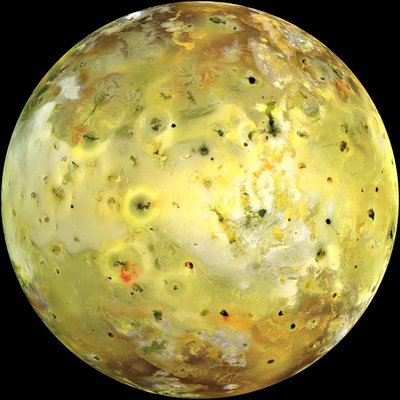
Jupiter's moon Io looking like a ripening cheese and:
Hexakosioihexekontahexaphobia
which means fear of the number 666 ... I began to suffer from this as soon as I knew it existed.
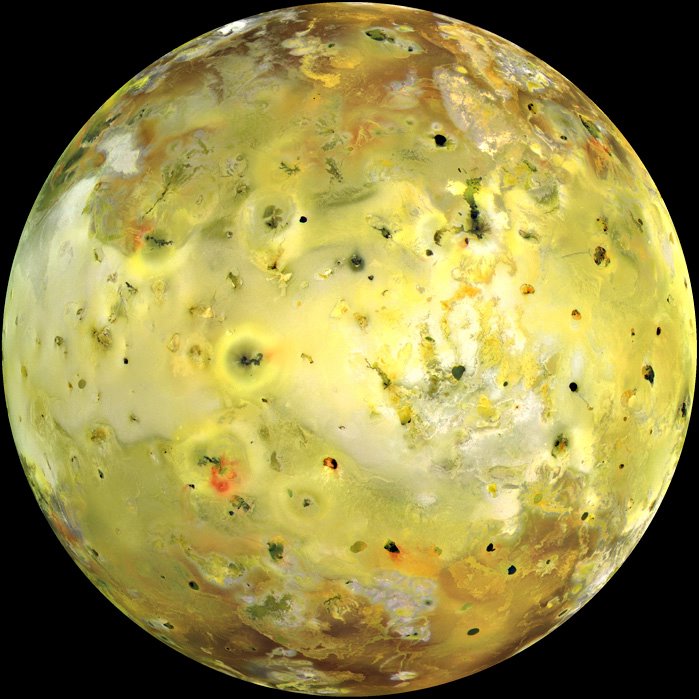
Jupiter's moon Io looking like a ripening cheese and:
Hexakosioihexekontahexaphobia
which means fear of the number 666 ... I began to suffer from this as soon as I knew it existed.
17.12.05
the colour yellow
Before I started reading Huge's Goya, I'd only really looked at the graphic work - Los Caprichos, The Disasters of War - and the late black paintings, all of which are more or less monochromatic if not actually black and white. I had not realised what a superb colorist he was. Out of all those many, varied, beautiful shades, it was his yellows that lingered in my mind: of a highwayman's jacket, of the trousers of an about to be executed street fighter, of the bodice of a maja on a balcony. Then these shades began to remind me of something, someone else, who turned out to be, of all painters, Vermeer.
Vermeer's yellows are different from Goya's - less ochre, less gold, more diaphanous - perhaps best seen in the colour of The Lacemaker's dress. (I also learned that Vermeer had used the same garment, a yellow robe trimmed with white, black-spotted fur, in no less than four other paintings, though not on the Lacemaker herself.)
I found that before sleep or upon waking, this, or these, shades would come to mind, a kind of membrane made not of pigment or cloth but of whatever materiality floats behind the eye in moments of recollection or reprise. And then, a stranger thing, I noticed that when I went back to the books to check my recall, what was on the page was never as vivid or as resonant as what I remembered.
How can this be? I know I am looking at reproductions, and that reproductions are not to be trusted; but is it possible that what I am remembering is not the reproduction at all, but the original? Is this how painting works, by giving an image of the unseen along with the lineaments of the seen? In my memory of those yellows was I remembering things I had never before seen?
Now, even when I look at something as ambiguous and haunting as the image below, it is the yellow of the enormous space above and behind the dog I see, not the previous gloom:
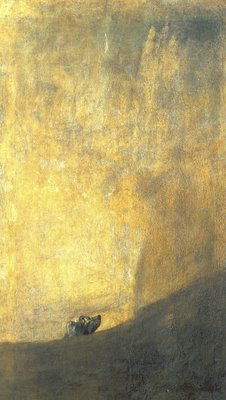
Vermeer's yellows are different from Goya's - less ochre, less gold, more diaphanous - perhaps best seen in the colour of The Lacemaker's dress. (I also learned that Vermeer had used the same garment, a yellow robe trimmed with white, black-spotted fur, in no less than four other paintings, though not on the Lacemaker herself.)
I found that before sleep or upon waking, this, or these, shades would come to mind, a kind of membrane made not of pigment or cloth but of whatever materiality floats behind the eye in moments of recollection or reprise. And then, a stranger thing, I noticed that when I went back to the books to check my recall, what was on the page was never as vivid or as resonant as what I remembered.
How can this be? I know I am looking at reproductions, and that reproductions are not to be trusted; but is it possible that what I am remembering is not the reproduction at all, but the original? Is this how painting works, by giving an image of the unseen along with the lineaments of the seen? In my memory of those yellows was I remembering things I had never before seen?
Now, even when I look at something as ambiguous and haunting as the image below, it is the yellow of the enormous space above and behind the dog I see, not the previous gloom:
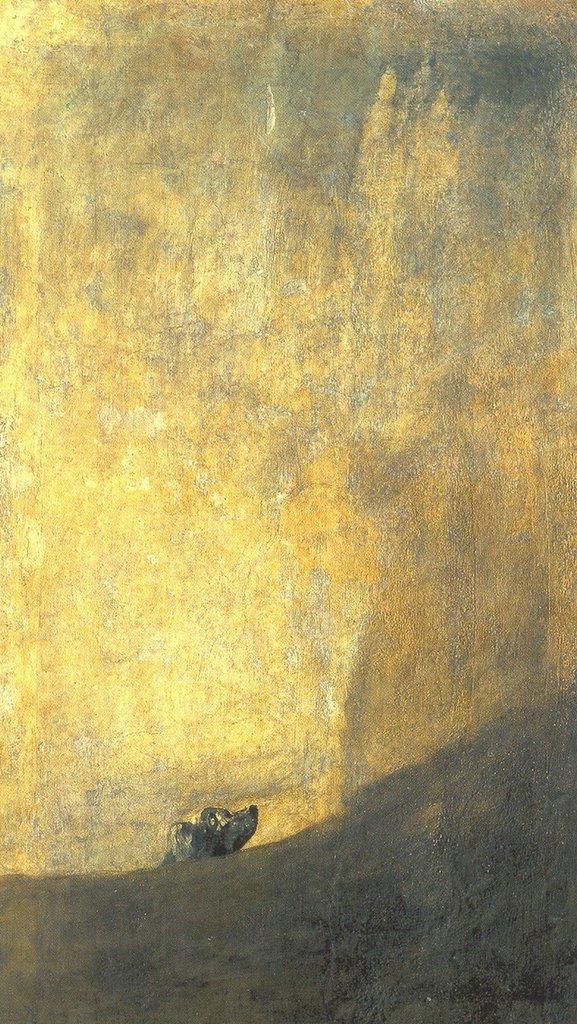
unforgiven
Can be tricky re-watching a loved movie a decade later, you might find the resonances faded, the relevancies irrelevant, the significances turned trite or opaque; but Clint Eastwood's masterpiece stacked up for me, I was rivetted all the way through.
One thing: my favourite exchange used to be the one between William Munney (Clint) & Sheriff Little Bill Dagget (Gene Hackman), just before the former delivers the coup de grace to the latter:
I don't deserve this ... to die like this, Little Bill squeaks. I was building a house.
Deserve's got nothin' to do with it, Munney replies.
Maybe it's changing times, but now I can't go past this:
You just kicked the shit out of an innocent man, sez the madame of the brothel, Strawberry Alice (Frances Fisher) to Little Bill.
Innocent? Bill says. Innocent of what?
One thing: my favourite exchange used to be the one between William Munney (Clint) & Sheriff Little Bill Dagget (Gene Hackman), just before the former delivers the coup de grace to the latter:
I don't deserve this ... to die like this, Little Bill squeaks. I was building a house.
Deserve's got nothin' to do with it, Munney replies.
Maybe it's changing times, but now I can't go past this:
You just kicked the shit out of an innocent man, sez the madame of the brothel, Strawberry Alice (Frances Fisher) to Little Bill.
Innocent? Bill says. Innocent of what?
15.12.05
Huge's Goya
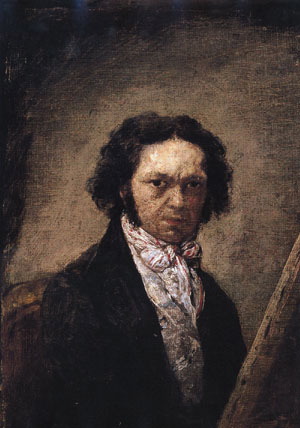
Reading Robert Hughes' Goya which I approached initially with great enthusiasm. Despite the undoubted virtues of Hughes' convict book The Fatal Shore, I've always thought his best writing has been about art and his best book, of those I've read, the collection Nothing If Not Critical which is informed, incisive, resonant, brief ... lapidary, even. So it is a surprise and a disappointment to find this ... a plod. And hence, a slog. There's something painfully dutiful about the way the history of Spain in the late 18th and early 19th centuries is narrated, something equally rote about the way Hughes marks off the works Goya made contemporaneously with these events. Occasionally the prose takes off, almost always when a work is being discussed, but these odd flashes and gleams are rare enough. Much of the rest is both dull and repetitive, as if, like so many books these days, not enough time was given over to editing the text. Also the balance between word and image seems wrong, there is so much writing that the illustrations, while high quality, are just too small for the detail to be properly seen, so that I often find myself peering into the shadows looking for something Hughes remarks upon, unable in fact to see it properly. All of these defects are bearable, plus Goya is such an extraordinary artist and his story so compelling, that I will certainly read the book to the end, though not without regret for what might have been.
But there's something else, which I guess could be described as Hughes' personal intrusions into the narrative. These begin in the first chapter, Driving into Goya in which Hughes reprises some aspects of the very bad car accident he was in in Western Australia in 1999, specifically the long and painful recovery period during which, he says, he 'met' Goya. This haunting and the attendant suffering, finally showed him how he could write his long contemplated book about the artist. So far, so good. But for anyone living in Australia who follows the news, that long-running episode of Hughes' accident and the aftermath does not recall the author's nobility of suffering and humility of insight so much as it does his pettiness, spite and anger at what he saw as his mistreatment by the State authorities and, by extension, his country as a whole. He doesn't go on here as much as he has in other places but what he does say is enough to taint, not so much his inquiry, as his tonality. And once that tone is established, it keeps recurring.
Nothing if not opinionated might be another way to describe Hughes and I'm comfortable with that so far as it relates to the subject of his book ... but do we need to hear what he thinks about the current fashion for Thanksgiving turkeys in the United States? Is it necessary for him to ask us to imagine him in bed for an afternoon with The Naked Maja? Do we want to hear his opinions about the West Australian government? Can't help thinking if there were less of this kind of bluster, less repetition, less Hughes, we could have had a lot more Goya. As it is, I have to read the book with another, one that has decent sized reproductions, to hand, so I can see the paintings, etchings and drawings. But, inevitably, not everything in the one is in the other and I end up frustrated.
Those bombasts, like Hughes, who turn against their country the way he has are not so very different in the end from those others who wrap themselves in the flag and proclaim, over and over, that this is the best country in the world. On other hand, he is a formidable scholar and a very learned man, so it might be better to end with a speculation he gives us quite early on in the piece: the young Goya sharing lodgings with Piranesi in Rome, circa 1770-1.

the Goya self portrait dates from the time of the illness in the early 1790s that left him deaf; the Piranesi was done in and of Rome about 1770.
13.12.05

9.12.05
smoke & mirrors
One of the oddest of Australian books is Michael Wilding's Raising Spirits, Making Gold & Swapping Wives: The True Adventures Of Dr John Dee & Sir Edward Kelly (Shoestring Press, UK; Abbott Bentley, Sydney). I came across a copy of it in, of all places, the Umina Public Library, several years ago now. However, sadly, so far as I could see, it was another book that did not allow itself to be read. This was partly because it was physically a very unsympathetic object: poorly printed, poorly bound, poorly made as a book.
I have somewhere read another novel about Edward Kelly (or Kelley) and Doctor Dee, quite a good one, but can't remember now what it was called or who wrote it. It was specifically concerned with their trip to central Europe, together with their wives and children, during which they visited various monarchs and attempted various transformations, including, it is said, a successful transmutation in Prague. Later the two men fell out, Dee returned to England, Kelly was imprisoned, then broke his leg apparently attempting to escape, and shortly afterwards died. A curious detail: Kelly had no ears, they had been lopped off in punishment for, I think, coining.
Kelly was Dee's scryer. They would collaborate in the calling up of spirits, which Kelly could see in whatever instrument they were using; he would dictate to Dee, who would write these visions down verbatim. Out of these collaborations, it was said, came several books and it is sometimes alleged that the Voynich Manuscript was one of these. Well, perhaps.
What is curious is that one, perhaps two, of these scrying instruments have surivived and are now in the British Museum. The first is a small crystal ball, about whose provenance there is some doubt; the other certainly belonged to Dr Dee and was used by he and Kelly. It is a polished obsidian mirror of Aztec manufacture, brought back from Mexico in the 1520s by Cortes. How it came to England is not known. The Aztec god of night, of rulers, warriors, sorcerers and all material things, Tezcatlipoca, carried such a magic mirror that gave off smoke and killed enemies; in fact his name can be translated 'Smoking Mirror'. Aztec priests also used mirrrors for divination and conjuring up visions.
A British artist, Rosalind Brodsky, along with much else, has interested herself in Dr Dee's mirror as part of one of her Time Travel Research Projects, Hexen2039. It's worth checking out, especially for the curious connections she makes between seemingly but perhaps not unrelated things.
I have somewhere read another novel about Edward Kelly (or Kelley) and Doctor Dee, quite a good one, but can't remember now what it was called or who wrote it. It was specifically concerned with their trip to central Europe, together with their wives and children, during which they visited various monarchs and attempted various transformations, including, it is said, a successful transmutation in Prague. Later the two men fell out, Dee returned to England, Kelly was imprisoned, then broke his leg apparently attempting to escape, and shortly afterwards died. A curious detail: Kelly had no ears, they had been lopped off in punishment for, I think, coining.
Kelly was Dee's scryer. They would collaborate in the calling up of spirits, which Kelly could see in whatever instrument they were using; he would dictate to Dee, who would write these visions down verbatim. Out of these collaborations, it was said, came several books and it is sometimes alleged that the Voynich Manuscript was one of these. Well, perhaps.
What is curious is that one, perhaps two, of these scrying instruments have surivived and are now in the British Museum. The first is a small crystal ball, about whose provenance there is some doubt; the other certainly belonged to Dr Dee and was used by he and Kelly. It is a polished obsidian mirror of Aztec manufacture, brought back from Mexico in the 1520s by Cortes. How it came to England is not known. The Aztec god of night, of rulers, warriors, sorcerers and all material things, Tezcatlipoca, carried such a magic mirror that gave off smoke and killed enemies; in fact his name can be translated 'Smoking Mirror'. Aztec priests also used mirrrors for divination and conjuring up visions.
A British artist, Rosalind Brodsky, along with much else, has interested herself in Dr Dee's mirror as part of one of her Time Travel Research Projects, Hexen2039. It's worth checking out, especially for the curious connections she makes between seemingly but perhaps not unrelated things.
8.12.05
The Voynich Manuscript

The other day, while I was looking online for information about a book - that does not allow itself to be read - mentioned in an Edgar Allan Poe story, I came across an article by sometime Time magazine book reviewer and novelist Lev Grossman. The piece is called When Words Fail and dates from the late 1990s. Subsequent checking suggests that not all of the information in the article is accurate or up to date but it will do as a summary introduction.
The Voynich Manuscript is, literally, a book that cannot by read, since it is written in an unknown language or else in a cipher no-one has yet decoded, at a time of which no-one is sure, by a hand that has not been identified. It is named for one Wilfrid M. Voynich, an American rare book dealer who found it in 1912 in the library of the Villa Mondragone, a Jesuit college in Frascati, Italy, near Rome. The Jesuits who owned the manuscript knew almost nothing about it. Recognising it as unusual and potentially valuable, Voynich bought it and took it back with him to America.
He circulated copies of the pages to scholars he thought might be interested in deciphering it: paleographers, medieval historians, cryptographers, linguists, philologists, even astronomers and botanists. (The book is beautifully illustrated with botanical drawings, astrological symbols, maps, and other arcana.) To date, nearly a hundred years later, no-one has succeeded, although many have tried and some have destroyed themselves in the attempt.
Evocative names swirl about the Voynich: St. Hildegard von Bingen, Roger Bacon, Doctor Dee and Edward Kelly, Rudolph II of Bohemia .... between the pages of the book was a letter, the date of which is probably 1666, from Johannes Marcus Marci of Kronland, rector of the University of Prague, to polymath Athanasius Kircher, a Jesuit famous for trying and failing to decipher Egyptian hieroglyphics and for having himself lowered into the crater of Vesuvius to observe the play of subterranean forces. Kircher was also the author of one of the earliest attempts at devising a universal language and Marci was seeking advice re: deciphering.
So the book was certainly in Prague in the mid-seventeenth century, and may have been purchased by Rudolph for a large amount of money late in the sixteenth; but where it was before that remains a matter for speculation. Many scholars think the physical object dates from early in the 1500s but, even so, it may still be a copy of an earlier book; on the other hand, it may be a hoax especially concocted to fool the King of Bohemia into parting with 300 crowns.
Currently massive efforts through interlinked Web sites are under way to solve the mystery once and for all ... but part of me wonders if it might not be better to leave something as strange and beautiful as this is, alone?

6.12.05
paranoia
Since I've switched to a Mac and subscribed to my current server I've had no problems with spam whatsoever ... until last week, when I started getting messages that came with attachments, all the same size - 54.2 k from memory. The first few suggested they related to mail I had sent which was unable to be delivered but were clearly not about anything I'd initiated. I deleted them without opening the attachment. A couple more came, again suggesting there was an error of some kind I could get help with by opening the attachment. I deleted them. Today one came purporting to be from the CIA. Langley, Virginia, it said and was signed by a Steven Allison. It informed me I had visited 30 (yep, that's all) illegal websites, the list of which was in the attachment and that they (the spooks) would like me to answer some questions about said sites. I deleted it. Shortly afterwards, I lost my connection both to this site and to dérives ... hell, I thought, they're onto me! They're shutting me down! I got so stressed I had to go out for a long walk, even though it's really too hot for walking. When I returned, half an hour ago, connection had been restored and a quick Google told me that, although there is a Steven Allison at the CIA, the email is a hoax and the attachment in fact contains the Sober.CF worm ... so, be warned.
1.12.05
this:
For the melancholic the lost love object is partly unconscious. Unable to give it up, he clings to it 'through the medium of a hallucinatory wish-psychosis' (Freud) in which the deeply cathected memories are obsessively repeated. Along with the sublimation of seduction, this process effects the uncanny nature of de Chirican scenes, hallucinatory and reiterative as they are; it also compounds the ambivalence that they register. For just as the subject of the fantasmatic seduction is ambivalent vis-à-vis the seducer, so too is the melancholic vis-à-vis the lost object. As the melancholic de Chirico internalizes his lost object, he also internalizes his ambivalence for it, which is then turned around on the subject. This ambivalence for both subject and object is most apparent in de Chirico and for a time he sustains it. However, its destructive aspect soon becomes dominant ... here melancholy seems to pass over into masochism.
The working over of seduction, the paranoid projections of persecution, the melancholic repetition of loss: all of these processes in de Chirico fascinate. Certainly they fascinated the surrealists - that is, until they could no longer ignore his necrophiliac turn ... compulsive repetition was always the motor of his obsessional work. For a time he was able to recoup it as a mode of art, to make a muse of uncanny returns, as he did in The Disquieting Muses (1917). Eventually he could inflect it no further, and his work petrified in melancholic repetition, as is evident in the many versions of this painting. As petrification became its condition rather than its subject, his art came to intimate, as Freud once said of melancholy, 'a pure culture of the death instinct.'
from: Compulsive Beauty by Hal Foster, pp 71-3, MIT Press, 1993
The working over of seduction, the paranoid projections of persecution, the melancholic repetition of loss: all of these processes in de Chirico fascinate. Certainly they fascinated the surrealists - that is, until they could no longer ignore his necrophiliac turn ... compulsive repetition was always the motor of his obsessional work. For a time he was able to recoup it as a mode of art, to make a muse of uncanny returns, as he did in The Disquieting Muses (1917). Eventually he could inflect it no further, and his work petrified in melancholic repetition, as is evident in the many versions of this painting. As petrification became its condition rather than its subject, his art came to intimate, as Freud once said of melancholy, 'a pure culture of the death instinct.'
from: Compulsive Beauty by Hal Foster, pp 71-3, MIT Press, 1993
the rich tapestry of life (not)
Analysis in today's press suggests the Gerard imbroglio is not exactly about what at first it seemed to be. Mr. Gerard, rather than Little Johnny's mate, is probably a closer buddy of Treasurer Costello, aka Mr. Smug, and the outing of his tax fiddle may in fact have been orchestrated by Little Johnny himself ... as a part of his on-going skirmish with his Deputy and (alleged) heir apparent over the Succession. I'd believe anything of this lot. Byzantine, scandalous, corrupt, nasty, ultimately meaningless unless you somehow derive meaning from the possession and exercise of political power for its own sake. Found out, inter alia, Mr. Gerard has a vineyard in South Australia. Tapestry, it's called. Looking for a bottle ... if it's good, maybe I can get my next instalment in kind?
30.11.05
complicity
One of the entertaining things about living in Australia is that there's always a scandal of some sort or other running in the newspapers. You can monitor the unfolding of these political, economic, criminal, domestic or whatever dramas the way you would watch a soap opera. You're just part of the audience, you're not involved ... unless you are.
Yesterday a story broke about Federal Treasurer Peter Costello's most recent appointment to the board of the Reserve Bank, Adelaide businessman Robert Gerard. Gerard was under investigation by the Tax Office when the appointment was made and evidently, subsequently, had to pay back a very large amount of tax - perhaps as much as $150 million - he had tried to avoid by claiming credits on money given by his family companies to an overseas insurer. The overseas company was in fact his own, registered in the Netherlands Antilles, and the money soon made its way back to him. Eventually, a confidential settlement was arrived at, where an undisclosed sum was paid on the basis that no allegations made by the Tax Office were admitted.
Gerard is a big contributor to the Federal Liberal Party - $1.1 million so far - but has never given a skerrick to Labor. He's a mate of John Howard's and was on the guest list when Little Johnny put on a barbecue for George W Shrub back in 2003, the same year Gerard joined the Reserve Bank Board.
The Gerard fortune - in 2004 he was said to be the 49th richest person in Australia - was made as Robert diversified Clipsal, an electrical accessories business founded by his grandfather, into a multinational empire, as they say. Gerard Industries, the business holding the family's interest in Clipsal, was sold to a French owned multinational towards the end of 2003, allegedly to pay the tax debt. Gerard retains ownership of Gerard Corporation, amongst whose interests is Adelaide publisher East Street. Yes, the same who are bringing out Luca Antara next year.
I knew about Gerard's Empire before I signed the deal in August, though I didn't know he was fiddling his tax, nor that he was on the board of the Reserve Bank, nor that he was a mate of Little Johnny's. If I had would it have made any difference? I don't know. Probably not. There was that advance, kept me solvent from September to November. Nevertheless, or consequently, I feel ... strange. Complicit. I think that's the word.
Yesterday a story broke about Federal Treasurer Peter Costello's most recent appointment to the board of the Reserve Bank, Adelaide businessman Robert Gerard. Gerard was under investigation by the Tax Office when the appointment was made and evidently, subsequently, had to pay back a very large amount of tax - perhaps as much as $150 million - he had tried to avoid by claiming credits on money given by his family companies to an overseas insurer. The overseas company was in fact his own, registered in the Netherlands Antilles, and the money soon made its way back to him. Eventually, a confidential settlement was arrived at, where an undisclosed sum was paid on the basis that no allegations made by the Tax Office were admitted.
Gerard is a big contributor to the Federal Liberal Party - $1.1 million so far - but has never given a skerrick to Labor. He's a mate of John Howard's and was on the guest list when Little Johnny put on a barbecue for George W Shrub back in 2003, the same year Gerard joined the Reserve Bank Board.
The Gerard fortune - in 2004 he was said to be the 49th richest person in Australia - was made as Robert diversified Clipsal, an electrical accessories business founded by his grandfather, into a multinational empire, as they say. Gerard Industries, the business holding the family's interest in Clipsal, was sold to a French owned multinational towards the end of 2003, allegedly to pay the tax debt. Gerard retains ownership of Gerard Corporation, amongst whose interests is Adelaide publisher East Street. Yes, the same who are bringing out Luca Antara next year.
I knew about Gerard's Empire before I signed the deal in August, though I didn't know he was fiddling his tax, nor that he was on the board of the Reserve Bank, nor that he was a mate of Little Johnny's. If I had would it have made any difference? I don't know. Probably not. There was that advance, kept me solvent from September to November. Nevertheless, or consequently, I feel ... strange. Complicit. I think that's the word.
29.11.05
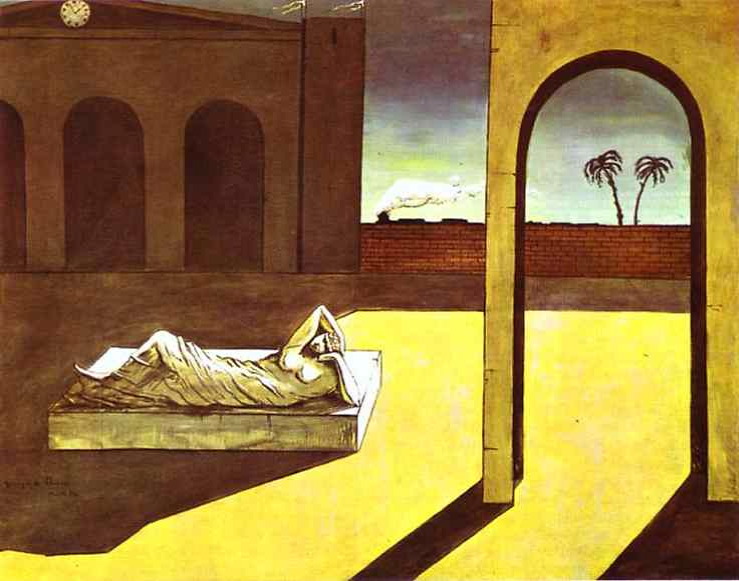
28.11.05
which painting ... ?
African sentiment. The arcade is here forever. Shadow from right to left, fresh breeze which causes forgetfulness, it falls like an enormous projected leaf. But its beauty is in its line: enigma of fatality, symbol of the intransigent will.
Ancient times, fitful lights and shadows. All the gods are dead. The knight's horn. The evening calls at the edge of the woods: a city, a square, a harbor, arcades, gardens, an evening party; sadness. Nothing.
One can count the lines. The soul follows and grows with them. The statue, the meaningless statue that had to be erected. The red wall hides all that is mortal of infinity. A snail; a gentle ship with tender flanks; little amorous dog. Trains that pass. Enigma. The happiness of the banana tree: luxuriousness of ripe fruit, golden and sweet.
No battles. The giants have hidden behind the rocks. Horrible swords hang on the walls of dark and silent rooms. Death is there, full of promises. Medusa with eyes that do not see.
Wind behind the wall. Palm trees. Birds that never came.
(Giorgio de Chirico: Meditations of a Painter, 1912, trans. by Loiuse Bourgeois & Robert Goldwater)
Ancient times, fitful lights and shadows. All the gods are dead. The knight's horn. The evening calls at the edge of the woods: a city, a square, a harbor, arcades, gardens, an evening party; sadness. Nothing.
One can count the lines. The soul follows and grows with them. The statue, the meaningless statue that had to be erected. The red wall hides all that is mortal of infinity. A snail; a gentle ship with tender flanks; little amorous dog. Trains that pass. Enigma. The happiness of the banana tree: luxuriousness of ripe fruit, golden and sweet.
No battles. The giants have hidden behind the rocks. Horrible swords hang on the walls of dark and silent rooms. Death is there, full of promises. Medusa with eyes that do not see.
Wind behind the wall. Palm trees. Birds that never came.
(Giorgio de Chirico: Meditations of a Painter, 1912, trans. by Loiuse Bourgeois & Robert Goldwater)
27.11.05
enigma:
1 a puzzling thing or person; 2 a riddle or paradox; [L aenigma f. Gk ainigma -matos f. ainissomai speak allusively f. ainos fable
{OED}
{OED}
enigma of an autumn afternoon

One clear autumn afternoon I was sitting on a bench in the middle of the Piazza Santa Croce in Florence. It was of course not the first time I had seen this square. I had just come out of a long and painful intestinal illness, and I was in a nearly morbid state of sensitivity. The whole world, down to the marble of the buildings and fountains, seemed to me to be convalescent. In the middle of the square rises a statue of Dante draped in a long cloak, holding his works clasped against his body, his laurel-crowned head bent thoughtfully earthward. The statue is in white marble, but time has given it a grey cast, very agreeable to the eyes. The autumn sun, warm and unloving, lit the statue and the church facade. Then I had the strange impression I was looking at these things for the first time, and the composition of my picture came to my mind's eye. Now each time I look at that painting I see that moment. Nevertheless the moment is an enigma to me, for it is inexplicable ...
(Giorgio de Chirico: Meditations of a Painter, 1912, trans. by Loiuse Bourgeois & Robert Goldwater)
Subscribe to:
Comments (Atom)