26.11.05
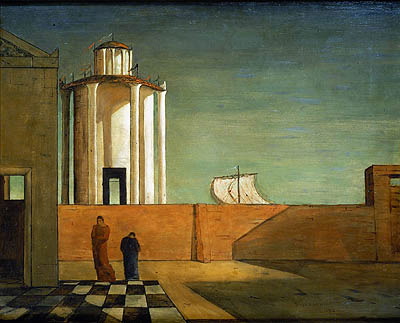
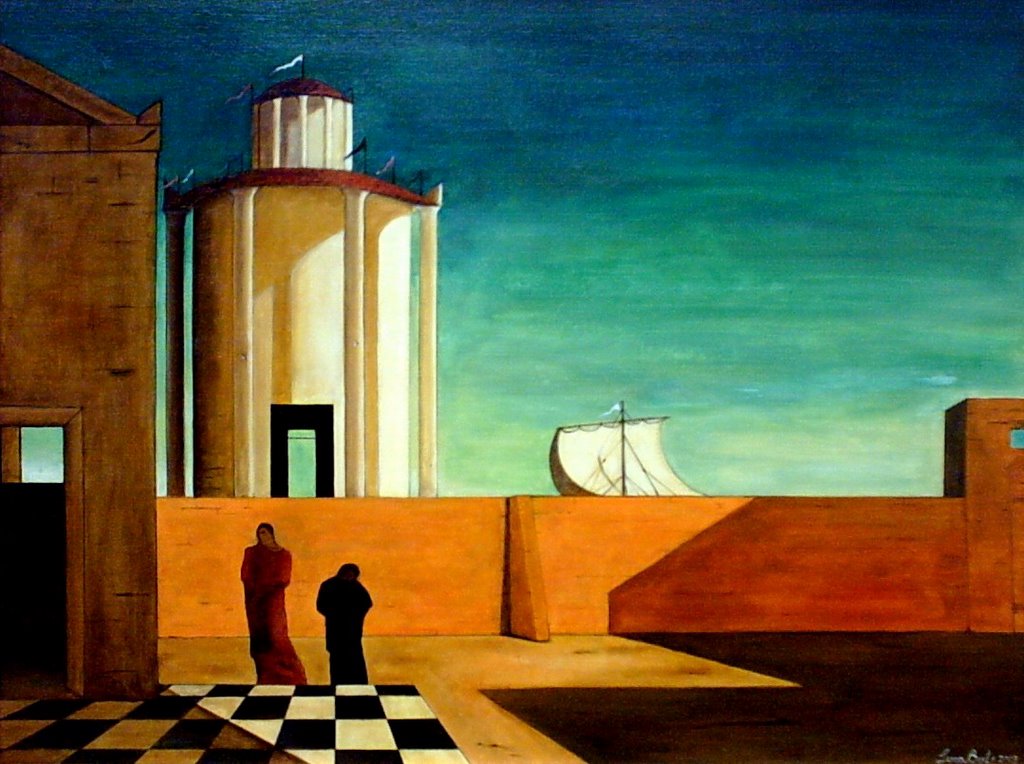
... because if you go trawling the net for images of de Chirico paintings you quickly find yourself in a forest of illusions, where versions proliferate, seeming sometimes to be of the same painting, at others of another almost, but not quite, identical. And it is never clear if you are looking at a later version painted by Giorgio himself or one done by a fake master like Luca Buti or even something digitally altered for some reason or other. In other words there are many cuckoos in de Chirico's nest, some of them laid there by himself. To me one of the most disturbing revisions is Magic and Melancholy of a Street with the image of the child bowling a hoop and the looming shadow at the top of the picture, removed. This was done as part of a project at NYU called Artistic Multiprojection Rendering. The researchers are developing an interactive tool for creating such multiprojection images and animations. Not sure why I find this particular redaction disquieting. It may be for the same reason that de Chirico's Arrival as so far superior to the fake master's: it's as if a genuine enigma is replaced by a simulacrum that mimics its particulars while eliding the very quality that made the picture so resonant in the first place. 'Real' de Chiricos, especially those made before about 1915, when the mannequins arrive, have the feeling of antique, incommensurable things. They are, strictly speaking, inimitable, which is I guess why it is so disorienting to find them imitated. In his Enigma of Arrival that is Odysseus' ship whose sail can be seen behind the wall, we are in Ithaca; but in Luca Buit's the sail is just a bit of prettiness before a pretty blue sky. Which is perhaps to ask, if I know a cuckoo when I see one, why can't those whose nest it is in? Or is it that we are all more or less deluded and our so-called integrity based upon honouring our particular delusions as true? I don't know ... but if the sail was black I would think, not Ithaca but Athens and the ship Theseus's returning, sans Ariadne, from Crete. With Aegeus about to throw himself from the walls into the sea that will bear his name.

25.11.05
the coucou is a pretty bird/she warbles as she flies/I'm preaching the word of god/I'm putting out your eyes
So I was walking along Pembroke Street, where Mary Poppin's author used to live, towards Liverpool Road, when I heard the insistent repeated cry of a bird. It was just an arm's length away in the shrubbery near the corner, a buttery yellow and grey, barred and checked bird that was already bigger than its parents. Who were two more or less frantic red wattle birds:
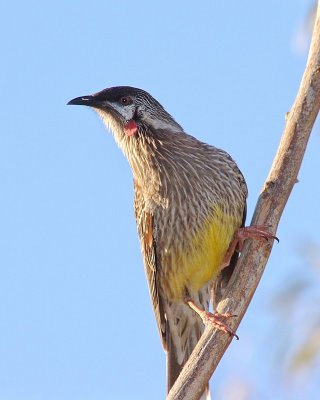
real busy getting insects to drop into the maw of this mad cuckoo that would not let up, not for a moment ... a relative cuckoo, the pallid, is known as the brain fever bird because of this demented insistence. I was impressed to see the struggle for survival going on so close that it seemed I could literally have reached out and plucked cuckoo or cuckoo-ed parents from the branch, if I'd wished. Later, like, now, I've checked the images and it seems that what I saw was a fledging Common Koel:
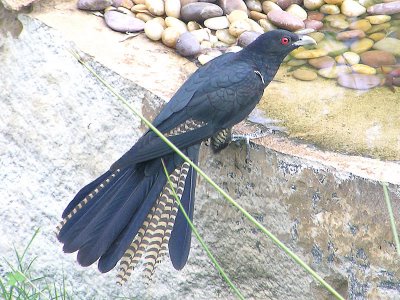
which goes about in plaid while adolescent before adopting (but not entirely) sober blue-black as its adult livery. It too, as an adult, has an insistent cry, often I hear it before dawn and sometimes deep in the heart of the summer night. As if the rage for existence knew no relief.
(this post probably belongs in dérives, however, there's some kind of analogy with the real & fake de Chiricos, below, which is why ... I pursue it here.)

real busy getting insects to drop into the maw of this mad cuckoo that would not let up, not for a moment ... a relative cuckoo, the pallid, is known as the brain fever bird because of this demented insistence. I was impressed to see the struggle for survival going on so close that it seemed I could literally have reached out and plucked cuckoo or cuckoo-ed parents from the branch, if I'd wished. Later, like, now, I've checked the images and it seems that what I saw was a fledging Common Koel:
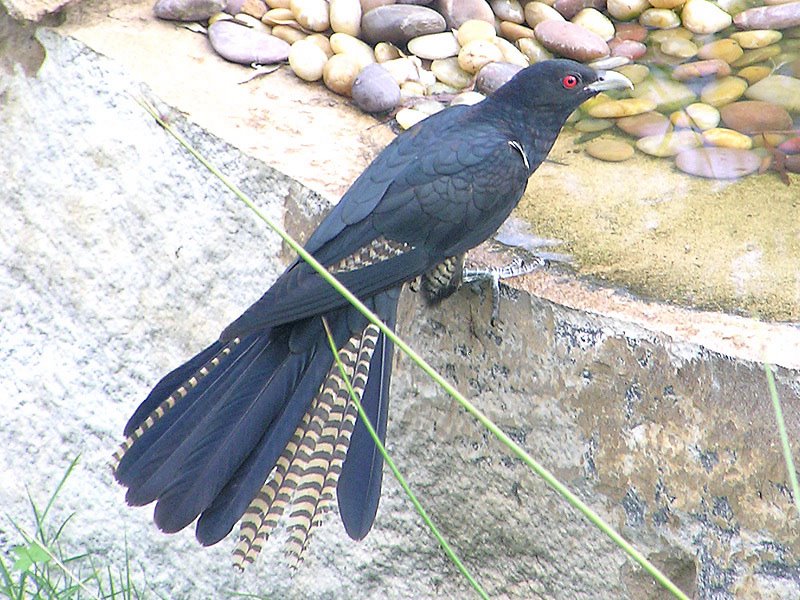
which goes about in plaid while adolescent before adopting (but not entirely) sober blue-black as its adult livery. It too, as an adult, has an insistent cry, often I hear it before dawn and sometimes deep in the heart of the summer night. As if the rage for existence knew no relief.
(this post probably belongs in dérives, however, there's some kind of analogy with the real & fake de Chiricos, below, which is why ... I pursue it here.)
22.11.05
the return of the prodigal
Finding yesterday a de Chirico that eerily answered my (failed) state of mind tweaked an old memory. Rolled up on a shelf at the top of a cupboard under the stairs in the first house I lived in in Sydney was a reproduction, on stiff, high quality paper, of a pencil drawing called The Return of the Prodigal (1917). It was one of a number of intricate drawings de Chirico did at this time, others include The Mathematicians and Solitude. De Chirico returned again and again to certain images and the prodigal was one of them. A later painting
 reiterates most of the main features of the 1917 drawing although the gibbet I recall is absent from it. Another was made in 1929, a closer view the two figures in more or less the pose above. It is bad, as are most, though not all, of the later works.
How did the drawing come to be there? The previous tenants were a couple of painters, friends, but it wasn't theirs. The landlord and lady were an art critic and a painter respectively, George was from Vienna and Mimi a Serbian-born 'abstract impressionist'. Berger was their married name. George had invented the movement of which Mimi was the only known exemplar and together they struggled to advance the cause of art in their world, which was not ours or even, realistically, theirs. They lived off rentals, which in our case and probably in others, if there were others, were always being raised: to compensate for the loss in the purchasing power of the Australian dollar, George used to say. It is hard to imagine a work more different than the de Chirico from Mimi's hectic acrylic washes. She is still alive, still working, under the name Mimi Jaksic-Berger, in a tradition now known as lyrical abstraction.
Not neccesarily but perhaps because of that coincidence Chippendale, where the house was, could put me in mind of de Chirico. The evening skies were sometimes green, there was a distant rumour of trains, the nearer presence of roaring traffic on Cleveland Street, people frozen in enigmatic attitudes (usually outside pubs) at end of day, most of all the facades and silhouettes of buildings in the warehouse district that seemed to exist, incontrovertibly but for no known purpose, in a darkness all their own beneath the radiance of that sky.
I found other things in the house. A commemorative badge, a relief of the Sydney Harbour Bridge, opened in 1932, mislaid at the back of another cupboard in the upstairs bedroom. Somewhere else, can't recall exactly where, a small metal anchor to be hung around the neck, which I still have, an antique symbol (it's on the Coat of Arms) of Sydney Town. And, in the garden which was a midden of black sand from an ancient swamp, a rusty old fob watch. When we moved out, for some forgotten reason I left the drawing where I found it, rolled up, creased, in the cupboard under the stairs.
Anyway ... the return of the prodigal: what is it about? At the time (1981) I thought it concerned the Great War and its aftermath, a flesh and blood father meeting his son returning from the Front as the mechanical or schematic man of the future. This can't be sustained in the painting, the suited man, if he is indeed the father and not the son, looks like he's made of marbled cloud, not flesh; while what I recall as an embrace in the drawing, in the painting looks more like two men bowing to one another so that, in faint absurdity, their foreheads touch. I see the horsed figure in the background as a conquistador and the low, flat building behind as some adobe compound from out of the new or old Mexico of Billy the Kid. But where was the gibbet?
There is no warrant for interpretation in any of de Chirico's work, it exists to confound interpretation in its infinite and possibly redundant suggestibility ... Robert Hughes writes: He could condense voluminous feeling through metaphor and association. One can try to dissect these magical nodes of experience, yet not find what makes them cohere. ... Et quid amabo nisi quod aenigma est? (What shall I love if not the enigma?) - this question, inscribed by the young artist on his self-portrait in 1911, is their subtext.
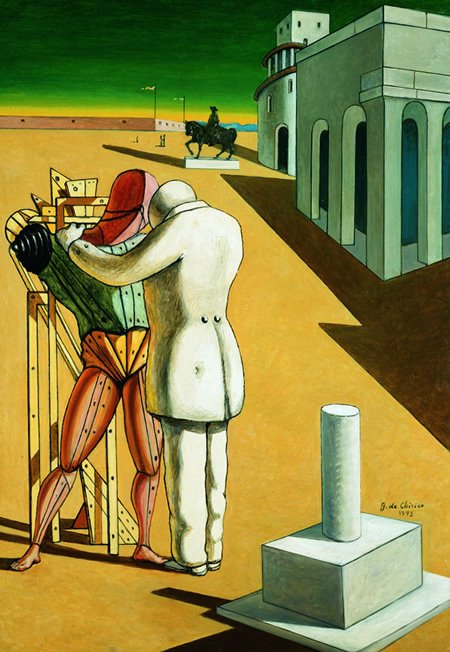 reiterates most of the main features of the 1917 drawing although the gibbet I recall is absent from it. Another was made in 1929, a closer view the two figures in more or less the pose above. It is bad, as are most, though not all, of the later works.
 How did the drawing come to be there? The previous tenants were a couple of painters, friends, but it wasn't theirs. The landlord and lady were an art critic and a painter respectively, George was from Vienna and Mimi a Serbian-born 'abstract impressionist'. Berger was their married name. George had invented the movement of which Mimi was the only known exemplar and together they struggled to advance the cause of art in their world, which was not ours or even, realistically, theirs. They lived off rentals, which in our case and probably in others, if there were others, were always being raised: to compensate for the loss in the purchasing power of the Australian dollar, George used to say. It is hard to imagine a work more different than the de Chirico from Mimi's hectic acrylic washes. She is still alive, still working, under the name Mimi Jaksic-Berger, in a tradition now known as lyrical abstraction.
Not neccesarily but perhaps because of that coincidence Chippendale, where the house was, could put me in mind of de Chirico. The evening skies were sometimes green, there was a distant rumour of trains, the nearer presence of roaring traffic on Cleveland Street, people frozen in enigmatic attitudes (usually outside pubs) at end of day, most of all the facades and silhouettes of buildings in the warehouse district that seemed to exist, incontrovertibly but for no known purpose, in a darkness all their own beneath the radiance of that sky.
I found other things in the house. A commemorative badge, a relief of the Sydney Harbour Bridge, opened in 1932, mislaid at the back of another cupboard in the upstairs bedroom. Somewhere else, can't recall exactly where, a small metal anchor to be hung around the neck, which I still have, an antique symbol (it's on the Coat of Arms) of Sydney Town. And, in the garden which was a midden of black sand from an ancient swamp, a rusty old fob watch. When we moved out, for some forgotten reason I left the drawing where I found it, rolled up, creased, in the cupboard under the stairs.
Anyway ... the return of the prodigal: what is it about? At the time (1981) I thought it concerned the Great War and its aftermath, a flesh and blood father meeting his son returning from the Front as the mechanical or schematic man of the future. This can't be sustained in the painting, the suited man, if he is indeed the father and not the son, looks like he's made of marbled cloud, not flesh; while what I recall as an embrace in the drawing, in the painting looks more like two men bowing to one another so that, in faint absurdity, their foreheads touch. I see the horsed figure in the background as a conquistador and the low, flat building behind as some adobe compound from out of the new or old Mexico of Billy the Kid. But where was the gibbet?
There is no warrant for interpretation in any of de Chirico's work, it exists to confound interpretation in its infinite and possibly redundant suggestibility ... Robert Hughes writes: He could condense voluminous feeling through metaphor and association. One can try to dissect these magical nodes of experience, yet not find what makes them cohere. ... Et quid amabo nisi quod aenigma est? (What shall I love if not the enigma?) - this question, inscribed by the young artist on his self-portrait in 1911, is their subtext.
21.11.05
The Profit

It is disconcerting the way screenplay writing seems to need to banish all other forms into limbo. I push everything back, both mentally and physically, file the files, shelve the books, clear virtual and actual desktop, leaving a blank anonymous space in which to entertain the dream ... and there it floats, not so far away that I cannot touch it, cannot reach in and change this for that, move such to here and the other to there, cancel a character, rename another, give the lines one speaks to someone else - but it feels like working at a remove, like operating one of those remote arms used to manipulate dangerous substances from behind a screen made of some impermeable prophylactic that prevents actual engagement, actual contamination, with the real. Maybe it is because a script is never more than a plan, a possibility, a map of a place that doesn't exist and may never do so. It is profoundly alienating, especially since I cannot see what else needs doing to this particular plan, but don't feel the unmistakeable sense of completion that would allow me to decide it is finished. So here I sit, like a monad on the wide bare plains of Forever and Not Yet, or, more exactly, like one of de Chirico's ghostly mannequins, frozen before a schema s/he may be the author of but is no less, and consequently, also blindly in thrall to. While someone out of the picture looms their shadow across the boards, promising - or threatening - what?
16.11.05
Sunday, I read in the Writer's Tent at the Newtown Festival. The event, Voices in the Park, has been going for a few years now, organised by the owners of King Street bookshop, Better Read Than Dead. My appearance there was a consequence of an earlier appearance at the Montanas in Wellington in July, where one of the owners, Derek, heard me speak and decided to issue the invite. There were three of us up there among the flies and the heat for the session, which was called Writing a Life : the Chair, Stephanie Green, a publisher at the National Library of Australia, myself, and Richard Glover, a well-known Sydney Morning Herald journalist, ABC radio host and author of nine books, mostly humorous. I asked to go before Richard, because of his higher profile and also because I was likely to come across as more literary. I read a section from Chronicle of the Unsung, about a job I once had writing pornography in New York. For some reason I was more nervous than I usually am before these events, so decided to speak my intro and outro from notes: always a mistake, I find, it's far better to work out in your head what you want to say and then just say it. However. After I'd finished my bit, an older man came out of the crowd and asked for my microphone so he could say something. I was a bit slow, I didn't immediately see the plastic cup of white wine he had in his hand, didn't straight away catch the whiff of alcohol on his breath. The mike was fixed and, anyway, there was another roving mike for the floor. Suggested he use that. There was a kind of tension in the tent now, no-one wanted some drunken idiot to crash the show; but Derek gave him the roving mike and he took his place in front of the crowd of about fifty people. He said he had something to get off his chest. He'd been in the British SAS, the anti-terrorism unit, and he wanted us all to know that they did fuck-all to prevent terrorism, then and now ... said he was 63 years old and ... dried ... I saw a woman over at the side of the tent, next to one of the open flaps, catch his eye and beckon him away. Someone in the crowd was smart enough to start clapping, everybody joined in and he took his bow and wandered off. He came back after Richard - who was very amusing - read and delivered essentially the same rap then lurched off again just like before. When the hour was over we waited round to sign books and I met Derek's wife, Maggie, who turned out to have known both my parents in Wellington in the 1970s. One of my mother's anthology pieces, Latter Day Lysistrata, was inspired by a production of Aristophane's Lysistrata Maggie directed at Bats Theatre in Courtenay Place. I didn't know that, and she didn't know how succesful the poem became. As for my father, she'd got to know him while working in the Education Department, where he had a desk job in the Curriculum Unit after a series of nervous breakdowns and his alcoholism had forced his retirement from active teaching and school administration. So that was all well and good. A friend had come to the reading, we went off to Kelly's Irish Bar for a beer and then, later, walked back through the fair to our respective cars. As we were going up some stairs into the park I saw the SAS man and his companion staggering along Lennox Street, very much the worse for wear. He waited, swaying, while she, who had seemed so together before, went towards an overflowing rubbish bin with their empties and stood there, also swaying, clearly unable to work out how to deposit them within - given that there was no within within. There's little point in expatiating further on the image, two sad drunks, it's familiar enough, however poignant/absurd/distressing it may also be. I just can't forget it. Don't know why. Something to do with righting a life perhaps.
15.11.05
unearthed
... a photo of Gran. Didn't think I had one. Was actually, ostensibly, looking for my (excuse for) a will. It was taken in Hamilton sometime in the mid fifties. Out on the front porch of, probably, Gran & Poppa's house. They are central, sitting side by side in chairs. Their three sons and two of their wives stand behind and there are eight grandchildren gaggled along the steps in front; the third wife, my mother, sits next to Gran with my sister Rachel, a babe in arms. That dates it: late 1954 or early '55; possibly Christmas. Poppa is almost indistiguishable, a blur: domed head, round glasses, no discernable self apart from the attitude, a mix of his native aggression and a kind of repletion. Pater familias I guess. Gran looks so like Dad I caught my breath. Spose I should say that he, when old, resembled her. She's smiling in a crooked way, it's a genuine smile but there is also in it the shadow of lifelong appeasement. That could just be the false teeth. Dad always said she was not a happy person. Nor was he a happy person, not in later years. As I said, they were close. That physical resemblance. She wanted a daughter and chose him, the middle son, the dark sensitive one, as her confidante. She used to give him cigarettes and tell him her troubles. Things he probably didn't need to know. When he went into therapy, in Wellington in the mid 1960s (only ten year's later), Mrs. Christella, a Jungian who had studied with Carl Gustav, said untangling his relationship with his mother was the key to a successful outcome; but she was an old woman by then and died before they got very far. His first faltering in fact happened when Ada, his mother, Gran, died, 1963 I think, and he could not control his fear on the flight back to Hamilton for the funeral. He whose life until then had been an immaculate trajectory. Was suddenly unruddered. The severing of the subterranean bond between them was perhaps catastrophic. I don't know. What was she really saying the other night? I want to claw my way back into the dream and ask her. But these things are never really questionable. Or always. Questionable.
13.11.05
restoration of a dream
The main thing … my grandmother! Was in the dream. I never really knew her, she was no more to me than a small brown woman huddled in a big chair. It was Alzheimer's or similar, my father told me later. They looked alike, Dad and his mother, and were certainly close. I haven’t dreamed about her before.
It was a long and confused ramble but at the heart of it were three old wooden houses in Burns Street, Ohakune, where I mostly grew up. In the dream was a photograph of these three houses as they looked in their glory days, but now ours was ramshackle, falling down. It did not look like the actual house we lived in which, much changed, is still there—like the two others, it was smaller, one of those four room railway cottages that stand up at the Junction.
I had used my inheritance (from my mother but, ultimately, from both my parents) to buy back the ancestral home. I was still with my former partner and the incipient chaos and unhappiness we lived in and with for the last few years we were together was the atmos of the dream. Friends of ours, happy friends with happy families, lived nearby. They were restoring their houses.
Some kind of party was going on, there was lots of coming and going. I was, as I used to do, trying to conceal our unhappiness—futile of course but there you are.
Won’t go into all the events that happened, they were too many and would require too much explanation to relate sensibly, though I understand most of them. But, in the midst of all this, inside the (dream) house, just beside the bathroom door, was it? Or the pantry? I met my grandmother.
Her birth name was Ada Trevarthen. A Cornish woman, the family came from Truro. A piano teacher who gave up music when she married my (Australian) grandfather. She was bigger than I remember her in life, a larger presence, but still recognisable. She said to me that the decline of the house had begun with my father, that the tumbledown dereliction of it all started with him, he was unable to preserve or maintain it as it should and could have been maintained. This was said without judgement or criticism, sadly if anything—the sadness of fact. The implication was that my attempt to restore what he had let go was doomed from the start.
There something ungainsayable about her that was both reassuring and confronting. Wisdom I guess, perhaps the wisdom of the dead. She said what she had to say and passed out of the dream.
Later, my ex and I were in bed together, beginning to make love, when revellers in trissy masks burst into the bedroom where we were, insisting we join in the fun. Tried to make them leave, shut the door and go, but they would not. It was an exact recall, without the interlopers, of the last time we did try to make love.
There was more … after Gran, as we called her, and the unhappiness, the strongest trace of the dream is the actual physical place it was set. As the phantasmagoria faded I remember thinking that tomorrow, that is, today, I would go down through the back garden to the river, wade across and walk along the further bank, which I don’t believe I ever actually have done. Wild land then and perhaps still wild; there were herds of brumbies though they will have gone now.
The intense joyful anticipation of that walk was replaced by regret when I woke … but, as always, I feel redeemed by the grace of a visit to a place where I was always happy. More than that, more than anything else, I have a sense of wonder, indeed elation, that that connection back to Gran, howsoever it may be, is, unlike the house itself, restored.
[We moved away from Ohakune in 1962 and the house was put on the market; it sold a few years later. I lamented it for many years & later did look into buying another house there - as impractical as that was. What Gran is saying (if it is not just me talking to myself) is not that Dad wrecked the family but that decisions taken then can't be rescinded now. That the garden of forking paths is a dream garden perhaps. Though no less real for that. Perhaps.]
It was a long and confused ramble but at the heart of it were three old wooden houses in Burns Street, Ohakune, where I mostly grew up. In the dream was a photograph of these three houses as they looked in their glory days, but now ours was ramshackle, falling down. It did not look like the actual house we lived in which, much changed, is still there—like the two others, it was smaller, one of those four room railway cottages that stand up at the Junction.
I had used my inheritance (from my mother but, ultimately, from both my parents) to buy back the ancestral home. I was still with my former partner and the incipient chaos and unhappiness we lived in and with for the last few years we were together was the atmos of the dream. Friends of ours, happy friends with happy families, lived nearby. They were restoring their houses.
Some kind of party was going on, there was lots of coming and going. I was, as I used to do, trying to conceal our unhappiness—futile of course but there you are.
Won’t go into all the events that happened, they were too many and would require too much explanation to relate sensibly, though I understand most of them. But, in the midst of all this, inside the (dream) house, just beside the bathroom door, was it? Or the pantry? I met my grandmother.
Her birth name was Ada Trevarthen. A Cornish woman, the family came from Truro. A piano teacher who gave up music when she married my (Australian) grandfather. She was bigger than I remember her in life, a larger presence, but still recognisable. She said to me that the decline of the house had begun with my father, that the tumbledown dereliction of it all started with him, he was unable to preserve or maintain it as it should and could have been maintained. This was said without judgement or criticism, sadly if anything—the sadness of fact. The implication was that my attempt to restore what he had let go was doomed from the start.
There something ungainsayable about her that was both reassuring and confronting. Wisdom I guess, perhaps the wisdom of the dead. She said what she had to say and passed out of the dream.
Later, my ex and I were in bed together, beginning to make love, when revellers in trissy masks burst into the bedroom where we were, insisting we join in the fun. Tried to make them leave, shut the door and go, but they would not. It was an exact recall, without the interlopers, of the last time we did try to make love.
There was more … after Gran, as we called her, and the unhappiness, the strongest trace of the dream is the actual physical place it was set. As the phantasmagoria faded I remember thinking that tomorrow, that is, today, I would go down through the back garden to the river, wade across and walk along the further bank, which I don’t believe I ever actually have done. Wild land then and perhaps still wild; there were herds of brumbies though they will have gone now.
The intense joyful anticipation of that walk was replaced by regret when I woke … but, as always, I feel redeemed by the grace of a visit to a place where I was always happy. More than that, more than anything else, I have a sense of wonder, indeed elation, that that connection back to Gran, howsoever it may be, is, unlike the house itself, restored.
[We moved away from Ohakune in 1962 and the house was put on the market; it sold a few years later. I lamented it for many years & later did look into buying another house there - as impractical as that was. What Gran is saying (if it is not just me talking to myself) is not that Dad wrecked the family but that decisions taken then can't be rescinded now. That the garden of forking paths is a dream garden perhaps. Though no less real for that. Perhaps.]
12.11.05
The Avatar of Venus
I was lonely that year. Read 256 books though I can’t pretend I looked at every word of every one of them. Remembered almost nothing of them except a few titles. Went to 43 movies. Remembered even less. Smoked 2,987 cigarettes. Drank 212 litres of red wine, mostly while sitting out on the veranda looking at the stars blurring up in the night sky. Mornings, my kidneys ached. That might have been the painkillers. Coughed less than you might expect. Liver? Don’t ask. My health stayed surprisingly good, perhaps because my mind remained active. Active? Frantic might be a better word. Slept occasionally, never enough. Someone was in love with me, I didn’t love her. Was in love with someone else, she didn’t love me. Such is life. Got to know all the passers-by, not by name, just by their looks, their routine passes up and down the street. Invented histories for some of them, others didn’t seem as if they had histories, just days. And nights. People are mysterious when you don’t know them, less so when you do. Unless you’re in love of course. Entertained many other phantoms, none of whom ever became quite real or never for long enough. One night Venus, the planet I mean, came down so close it felt as if I could reach out and touch—her? It? Whatever. Though it was clearly another delusion, extended my hand anyway then closed it to a fist. The feeling was indescribable but I will try. Like clutching incandescent mist. Like wet fire. Like a viscous bounteous mucous. When I couldn’t stand the heat any more, I withdrew my fist and opened it. In the palm shivered one silvery drop, I’d say mercury but that’s a different planet. Anyway this liquid was clear as water. I touched it with the forefinger of my other hand, it burned. No whorls left now on that fingertip. The little drop of Venus was undiminished. In a moment of recklessness, I licked it up and swallowed. It went through me like white lightning and nothing’s been the same since. I'd become her avatar. I was a tiny part of her, wherever she went I went. Round and round the sun. Sometimes I saw Earth like a single blue tear in space. And I remembered everything, every sip, every gasp, every image, every word. Every touch … it wasn’t enough. After that I slept even less and often found myself singing the old song: It’s never enough/it’s never enough/until your heart stops beating/the deeper you get/the sweeter the pain/don’t give up the game/until you’re heart stops beating ... I think that’s how it goes.
11.11.05
some words
... that W. H. Auden used in poems :
blouts, pirries, stolchy, glunch, sloomy, snudge, snoachy, scaddle, cagmag, hoasting, drumbles ...
(he used to scour the OED for curiosities then find a way to fit them in; but what do they mean?)
blouts, pirries, stolchy, glunch, sloomy, snudge, snoachy, scaddle, cagmag, hoasting, drumbles ...
(he used to scour the OED for curiosities then find a way to fit them in; but what do they mean?)
10.11.05
blog be my bog
It is perhaps not useful to think of a weblog as a site of publication but that's how it always seems to me. Not a notebook or a diary because those forms do not assume an immediate readership of more than one. On the other hand, I also feel a kind of pressure to post regularly here even when there is nothing urgent to say. When a week goes by, as it has, and I post nothing, I start to feel as if some essential activity has lapsed even though that's probably not so. It's a dilemma that could be resolved I suppose if I could learn to think differently about this site. So, in the interests of that resolve, what have I been doing apart from not blogging? A list, perhaps?
... totally absorbed by Peter Russell's Prince Henry 'The Navigator', A Life which I read a chapter of most mornings;
... listening to Cesaria Evora while studying the atlas so as to place the Azores, Madeira, the Canaries and the Cape Verde islands with respect both to Portugal and the West African coast;
... trying to work out who the indigenes of the Canaries were: Berbers? Germanic peoples left there by the Phoenicians or the Romans? Some entirely other tribe?;
... getting my thoughts in order to redraft portions of my still untitled screenplay, which needs to be 'completed' by Christmas;
... spending much of the past month in intense email confab with a friend and colleague in NZ as we try to elucidate the mysteries and depths of Alan Brunton's book length poem Moonshine; re-reading Jessie L. Weston's epochal From Ritual to Romance as a part of that inquiry;
... feeling anxious about my publisher's request for a subtitle for Luca Antara but unable to resolve the anxiety with a magic phrase;
... wondering why the critics have been so kind about the half dozen Australian movies I have been to this year, all of which, with one exception only - Look Both Ways - are more or less bad; walked out of Wolf Creek, the most successful of them, the other night feeling sick and disgusted about two thirds of the way through;
... feeling anxious that my screenplay, if it gets made, will also produce a movie that is more or less bad;
... making random notes for the book I want to write next year; feeling anxious in case it dies on me;
... reading Robert Burns;
... reading a history of the Kings & Queens of England, because I've never quite figured out the succession;
... becoming more and more interested in the island of Halmahera, which, according to genetic studies of the Pacific rat, may be the point of origin for the Lapita dispersal;
... wondering how I might arrange to go up there sometime in the second half of next year;
... speculating about the possibility that a funding body will support my application for money to write a psychological thriller about cab driving next year (they will, I just got the phone-call; now feeling anxious about my ability to write it);
... smoking cigarettes and watching Captain Kangaroo;
... feeling anxious about not blogging ...
I'm not really an anxious person - or am I? - but anxiety of the kind I mention is certainly an engine of my writing, ie the only way to dispel this anxiety is to write. It's a form of expectation perhaps. Once I post this - if I post it - I know I'll feel better at least about this bog, I mean, blog.
... totally absorbed by Peter Russell's Prince Henry 'The Navigator', A Life which I read a chapter of most mornings;
... listening to Cesaria Evora while studying the atlas so as to place the Azores, Madeira, the Canaries and the Cape Verde islands with respect both to Portugal and the West African coast;
... trying to work out who the indigenes of the Canaries were: Berbers? Germanic peoples left there by the Phoenicians or the Romans? Some entirely other tribe?;
... getting my thoughts in order to redraft portions of my still untitled screenplay, which needs to be 'completed' by Christmas;
... spending much of the past month in intense email confab with a friend and colleague in NZ as we try to elucidate the mysteries and depths of Alan Brunton's book length poem Moonshine; re-reading Jessie L. Weston's epochal From Ritual to Romance as a part of that inquiry;
... feeling anxious about my publisher's request for a subtitle for Luca Antara but unable to resolve the anxiety with a magic phrase;
... wondering why the critics have been so kind about the half dozen Australian movies I have been to this year, all of which, with one exception only - Look Both Ways - are more or less bad; walked out of Wolf Creek, the most successful of them, the other night feeling sick and disgusted about two thirds of the way through;
... feeling anxious that my screenplay, if it gets made, will also produce a movie that is more or less bad;
... making random notes for the book I want to write next year; feeling anxious in case it dies on me;
... reading Robert Burns;
... reading a history of the Kings & Queens of England, because I've never quite figured out the succession;
... becoming more and more interested in the island of Halmahera, which, according to genetic studies of the Pacific rat, may be the point of origin for the Lapita dispersal;
... wondering how I might arrange to go up there sometime in the second half of next year;
... speculating about the possibility that a funding body will support my application for money to write a psychological thriller about cab driving next year (they will, I just got the phone-call; now feeling anxious about my ability to write it);
... smoking cigarettes and watching Captain Kangaroo;
... feeling anxious about not blogging ...
I'm not really an anxious person - or am I? - but anxiety of the kind I mention is certainly an engine of my writing, ie the only way to dispel this anxiety is to write. It's a form of expectation perhaps. Once I post this - if I post it - I know I'll feel better at least about this bog, I mean, blog.
4.11.05
don't forget to remember ...
Consolidation is the progressive postacquisition stabilization of long-term memory. The term is commonly used to refer to two types of processes: synaptic consolidation, which is accomplished within the first minutes to hours after learning and occurs in all memory systems studied so far; and system consolidation, which takes much longer, and in which memories that are initially dependent upon the hippocampus undergo reorganization and may become hippocampal-independent. The textbook account of consolidation is that for any item in memory, consolidation starts and ends just once. Recently, a heated debate has been revitalized on whether this is indeed the case, or, alternatively, whether memories become labile and must undergo some form of renewed consolidation every time they are activated. This debate focuses attention on fundamental issues concerning the nature of the memory trace, its maturation, persistence, retrievability, and modifiability.
I knew that we revise a memory each time we access it, so that our record is not some kind of holy writ but a palimpsest; but had not realised (though in a way it is obvious) that every time a memory is activated, even a long term memory, it also becomes vulnerable to erasure. Remembering can thus lead to irretrievable forgetting:
Experimenting with rats we reactivated long-term memory and then, using the drug propranolol, blocked protein synthesis in the amygdala - one of the systems crucial for learning and consolidating memories of fearful events - and the rats were no longer afraid ... it was bizarre. It should have been a fixed memory ... the same process has been demonstrated in snails, honey bees, earthworms, crabs and, last year, humans ...
The humans in question were cocaine users and the technique of erasure was designed not so much to eliminate memory of drug-taking per se as it was to neutralise the emotional boost given the memory of a hit when it is recalled. There are clearly all manner of other possible applications for this process (=rediscovered reconsolidation), for instance in the treatment of Post Traumatic Stress Disorder; but, equally obviously, some of these applications have a sinister side.
These and other neuro-ethical issues are being monitored by the Centre for Cognitive Liberty and Ethics, whose Director, Dr Wrye Sententia, predicts a coming boom in the production and consumption of neuroceuticals just like the industry that has grown up around plastic surgery. The genie is already out of the bottle, Dr Sententia allowed.
Guess we'll just have to wait and see what form(s) cosmetic neurology might take; I can think of a few ...
(The first quote is the abstract of a paper entitled The neurobiology of consolidations, or, how stable is the engram? by Y Dudai, published in the Annual Review of Psychology, 2004; the second from Choose to forget Sydney Morning Herald, Health & Science, 3.11.05.)
I knew that we revise a memory each time we access it, so that our record is not some kind of holy writ but a palimpsest; but had not realised (though in a way it is obvious) that every time a memory is activated, even a long term memory, it also becomes vulnerable to erasure. Remembering can thus lead to irretrievable forgetting:
Experimenting with rats we reactivated long-term memory and then, using the drug propranolol, blocked protein synthesis in the amygdala - one of the systems crucial for learning and consolidating memories of fearful events - and the rats were no longer afraid ... it was bizarre. It should have been a fixed memory ... the same process has been demonstrated in snails, honey bees, earthworms, crabs and, last year, humans ...
The humans in question were cocaine users and the technique of erasure was designed not so much to eliminate memory of drug-taking per se as it was to neutralise the emotional boost given the memory of a hit when it is recalled. There are clearly all manner of other possible applications for this process (=rediscovered reconsolidation), for instance in the treatment of Post Traumatic Stress Disorder; but, equally obviously, some of these applications have a sinister side.
These and other neuro-ethical issues are being monitored by the Centre for Cognitive Liberty and Ethics, whose Director, Dr Wrye Sententia, predicts a coming boom in the production and consumption of neuroceuticals just like the industry that has grown up around plastic surgery. The genie is already out of the bottle, Dr Sententia allowed.
Guess we'll just have to wait and see what form(s) cosmetic neurology might take; I can think of a few ...
(The first quote is the abstract of a paper entitled The neurobiology of consolidations, or, how stable is the engram? by Y Dudai, published in the Annual Review of Psychology, 2004; the second from Choose to forget Sydney Morning Herald, Health & Science, 3.11.05.)
2.11.05
The Proposition
Nick Cave was in town recently, talking up The Proposition, for which he wrote both screenplay and score, boasting that the script was written in 21 days (one version) or a weekend (another). He said something to the effect that it was easy for him because he has what most screenwriters lack, that is, talent. Well, no-one could doubt that the probably tongue-in-cheek Mr Cave has talent. However, as was pointed out to me long ago in a graffiti in the back room of a club in Berkeley, below a dripping guitar hero drawn a la Rbt. Crumb complete with ejaculating axe: it takes more than talent ...
I went to The Proposition on Sunday with a friend who is a director. It wasn't as bad a film as I had heard but it wasn't that good either. It was, I guess, a missed opportunity. A great set-up was never really delivered upon, not through absence of talent but rather a lack of that staple of the screenwriter's craft, technique. The middle brother (Guy Pearce, in a fine performance) of three is offered the chance to free his younger, intellectually disabled sibling from death if he will bring in his rogue elder bro, who is psychopathically holed up in the hills somewhere, periodically visiting mayhem on the good and bad citizens of the lowlands.
A warning note for me sounded in the very first scene, a shoot-out in what turns out to be (didn't learn this until the credits) a brothel. The women in the brothel are Asian, presumably Chinese: not historically accurate, my director friend, who is Chinese, told me, there were very few Chinese women in Australia in the C19th and none in brothels frequented by white men, although there were some in Chinese-only brothels a bit later on. However, what bothered me was the wallpaper: faded versions of Japanese erotic prints from the floating world, Utamaro et al. The ahistorical or anachronistic doesn't concern me per se, it was the sense that this kind of cleverness signalled the primacy of style over substance.
The director of The Proposition, John Hillcoat, seems mostly to have made commercials and music videos since his 1988 film Ghosts of the Civil Dead, in which Mr Cave appears. While his direction is otherwise skilled, Mr Hillcoat shows a tendency, common in ad makers, to indulge in visual longeurs of various kinds instead of advancing the action. In like manner, the screenplay is more intent upon constructing vignettes, some quite powerful, than it is on telling a story. The crux of the matter is the relationship between the three brothers and the dilemma posed by the requirement upon the middle one to betray the elder to save the younger. Incredibly, this is never explored in any depth - an oversight which, given the strength of the set-up, strikes me as almost criminal.
Some of the quite trenchant local criticism of The Proposition has focused upon the self-righteousness of its judgmental view of Australia then, and by implication, now. The brothel scene might be a case in point: if there weren't such brothels then, there certainly are now and that was perhaps the point of opening the film where and when they did. Again, I don't mind if Mr Cave and Mr Hillcoat want to take contemporary mores to task by medium of a period film: why not? No, I'm offended by the laxness of the story-telling, the stylistic self-indulgence, the woeful dissipation of the energy of the premise until, by the end, there's simply no dramatic tension left.
That was a Western?
I went to The Proposition on Sunday with a friend who is a director. It wasn't as bad a film as I had heard but it wasn't that good either. It was, I guess, a missed opportunity. A great set-up was never really delivered upon, not through absence of talent but rather a lack of that staple of the screenwriter's craft, technique. The middle brother (Guy Pearce, in a fine performance) of three is offered the chance to free his younger, intellectually disabled sibling from death if he will bring in his rogue elder bro, who is psychopathically holed up in the hills somewhere, periodically visiting mayhem on the good and bad citizens of the lowlands.
A warning note for me sounded in the very first scene, a shoot-out in what turns out to be (didn't learn this until the credits) a brothel. The women in the brothel are Asian, presumably Chinese: not historically accurate, my director friend, who is Chinese, told me, there were very few Chinese women in Australia in the C19th and none in brothels frequented by white men, although there were some in Chinese-only brothels a bit later on. However, what bothered me was the wallpaper: faded versions of Japanese erotic prints from the floating world, Utamaro et al. The ahistorical or anachronistic doesn't concern me per se, it was the sense that this kind of cleverness signalled the primacy of style over substance.
The director of The Proposition, John Hillcoat, seems mostly to have made commercials and music videos since his 1988 film Ghosts of the Civil Dead, in which Mr Cave appears. While his direction is otherwise skilled, Mr Hillcoat shows a tendency, common in ad makers, to indulge in visual longeurs of various kinds instead of advancing the action. In like manner, the screenplay is more intent upon constructing vignettes, some quite powerful, than it is on telling a story. The crux of the matter is the relationship between the three brothers and the dilemma posed by the requirement upon the middle one to betray the elder to save the younger. Incredibly, this is never explored in any depth - an oversight which, given the strength of the set-up, strikes me as almost criminal.
Some of the quite trenchant local criticism of The Proposition has focused upon the self-righteousness of its judgmental view of Australia then, and by implication, now. The brothel scene might be a case in point: if there weren't such brothels then, there certainly are now and that was perhaps the point of opening the film where and when they did. Again, I don't mind if Mr Cave and Mr Hillcoat want to take contemporary mores to task by medium of a period film: why not? No, I'm offended by the laxness of the story-telling, the stylistic self-indulgence, the woeful dissipation of the energy of the premise until, by the end, there's simply no dramatic tension left.
That was a Western?
31.10.05
daylight spending
... always upsets me. Then I feel foolish. Nothing has changed, except the clock. But I am thrown. So, this morning, after a brief night of cartoonish dreams, I wake at 4 a.m. and stumble out on to the balcony. Why not? ... light up a Gadang Garam, go to the far end to look into the east. There, above the murk, hangs a silver crescent moon, larger than I have ever seen it. Dark city of dreams, almost purple ... I recall, the phrase is Robin Hyde's. 1926, as she came in to Sydney off a ship from Auckland. I look into the west and there is Mars setting, so big it seems almost like that picture in the post previous but one to this. I can see the cracks and don't for a moment suppose they are canals. They are clearly scars, probably tectonic. Something strange is happening to the atmos, it is as if it is swallowing the red planet. Oh, well, let it. In my confusion I think the moon is also setting but of course it's rising. The sun will eat its borrowed light soon enough. Already the currawongs are yodelling. And the koels koelling. The apocalyptic can only be faced down by the domestic, so I go and put the kettle on. A cup or three of lapsang souchong will probably sort me out. When I go back out I see the jacarandas, flowering as they are, emerging from that purple darkness. Umbelliferous. They are globes themselves, or half globes, clouds of a lighter purple breathed out of the gloom like membranes. Why do birdcalls at dawn evoke the ancient of days? Guess it's because it's always the first time for them. And for once, and again, for me. Whoops, there's the kettle singing ... I go back to bed and read for an hour, Peter Russell's Prince Henry 'The Navigator' A Life. But I don't forget that vision ... palm trees rising up like the frigid stalks of fountains, and houses down to the water's edge; no wildness, no great bare tawny patches or hills like the flukes of sea-monsters ... houses and purple dark ...
28.10.05
John Prine sings:
Constantinople/is a mighty long word
Got three more letters than/mocking bird
You put me on a morning train
Put me on a morning train
Ain't no need to explain ...
Just put me on a morning train
Got three more letters than/mocking bird
You put me on a morning train
Put me on a morning train
Ain't no need to explain ...
Just put me on a morning train
27.10.05
Aphrodite/Ares

At present, in my small corner of the world, if I stand out on the balcony in the early evening, as I do, I see silvery Venus setting in the west and bloody Mars rising in the west ... both seeming to hurry faster than Earth turns towards their respective destinations. This is an illusion. They have no destinations, or none to be found outside the yearly round. Like so much else. Venus is a hurricane planet of storming vapours that would poison any of us in a breath or two. Mars is somewhere we might perhaps, with proper support systems, go. Even somewhere we (taking that pronoun in its most generous sense) may already have been. Love and War seem peculiarly reversed in the contemplation of the actual places where they have been anciently thought to have their homes. But not as viewed from here, now. All this is more or less obvious. It is strange however to be drawn so powerfully to a place I cannot go, stranger to feel repelled by another where I (generously thought ... ) might still go or yet have been. My balcony does sometimes feel like the bridge of a ship adrift among planets and stars, at other times it has the aspect of a see-saw which I can stand in the centre of, shifting my weight so it tips now one way, now the other. In Greek thought the goddess of love and the god of war were illicit lovers; but that now seems elementary. What I want to understand is how these three bodies are disposed with respect to one another in space, which I guess means in reference to the sun. In a visceral sense, that is, as a being on the Earth. Might take a lifetime.

24.10.05
krap anul

This was where we went on Saturday, through that mouth and into the carnie world beyond. I have bruises all over my mind. I need a spanner to tighten the bolts holding my knees together. And all I hear is a massed, high-pitched screaming. Was otherwise a great day.
19.10.05
when lilacs last

Was just coming back from picking up my washing from the laundry where the guy told me he's ironed eighty shirts today but that's nothing, he used to iron 2000 of some other garment which he mimed for me but I couldn't understand what it was - trousers of some kind - when he worked for someone else, probably not here, probably in Vietnam although he might have said Thailand ... anyway, outside of Muse there was one of those slight mix-ups you get into on the street sometimes, two women were saying goodbye to one another and one of them stopped almost in front of me, I was feeling dreamy what with the rain just starting to fall and it being the late afternoon of a slow day, but I had enough presence of mind to sidestep in time and that brought me abreast of the second woman, the one who was going to be going my way. I heard the other say ... you're a strong country girl ... apropos of what I could not say and then I looked sideways and there in her bag, the country girl's bag, except she was no girl she was seventy perhaps with strong legs in thick white stockings, sensible shoes, more like a farmer's wife, in her bag was a bunch of lilac and I got the faintest whiff of it before I was past and going on by the Rio and Francois' Hair Salon which has some exotic name too but I can't remember what it is right now. Lilac. Every time I smell it I'm back on the front lawn at Burns Street. A country girl on her way home with health worries and a bunch of lilac which seems now like an unfashionable flower, you don't see it much in peoples' gardens here or maybe that's just because it prefers a colder climate, if it grew so profusely in Ohakune it must like the cold. I don't want to sentimentalise, I agree with what my cousin wrote once, somehow it never seems to be the right day/for nostalgia, but these scents just do ... send me. From the Greek, nostos, return home. Anyway, I'm back now, listening to a drunk who's sitting outside the building with his back to a street sign telling everyone what a great fighter he is. Maori guy by the sound of him. No way of knowing how he'll get home, guess eventually the cops will pick him up ... And the great star early droop’d in the western sky in the night ...
16.10.05
It was a disturbance in the realia. A bird unzipped the sky. There was nothing behind it. The heavy grey clouds peeled back against a black without green or blue or purple highlights, no, no red either in that darkness. Unutterable. Might only last a second but how long is that? What first is it seconding? Is this the first black, darkness moving upon the face of the waters? The bird's faint cry collapsed the air its wingbeat opened up, burned out like a spark. Fire, then? No fire. No air. No water. Earth ... yes, earth. Urth was here. The envelope of urth, that was what the sky was. Those past tenses layered before the bird's wings like waves, sound waves, the barrier it had broken, gone through. An explosion then? No explosion. Who, what, would zip up the sky? Restore the atmos? The breathlessness of unutterability. Wanted. A signifier, some thing, one, to bear witness, speak, so that this atrocity might end. End? There was no such thing. Beginning then? Again? Start over ... it was like a great soundless wingbeat, feathered, yes, shocking in its whisperless cacophony. No one saw, heard, felt the sky come back. The sigh come back. Realia ...
14.10.05
Force Majeure
The contract for Luca Antara arrived yesterday, signed, sealed, delivered, 'for your records'. I made a pretence of reading it before I signed back in August but could not really concentrate and, besides, knew before the fact that I wasn't really going to object to anything in it ... I wanted the advance, I wanted the book to happen and I had my agent's assurance that she'd already vetted it. So, today, I thought, I will read and understand what it is I've agreed to. But I still can't get beyond the definitions on page one, especially:
1.5: "Force Majeure" means circumstances beyond the reasonable control of the parties that results in a party being unable to observe or perform on time an obligation under this Agreement. Such circumstances will include but not be limited to:
1.5.1 Acts of God, lightning strikes, earthquakes, floods, storms, explosions, fires and any natural disaster;
1.5.2 Acts of war, acts of public enemies, terrorism, riots, civil commotion, malicious damage, sabotage and revolution; and
1.5.3 Strikes;
Any or all of these are possible, some, indeed, likely, with the exception perhaps of revolution. And, I don't know, they all seem to have ghostly subtexts, as if each objective phenomenon listed has an interior, or emotional equivalent whose occurrence is even more probable. The one that worries me most is 'explosions'. I feel one coming now, as I tap away, trying and failing to ignore the machine whine of the mad topiarist next door who is sculpting the cypresses into perfect cones that look exactly like rockets; any minute now he, or I, might light a fuse.
1.5: "Force Majeure" means circumstances beyond the reasonable control of the parties that results in a party being unable to observe or perform on time an obligation under this Agreement. Such circumstances will include but not be limited to:
1.5.1 Acts of God, lightning strikes, earthquakes, floods, storms, explosions, fires and any natural disaster;
1.5.2 Acts of war, acts of public enemies, terrorism, riots, civil commotion, malicious damage, sabotage and revolution; and
1.5.3 Strikes;
Any or all of these are possible, some, indeed, likely, with the exception perhaps of revolution. And, I don't know, they all seem to have ghostly subtexts, as if each objective phenomenon listed has an interior, or emotional equivalent whose occurrence is even more probable. The one that worries me most is 'explosions'. I feel one coming now, as I tap away, trying and failing to ignore the machine whine of the mad topiarist next door who is sculpting the cypresses into perfect cones that look exactly like rockets; any minute now he, or I, might light a fuse.
13.10.05

11.10.05
Sometimes it is possible to look at another person and know exactly what is going on with them; and I don't necessarily mean people you know well. It may even be harder to know what is happening with someone you know well: you are familiar with them, they are familiar with you, you know how to veil things from each other. Though not always; it depends on the person. The first time I ever smoked dope, I was eighteen, it was at my sister's place in Newmarket, we were lying on the floor in the dark listening to Blind Faith, this was 1970, and I closed my eyes and saw face after face float up in that interior space, these were people I knew, and as I looked at them I saw them change and age and become as they would be when they were old. The vision was involuntary and has never been repeated; while it was happening I had no doubt whatever that my view of these peoples' future faces was entirely accurate, indeed, true. There are no detailed memory traces so I can't check if I was right or not, yet I still think I was. What’s more, if an intuition like that—evanescent, involuntary, seductive—comes again about a person, I trust it. I wouldn’t say I’m never wrong, that would be absurd and anyway half the time the contact or the encounter is casual and fleeting and not of any great moment to yourself or the other; but as a way of being in the world, of negotiating the world, it can sometimes seem more profound than just about any other.
10.10.05
The title Your Face Tomorrow makes me think of the John Berger book, And Our Faces, My Heart, Brief As Photos, a copy of which I owned for just a few months ... it was given me by a friend and I gave it on to another friend and I don't know what happened to it after that. The only thing the two titles have in common is the word 'face'(s) and, perhaps, the 'our' which re-appears in 'your'; but the books seem to be about the same thing, even though the one consists only of images and the other almost exclusively of words. In every face you can see futures if you know how to look; also pasts; both, it seems, are only possible if you also see presents.
9.10.05
narrative horror
Narrative horror, disgust. That's what drives him mad, I'm sure of it, what obsesses him. I've known other people with the same aversion, or awareness, and they weren't even famous, fame is not a deciding factor, there are many individuals who experience their life as if it were the material of some detailed report, and they inhabit that life pending its hypothetical or future plot. They don't give it much thought, it's just a way of experiencing things, companionable, in a way, as if there were always spectators or permanent witnesses, even of their most trivial goings-on and in the dullest of times. Perhaps it's a substitute for the old idea of the omnipresence of God, who saw every second of each of our lives, it was very flattering in a way, very comforting despite the implicit threat and punishment, and three or four generations aren't enough for Man to accept that his gruelling existence goes on without anyone ever observing or watching it, without anyone judging it or disapproving of it. And in truth there is always someone: a listener, a reader, a spectator, a witness, who can also double up as simultaneous narrator and actor: the individuals tell their stories to themselves, to each his own, they are the ones who peer in and look at and notice things on a daily basis, from the outside in a way; or, rather, from a false outside, from a generalised narcissism, sometimes known as "consciousness". That's why so few people can withstand mockery, humiliation, ridicule, the rush of blood to the face, a snub, that least of all ... I've known men like that, men who were nobody yet who had that same immense fear of their own history, of what might be told and what, therefore, they might tell too. Of their blotted, ugly history. But, I insist, the determining factor always comes from outside, from something external: all this has little to do with shame, regret, remorse, self-hatred although these might make a fleeting appearance at some point. These individuals only feel obliged to give a true account of their acts or omissions, good or bad, brave, contemptible, cowardly or generous, if other people (the majority, that is) know about them, and those acts or omissions are thus encorporated into what is known about them, that is, into their official portraits. It isn't really a matter of conscience, but of performance, of mirrors. One can easily cast doubt on what is reflected in mirrors, and believe that it was all illusory, wrap it up in a mist of diffuse or faulty memory and decide finally that it didn't happen and that there is no memory of it, because there is no memory of what did not take place. Then it will no longer torment them: some people have an extraordinary ability to convince themselves that what happened didn't happen and what didn't exist did.
Javier Marías : Your Face Tomorrow
Javier Marías : Your Face Tomorrow
8.10.05
the land of once begun
Somewhere in his writing Bill Manhire speaks of a slight lift of excitement as he sees a Zed on the page he is reading. As I recall he goes on to say something about how his eye then slides away to other disappointments, suggesting the Zee in question was not after all a signpost to the back end of 'home'. Yes, it happens, I've experienced that. Rarely do you find any particularity in those instances where the Zed does point to the South Pole, it's usually just a sign for somewhere derisively or unimaginably elsewhere ... but not always. I'm reading Javier Marías' Your Face Tomorrow, the first volume of a novel cycle entitled Fever and Spear. I think there's two more after this, one written but not yet translated, one a work in progress. (This translation from the Spanish is by Margaret Jull Costa whose version of Pessoa's Book of Disquiet is my favourite). Your Face Tomorrow is set in Oxford now and is about the recruitment of a Spanish academic to a shadowy network of ... shadows. He has the ability to see through people, not necessarily to their future though that is part of it. What he and those he works with see is character and their view is dispassionate, objective, real, if you like. I'm not going to say character is fate because what the book is about is those two terms and how they might be related. Jacques Deza is recruited by a man called Sir Peter Wheeler who is in turn based upon a real figure, Sir Peter Russell, a distinguished scholar who recently published a much praised life of Henry the Navigator. I do not know if Russell was born in Christchurch, New Zealand before the First World War, but Wheeler was. There's not a lot of his childhood in the book, it's not about that, but it is curiously pleasing to find in a fiction, or a quasi-fiction, the historic connection between NZ Universities and Oxford honoured and particularly the tradition whereby literary men from those antipodean halls of learning became spies of one sort or another during the 1930s and 40s. Your Face Tomorrow is multilayered, multifaceted if you like, reflective, analytic, measured, leisurely and extremely perceptive about motivations, particularly where trust and betrayal are concerned. I'm loving it. Incidentally, on the back cover are praises by J. M. Coetze, whom Marías has made a peer of a Kingdom he rules (really!), W. G. Sebald (from beyond the grave?) and Marina Warner, who compares Marías with Sebald. The comparison is I think made because of the alluring intertwine of the real and the imaginery in Marías but their styles are very different. Reading Marías is more like reading José Saramago. And just as good.
aubade
Was that the rain falling in his sleep? Or was that the rain falling outside the window? Was it the same rain raining in his sleep and out the window? It was as if in this half-dreaming, half-waking state his mind—but not his mind alone, his body was also implicated—became a vast extension, flat, two dimensional, reaching, perhaps, as far as the edge of the rain cloud that hung over the city. How far was that? When the wind gusted and the makeshift tapa curtains belled and sucked, those perturbations rippled the ridges of dream, they rucked the silks of thought, sent shivers across his skin and then it was all one, the distance to the end of the rain was no distance at all, it was he who lay over the city, over the ocean, over the bed, over the cloud that clouded his mind; and this was where the humdrum hauntings showed their faces: his books and papers specked with rain drops on the bar, the huddle of dark musicians sitting on beer crates, reaching their hands up behind them without looking to shake his, the procession of martyrs from door to door, bound into their starched formalities, deriding all other faiths as they came uselessly a second time in the same door and out the other; and why was the wrinkled penis hanging out the front of someone’s trousers considered an act of fealty by these pilgrims of despair? Why could he not go elsewhere, into the next room perhaps, where masses roared shoulder to shoulder at their pots and sawdust lay on the floor? There seemed no end to horror, as if the consequence of every act of bad faith was exile to this place he could neither be in or leave. And thus the rain, falling in the window, falling in his sleep or not-sleep, whichever it was, laying the dust on the grimy floor, came to seem like a benison which, waking, he might at last receive. Grey wet streets, a fallen frond, melancholy cries of birds. A trickle of liquid spiralling in the cochlea of a shell like something running out his ear. Streets, leaves, birds, a water droplet upon which, in the faint early light, he saw tremble a meniscus of pollen dust.
5.10.05
untitled

I very much regret that I never accepted the several offers of paintings Phil Clairmont made to me over the time I knew him. Because, although I've written a book about him and probably looked at more of his works than just about anyone still alive, I don't have one to hang on the wall. C'est la vie - only my silly younger self to blame. All I had to do was say yes, please but some inverted sense of pride prevented me. However, when my sons gave me a small black picture frame for Father's Day, and, coincidentally, going through some old folders, I found a photo I took about ten years ago of a Clairmont self portrait, something clicked: sure enough, photo fits frame perfectly and looks gorgeous sitting up there on the bookshelf at eye level so I see it each time I leave the room. The image above doesn't do the picture justice, it's too bright, too washed out, although I do like that mad flare of light from the right eye. My photo's much better. The blues are more lustrous, the whites starker, the reds bloodier. At the time I took it the painting was hanging on a wall in pre-fab office at a rendering plant in the Waikato in NZ's North Island; the stench was suffocatingly bad and yet the painting, which is to me about the self as the site of atrocity, seemed to fit the strange ambience. I don't know who ever looked at it though. I understand it's now back in the mansion of its owner in Auckland. Although of unknown provenance, I'm fairly sure it's one of the last, if not the very last, of the many self portraits Phil made. Though I would of course rather have a real one, if I did it would probably not be as haunted and haunting as this one, even in reproduction, is. I'll settle for it.
4.10.05
Andreas
For some reason I've been thinking lately of Andreas St. Jean, a guy I knew briefly in San Francisco quarter of a century ago now. Andreas was Chilean, a small red-haired man with pale skin and an unquenchable anger at what had been done to his country. That he had ended up living in the nation whose government had destroyed his was an irony which would not let him rest, not ever, not once. The assassination of his former commanding officer during the the time of his military service, Orlando Letelier, blown apart in Washington DC in 1976 by agents of Pinochet's junta with the collusion of the US authorities, was likewise a constant goad to him. But he had more pressing problems of his own. He was himself a fugitive from justice, as they say. Andreas and his girlfriend, Marsha, a very beautiful woman whose father was the Guatemalan ambassador, had been hanging out one day in the house they lived in then over, I think, in the Avenues, when a drunken sailor stopped at their window. This guy lingered, wanting a smoke, offering them speed, trying to join them. He wasn't welcome, especially when he started hitting on Marsha. Andreas warned him off but he took no notice. He was given a second warning, also unheeded. Andreas went to the kitchen and came back with a knife, with which he widened the smile of the sailor. Widening the smile, Andreas explained, is a ritual punishment in his culture for the type of harrassment the guy was guilty of. It involves cutting the skin at either corner of the mouth, just where top and bottom lip meet. Well. They had to leave that place in a hurry, going to live with some Israelis in another part of town and then, later, moving into the flat where we lived, above a Chinese laundry at Greenwich and Gough, just a couple of blocks from Highway 101 where Van Ness Avenue turns into Lombard Street on the approaches to the Golden Gate bridge. At the time Andreas was working as a cook at a restaurant in Union Street which specialised in omelettes and was assiduous, even passionate, in his desire to master the technique of making them. He didn't let on right away the trouble he was in, waiting, I guess, until he knew me better. What had happened was that the sailor had an influential family, including an older brother in the military, and they were determined to hunt Andreas down and get their revenge. There was a warrant out for his arrest, the charge, which amused him, was mayhem. He'd been eluding capture, as he saw it, for about nine months and that amused him too. His political anger was somehow fused with his personal predicament and he clearly felt no guilt about the 'crime' he'd committed, not so much because the guy was connected to the US military as because he got what he deserved. Incidentally, Andreas and Marsha were not only very much in love, they were also one of those couples who seem absolutely right together. We were a rock 'n' roll band, gigging around the Bay Area, hanging on by the skin of our teeth, illegal in that we had already overstayed the three month tourist visas with which we'd entered the States and also working without Green Cards. It was a strange time, the Jonestown Massacre had just happened, not long after the murders of George Moscone and Harvey Milk would occurr. Every time we went down to the Fillmore where the other half of the band lived in a big old mansion on Steiner Street where various alternative therapies flourished, we passed by the People's Temple compound and saw piled up there the sea containers full of the dead pilgrims' personal belongings. One place we played regularly was the Miramar Beach Inn, south of the city on the coast, a lovely room looking out over the ocean where, I don't know, the punters liked us and we liked them. One night Andreas and Marsha came down there with us, as they sometimes did. It was a good gig and we were happy as we drove back to town in the wee small hours; we had an old Buick station wagon and a small white van for the gear. Our habit was to go in convoy to the Steiner Centre in the Fillmore to unload before heading home. We were bumping the black boxes into the basement when the cops pulled up. This wasn't unusual, we were always having to deal with them for some reason or other and usually managed to avoid trouble simply because a bunch of Kiwi musicians seemed so improbable, even exotic, even to cops. Andreas and Marsha were asleep in the back of the van, maybe they'd had a bit to drink, maybe they were just tired, but when one of the cops shone a high-powered torch in Andreas' face and asked him who he was, he told them. It was startling how quickly they came up with the information that he was a wanted man, distressing to see him manacled and hauled away, horrible to witness the cops' gleeful brutality ... needless to say, once they'd fixed on Andreas they altogether lost interest in us. He got two years. I visited him in the city jail, where he was awaiting trial, before we left SF for NY, we talked on telephones through a smeared plastic screen; a year or so later, when we were back in LA and about to return to NZ, I called him up and learned that he'd been released after serving just nine months of the sentence. It was a strange conversation, there was no ease or lightness in it as there had always been between us before; Andreas seemed dulled, perhaps diminished, by his experience in jail, which he did not want to talk about at all. It might be too much to say that his spirit was broken, it might just have been the exigencies of a long distance call between two people who, after all, did not know each other all that well ... I don't know. But, when Harry Lyon, one of the songwriters in another band I was connected with, entirely coincidentally, came up with a tune called Allende ... Thanks very much I don't like to cha cha/That old Latin beat you know it's bad for my feet/I don't like to tango/I don't want to hang though ... I could never hear the chorus, which consisted solely of a wild yearning cry of the dead leader's name, without thinking of Andreas; but I have never had any further news of him from that day to this.
2.10.05
Ibis

It was one those tears in the fabric, one of those rents, one of those places where you enter a stillness that is not so much outside time as more deeply embedded in it. He saw it first through the train window and only later found a way to get there past the derelict sheds, the daubed superannuated carriages, the dead engines, the great wheeled machines whose uses were forgotten and gone. A rectangular enclosure fenced with hurricane wire. A silver tank that had lost its bogies. Heaps of blue metal here and there on the brown beaten earth. Pampas grass. And everywhere, the sacred ibis. It did not seem a likely place for them to be nesting, so far from water, nor could he imagine that they found food there either. It just seemed a place they wanted to be. He stood a little way off, close enough to see them clearly but not so close as to scare them away. In a patch of sun beside a pile of bricks. It was hot, the first real hot day of the year and he thought it was the heat making him feel dizzy; but when he moved into the shade and sat down on a piece of masonry, the buzzing in his ears increased to a near unbearable whining hum and then suddenly accelerated out of range and he was through, he was there, in the oasis. Not pampas grass, papyrus. Lotus pools where the brown earth had been. Flash of silver from the meniscus of the river and a reflection of palms shimmering there. This was what the ibis saw, this was why they were here. The illusion lasted only a moment and then he was back on his stone, back in the dust of the abandoned rail yard, faint with longing. He heard the metallic sound of wheels on rails and saw the grey train passing. That was him at the window, one minute he was watching himself go by, the next, looking out through smeared glass at that enigma of ibis about weedy gravel mounds behind the hurricane fence.
1.10.05
local history (2)
Next time he went to the Town Hall there was just one couple turning on the wide floor. Nothing somnambulist about them: they were practiced ballroom dancers, practising. He, thin, sandy, suited, peremptory; she, buxom, brown, skirted, dutiful, wearing lime green high-heeled shoes. No music played and yet, as he watched through the plate glass windows from the foyer, it was as if something unheard lay upon the air and guided them through their moves. The same telephone hung upon the wall as before but he made no move to pick it up. There was a poster of a painting by Pro Hart on the noticeboard, boys playing cricket with sticks and apple boxes in some stony paddock. Just over the way was the Oval where Bradman made his first first grade century. Broke his bat on 97. Run out at 110. He could not help eliding, every time he saw the famous name, that r, turning super hero to villain. Upstairs he met for the first time the local historian. She gave him a box of microfiche on which were recorded the names on every inscribed stone at the necropolis. Largest in the Southern Hemisphere he recalled reading somewhere. The names were indexed according to religion: Old Anglican, Anglican, Methodist, Catholic, Jewish, Indeterminate, No Religion ... the one he was looking for was not there, nor did he expect that it would be. It might not even be the right graveyard: the only clues were red earth and daisies, far out west. And a pale child interred there, who would bequeath his name to his grieving mother. The archives were held in the old Council Chambers where the dark wood and red leather furniture remained bizarrely in situ, as if the ghosts of councillors gone still mumbled over the traces they had left. Minutes turning to centuries as they watched. It was History Week. The display celebrated the place of women workers in the industrial suburb of the mid-century years, with a brief nostalgic glimpse at the bucolics that had preceded it. Coming down the stairs later he remembered nothing except the picture of the General Motors plant opened with great fanfare in 1926 and closing abjectly only five years later. The resounding names along the front of the building: Oldsmobile Vauxhall Bedford Pontiac Cadillac Buick Chevrolet GMC Truck. The Hall was empty, the dancers had gone; but the unheard music lingered. It carried him all the way back home, where there were lines out to places you could never go by car.
29.9.05
Just had a couple of queries from my publisher. Not things I usually think that much about. And, hard to answer without sounding self-important or portentous. Not sure if I've avoided those pitfalls but anyway, here's what I said:
When you write - do you have a reader in mind or do you write what gives you pleasure in the genre you would like to read? And if you were to attempt to define the reader of 'Luca Antara' who would he/she be?
I think I write for an ideal reader who is at once myself and a cohort of shadowy others whose tastes coincide with mine. It’s certainly a pleasure to write, especially when you feel something previously inchoate come into words, whether that be at the level of a sentence or of an entire book. But a part of that pleasure lies in the anticipation that it will be experienced by others. You write what you want to read with the faith that there are others of similar mind who will also want to read it.
Who are these others? I don’t aim for any specific type of person though I know not everyone is going to want to read what I write. My books have a quest structure, they are about finding things out but with the proviso that the questions being asked might not have answers. That narrows things down because there are people who can’t stand mysteries, just as there are others who seem to prefer them. My readers are probably mostly the second kind.
In other words I don’t necessarily want to make things simple for a reader, though nor do I want complexity for its own sake. I like the sense of language and/or thought extending into areas it might not have been before. Also picking up odd words, maybe from foreign languages, for their sounds and for their suggestiveness. Perhaps what I’m trying for is a sense of places beyond the everyday where writing and reading can take you.
These places can be at the same time out in the world and within the mind. There has been a confessional strain in my earlier books, less so in Luca Antara. This aspect was not so much about trying to tell all as it was trying to get to areas of the mind that are not often visited. Blake’s mental traveller is a constant reference: For the eye altering, alters all. My readers then would be people who enjoy mental travelling even when some psychological discomfort might occur – just like real travellers.
This perhaps suggests a literary readership of a certain age but I’m not sure if that’s so. I remember an enthusiastic conversation with a travelling salesman who sold socks about a book of mine he’d read. I’ve encountered kids in their teens or early twenties who’ve read and enjoyed my books. Also people much older than I am. A common factor seems to be a willingness to go somewhere you haven’t been before. But isn’t that true of all readers?
When you write - do you have a reader in mind or do you write what gives you pleasure in the genre you would like to read? And if you were to attempt to define the reader of 'Luca Antara' who would he/she be?
I think I write for an ideal reader who is at once myself and a cohort of shadowy others whose tastes coincide with mine. It’s certainly a pleasure to write, especially when you feel something previously inchoate come into words, whether that be at the level of a sentence or of an entire book. But a part of that pleasure lies in the anticipation that it will be experienced by others. You write what you want to read with the faith that there are others of similar mind who will also want to read it.
Who are these others? I don’t aim for any specific type of person though I know not everyone is going to want to read what I write. My books have a quest structure, they are about finding things out but with the proviso that the questions being asked might not have answers. That narrows things down because there are people who can’t stand mysteries, just as there are others who seem to prefer them. My readers are probably mostly the second kind.
In other words I don’t necessarily want to make things simple for a reader, though nor do I want complexity for its own sake. I like the sense of language and/or thought extending into areas it might not have been before. Also picking up odd words, maybe from foreign languages, for their sounds and for their suggestiveness. Perhaps what I’m trying for is a sense of places beyond the everyday where writing and reading can take you.
These places can be at the same time out in the world and within the mind. There has been a confessional strain in my earlier books, less so in Luca Antara. This aspect was not so much about trying to tell all as it was trying to get to areas of the mind that are not often visited. Blake’s mental traveller is a constant reference: For the eye altering, alters all. My readers then would be people who enjoy mental travelling even when some psychological discomfort might occur – just like real travellers.
This perhaps suggests a literary readership of a certain age but I’m not sure if that’s so. I remember an enthusiastic conversation with a travelling salesman who sold socks about a book of mine he’d read. I’ve encountered kids in their teens or early twenties who’ve read and enjoyed my books. Also people much older than I am. A common factor seems to be a willingness to go somewhere you haven’t been before. But isn’t that true of all readers?
24.9.05
22.9.05
genuflexion's end
Despite some chest-thumping posts a while back I've been lazy the last few months. Been to the pool a fair bit, but only to play around with the kids awhile then find a sunny spot where I can watch them carry on without me. Too busy sucking on kreteks and guzzling red wine to look after my health/fitness. Then I get anxious about said health/fitness and consequently smoke/drink even more ... part of it is that I fell out of love with the Leichhardt pool. It's pretty and all, but very crowded and, I don't know, a bit too gentrified for my liking. So a couple of weeks ago we went off to check out the Ashfield pool. Not pretty, not pretty at all, a bare concrete pit in blinding sunlight with the raised embankment of the railway line at one end and tiered seating on either side of the main pool like the swimming pools of my youth. But far more comfortable to be at. The kids loved it and so did I. Plus, half the price of entry.
So I bit the bullet and went back there today to see what the damage was. A lane to myself, half in sun, half in shade. Sun up, shade down, I liked that. The water, I think, a degree or two warmer than at Leichhardt; or maybe that's just because the air temperature is higher. 25 C today (the air, I mean). First length, you always feel like Ian Thorpe. Second length, like yourself on an average day. Third, you're struggling and by the fourth, sinking ... but that didn't happen. I picked up on the fourth and basically sailed through the next sixteen until I'd swum a kilometre. Hell, I could have gone on. There's graffiti on the black guide line at the bottom of the pool. Long lines of indecipherable script interspersed with big fat cocks-and-balls. Lots of them. They looked quite strange, swelling and sliding with the motion of the water. Nice pool, I said to the attendant who was tightening the lane markers. Yeah, it's got a certain something, he allowed.
On the subject of health ... a major worry at the moment is knees. Mine don't seem to work properly anymore. I broke my right patella in a motorbike accident at eighteen and this injury has troubled me intermittently ever since; but now my left knee has seized up. It happened while I was cab driving earlier this year and I don't know why. Long hours of immobility lying half flexed while the other leg worked the pedals seems to have had some deleterious effect. This is of particular concern because unless some miracle supervenes I'll be driving again soon. Oh, well. I can still walk, run, skip, hop, jump, stand still, sit, drive, lie ... the one thing I can't do any more is kneel.
So I bit the bullet and went back there today to see what the damage was. A lane to myself, half in sun, half in shade. Sun up, shade down, I liked that. The water, I think, a degree or two warmer than at Leichhardt; or maybe that's just because the air temperature is higher. 25 C today (the air, I mean). First length, you always feel like Ian Thorpe. Second length, like yourself on an average day. Third, you're struggling and by the fourth, sinking ... but that didn't happen. I picked up on the fourth and basically sailed through the next sixteen until I'd swum a kilometre. Hell, I could have gone on. There's graffiti on the black guide line at the bottom of the pool. Long lines of indecipherable script interspersed with big fat cocks-and-balls. Lots of them. They looked quite strange, swelling and sliding with the motion of the water. Nice pool, I said to the attendant who was tightening the lane markers. Yeah, it's got a certain something, he allowed.
On the subject of health ... a major worry at the moment is knees. Mine don't seem to work properly anymore. I broke my right patella in a motorbike accident at eighteen and this injury has troubled me intermittently ever since; but now my left knee has seized up. It happened while I was cab driving earlier this year and I don't know why. Long hours of immobility lying half flexed while the other leg worked the pedals seems to have had some deleterious effect. This is of particular concern because unless some miracle supervenes I'll be driving again soon. Oh, well. I can still walk, run, skip, hop, jump, stand still, sit, drive, lie ... the one thing I can't do any more is kneel.
21.9.05
Dreamland
The earliest maps, circa 1865, of the area surrounding the present Luna Park show a wasteland mostly covered by a lagoon.
The lagoon was drained in the 1870s and remained unoccupied in the 1880s.
The St Kilda Foreshore Committee was formed and held its first meeting on 22 June 1906.
The committee’s role was to promote positive use of the foreshore area and to manage the Crown Lands along the beach from Fraser Street in the north to Head Street in the south.
A vaudeville performer, Mr E. S. Salambo applied for a lease on the paddock next to Shakespeare Grove at this meeting.
On 2 November 1906 Mr Salambo opened Dreamland which was an outdoor amusement park situated approximately where Luna Park stands today.
Its attractions included Mt Fujiyama, The Rivers of the World, The Destruction of San Francisco, The Underworld, The Figure-8, a Grecian Theatre, an Airship and a Band.
The venture failed after three seasons, possibly due to its high entrance price.
Dreamland was demolished in 1909 but one ride, The Figure-8, located approximately on the site of the Palais Theatre, was popular enough to be retained. It was a primitive type of roller-coaster and remained until about WWI.
text found verbatim here: http://www.lunapark.com.au/early.html
The lagoon was drained in the 1870s and remained unoccupied in the 1880s.
The St Kilda Foreshore Committee was formed and held its first meeting on 22 June 1906.
The committee’s role was to promote positive use of the foreshore area and to manage the Crown Lands along the beach from Fraser Street in the north to Head Street in the south.
A vaudeville performer, Mr E. S. Salambo applied for a lease on the paddock next to Shakespeare Grove at this meeting.
On 2 November 1906 Mr Salambo opened Dreamland which was an outdoor amusement park situated approximately where Luna Park stands today.
Its attractions included Mt Fujiyama, The Rivers of the World, The Destruction of San Francisco, The Underworld, The Figure-8, a Grecian Theatre, an Airship and a Band.
The venture failed after three seasons, possibly due to its high entrance price.
Dreamland was demolished in 1909 but one ride, The Figure-8, located approximately on the site of the Palais Theatre, was popular enough to be retained. It was a primitive type of roller-coaster and remained until about WWI.
text found verbatim here: http://www.lunapark.com.au/early.html
16.9.05
writing:
a calling to mind of the inexistent, thereby giving it a provenance, a history, perhaps even a future.
local history
Each morning he woke to a future; but this future never lasted longer than a tick of the clock. It could neither be prolonged nor postponed, it could not be inhabited even for a moment. It was less a future than a fugitive, imperceptibly decaying into the present which itself decayed, perceptibly now, into the past. The past was easy, was all around, could be entered at will or involuntarily, as he pleased ... in the grand deco entrance of the Town Hall he watched through glass as somnambulist couples turned about each other in a ring that also turned across the sprung floor. A rudimentary shuffle, some of the old ones orbiting at arms length about a still centre that was nowhere—or everywhere—between them. They moved to a muzak version of Dance of the Hours. A notice on the wall next to a telephone suggested dialing the local historian's extension, which he did, only to find himself apparently connected to his own voice mail: as if he were himself the local historian. This was both true and not true, it didn't matter. In the same way the square, squat tower over the entrance to #20 Terminus Street was and was not the citadel of the Prince of Tyre. There were no odd numbers on the left hand side of Terminus Street but no houses on the right either, only train tracks. Would the local historian know if there had ever been? Her assistant wrote down the opening hours of the library at which, it may be, the answer was to be found in some book. He wanted to ask where Taverners Hill was but suspected he already knew: north of here, that line of dim shacks where ghost children played with sticks and kerosene cans. Terminus Street ran between Crystal and Palace. White paint peeled from a balustrade, exposing grey concrete beneath. A sacred ibis bisected the sky. He thought: pterodactyl. Wondering if it would rain. And if the pterodactyl thought: ibis? He hoped so. After all, there's no time like the future. He took another book down from the shelf, opened it and read: ... most of the universe consists of huge clouds of uncertainty that have not yet interacted with a conscious observer ... a vast arena containing realms where the past is not yet fixed ... The couples left the floor, they filed into the tearoom next to the auditorium and began to eat pieces of crumbly rhubarb cake. Rebarbative, now there was a word. It was what the future was. Or wasn't. How, he thought, to remain here, in this moment of arrival in the fleeing moment? His mouth improbably fixed to two mouths and ecstasy rising like smoke through his veins?
15.9.05
Spring is breaking out all over, the air full of heady scents ... and the sound of power tools. All the old guys up and down the street are pulling out their machines and ripping into the vegetation, as if the burgeoning growth is some kind of affront to their sensibilities. Or sexualities, maybe. I don't know. Recall how my father in his decline used to regard the lawn and hedge with a kind of despair, they were 'getting away from him'. But it isn't just the blokes. We have a keen gardener in this building, a nice woman, but so far almost all I have seen her do is pull things out, cut things back, clip, prune, slash and burn. She got onto the nightsweet last week, which was cascading nicely over the back fence and then moved on to severely curtail the plumbago that grows over the letter boxes. I don't understand it ... times I've been lucky enough to have a garden I let everything grow. Currently it's just pots on the balcony - a piece of rosemary I found on the lawn after one of the gardener's blitzkriegs and kept in water until it rooted; some ancient poppy seeds (yes, that kind) I found in a ginger jar, which probably won't come up but who knows ...
Meanwhile the air is delicious. Walking in Haberfield yesterday I became preternaturally aware of how the different perfumes are somehow geographically keyed in my brain, viz: jasmine, I am back on the front balcony of a friend's house in Mere Mere, it is a Friday night in 1968, we are having a party; freesias send me to St Mary's Bay in Auckland, the summer of 1980-81, just before I came over to live in Sydney; wisteria, Auckland again, early 1970s, the house at 56 Grafton Road whose verandas were festooned ... but this is a split memory because the scent also takes me up to the Winter Gardens in the Domain behind that house where we used to go to look at the carp in the pools; then there's the to me melancholy scent of daphne which locates me in the dank late winter streets of Heretaunga, Upper Hutt in the late 1960s, the only time in my life I lived in a neighbourhood of wealthy people; finally - though there's plenty more - gardenia, hyacinth, jonquil, tuber rose - the cream waxy flower that grows on a tree, a native I think, whose name I don't know but which transports me instantly to Pearl Beach where right now it will be flowering en masse down by Emerald Creek just behind the dunes ...
Meanwhile the air is delicious. Walking in Haberfield yesterday I became preternaturally aware of how the different perfumes are somehow geographically keyed in my brain, viz: jasmine, I am back on the front balcony of a friend's house in Mere Mere, it is a Friday night in 1968, we are having a party; freesias send me to St Mary's Bay in Auckland, the summer of 1980-81, just before I came over to live in Sydney; wisteria, Auckland again, early 1970s, the house at 56 Grafton Road whose verandas were festooned ... but this is a split memory because the scent also takes me up to the Winter Gardens in the Domain behind that house where we used to go to look at the carp in the pools; then there's the to me melancholy scent of daphne which locates me in the dank late winter streets of Heretaunga, Upper Hutt in the late 1960s, the only time in my life I lived in a neighbourhood of wealthy people; finally - though there's plenty more - gardenia, hyacinth, jonquil, tuber rose - the cream waxy flower that grows on a tree, a native I think, whose name I don't know but which transports me instantly to Pearl Beach where right now it will be flowering en masse down by Emerald Creek just behind the dunes ...
14.9.05
13.9.05
The St. Vincent de Paul in Smith Street has good shirts, good cushion covers, good books - and much else. At present they have a feature on clocks. I'm not big on clocks, don't like the ticking, but if I was ... anyway, having just read Claudio Magris' Danube, when I saw Embers by Hungarian writer Sándor Márai, I bought it. In my mind I thought Márai was a writer discussed in Magris' voluminous account of the river and its voices but no ... I googled him and found an excerpt from his American Journal (http://www.hungarianquarterly.com/no173/2.htm). Some strange wind of history blows through San Diego here.
12.9.05
It takes a lot to laugh, it takes a train ...

An odd thing happened yesterday morning. I was sitting here with my sons going over a speech Jesse, the older one, is going to give to his year three cohort at the end of this term. It's about an idea he has for a film, a comedy called When Grannies Go Bad. The Grannies get fed up with life in the nursing home and break out ... most of the film appears to be shoot-em-up action as the forces of lawn order try, unsuccessfully, to round them up. Eventually they succeed in busting out the Granddad's from their nursing home. And off they go into a geriatric sunset. It's full of food jokes: one reason the Grannies are jack of the nursing home is because, every night, dessert is that old English favourite Spotted Dick; while the Granddads subsist on a diet of Toad in the Hole. I've had nothing to do with the genesis of this idea, Jesse's made it up himself with a couple of his mates ... but I don't mind helping out when I can, because I think it's really funny and also credible: you could actually make a picture like this.
Anyway, we're sitting here yesterday morning giggling over pictures of Haggis we found on the net when we hear a train whistle blowing and catch the chugga-chugga-chugga sound of a steam engine drifting on the air, along with the clackety-clack of wheels on the rails ... we looked at each other: that's the 3801 going by, we said. We've been on that train, about six years ago, on a run up to Newcastle. Liamh was just a babe in arms then, I remember he was in a front pack as I walked along the bank of the Hunter River, not noticing until it was too late that he was getting a touch of sunburn on the top of his head.
What was strange for me was how the sound whirled me back to my childhood in the 1950s, to the world of the images I posted last week: because every night there the Limited Express went through twice, first the north bound train then, a little later, the south bound. Something about the acoustics meant that the sound of the train bounced off the hills below the mountain in a way that amplified it, with echo. You'd hear this enormous lonely wailing, then the steam engine building pressure, the clackety-clack rising then fading ... so that, even though our house was probably a mile or more away, it always seemed like the train was passing much closer - across the river maybe. The 3801 going through Summer Hill station yesterday morning had that exact same resonance ...
top: the 3801 at Sydney; bottom: at Newcastle
11.9.05

At the present the days begin and end with the larrikin operatic of the currawong, a bandit bird that makes the historical decision to populate this country with convicts seem not so much prescient as ordained. Like quite a few of the local avians they are carnivores and are in the habit of leaving bits of bodies in remembered places for later. They are also social birds and the calling morning and evening is them telling their fellows about waking up and going to rest. Despite my generalised sympatico for their tribe I can't help thinking there is something alien about birds as there is about reptiles. The logic of their association escapes me: I understand more when my green cloudy looks direct into the beady eye of lizard or bird than I do when I overhear-or-see some interaction between saurian and saurian, bird and bird. The other afternoon a couple of currawong were gurgling avidly together over some morsel in the flowering gum out the front, so enticing it required a perch and further anticipation ... first one, then the other, elected the balcony where I was as their lounging spot. Each banked my way before croaking alarmedly and pulling out; from both I got the peculiar yellow eye they give. It is like being looked at by one of the Martians in Spielberg's War of the Worlds. A gaze in which none of your self-identifiers is evident. The alien sees you as alien and at that moment you are undeniably so, even to yourself. Aha ... ! you think. So that's what I am. One of those ...
8.9.05
The Ruapehu Hotel
This is a photo from 1980 of an old hotel that used to stand out on the Dreadnought Road at Rangataua, near where I grew up. Last time I went to look, all there was on that corner was a pile of splintery grey boards ... it had been knocked down by someone, for some reason. Even though it looks derelict in the photo, it was in fact being lived in at the time. Here's what I wrote about it then:
You could make out the letters of its name fading along the weatherboards of the right hand gable. In the overgrown garden, red hot pokers raised their vivid cones in the air. The veranda sagged. One of the dormer windows, broken, was stuffed with boards and straw. The front door opened and a woman came out. She was big-boned and bare-foot and did not look her sixty-five years. She said she'd raised seventeen children and six grand-children in that house. No regrets, except perhaps the lack of royalties from the many who came to photograph her gothic mansion. Mr. Smiles, selling pictures of it in his shop on Cuba Street. Someone else had made place mats. There were tea trays too. There ought to be a law. What else? You have to be patient. You have to wait out the silences, staring into the white distance between one remark and the next. The slight rain drifted down Dreadnought Road towards us. It rains more since they milled the bush, she offered. She remembered when there were thirty sawmills within an eight mile radius of the town. Then the bad years after the boom was over, the Depression, the War, the long slow post-war decline, which the opening of the ski fields reversed. A fifty year slump between the bush and the mountain. She didn't ask us in, but through the half open door I caught a tantalising glimpse of wonders ... a glass-doored tallboy full of bric-a-brac ... a painted plaster parrot won at the Taihape Show … little ornamental dolls a sailor son brought back from Japan ... pieces of kauri gum ... postcards from Spain ... a cuckoo clock. In a falling down garage round the side of the house was a 1955 FJ Holden Special, pristine, before a lawn edged with white painted car tyres upon which stood a single cabbage tree.
I was going to use this and other photos from the same time to illustrate a possible reprint of my essay The Abandoned House as a Refuge for the Imagination in a book of Gothica but realised, just this week, that for copyright reasons this will not be possible. Ho hum. So I've been out looking for possible replacement images and have found a remarkable series of photographs, mostly from the early 20th century, of my old home town and envirions. Here's a few favourites:
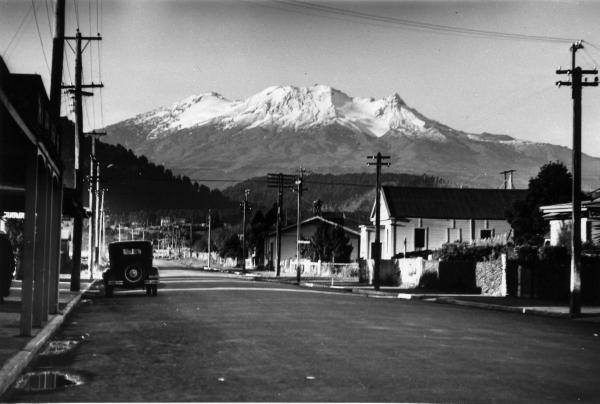
This is more or less how Ohakune looked when I was growing up there in the 1950s - even the old car is right, because in those days people still drove around in Model T Fords and such like.
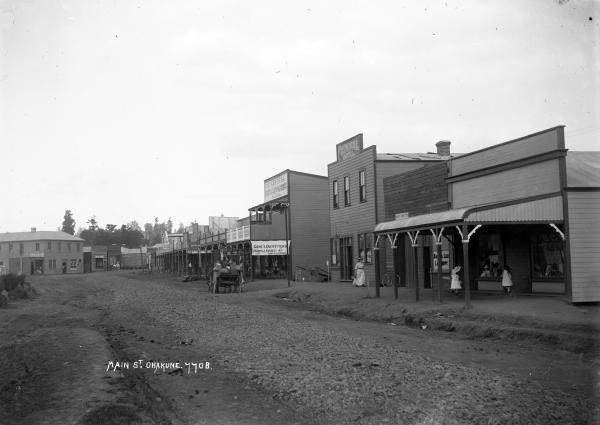
This the actual street I grew up in, our house was away in the foreground from the POV of this shot ... but hardly any of those buildings survived the Great Burns Street Fire of 1917.
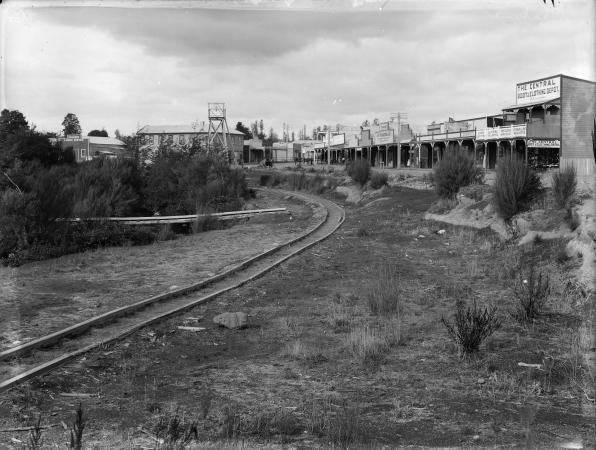
The same stretch from a slightly different POV. That's a stream, the Mangawhero, running parallel to the railway line; it's about to join another stream, the Mangateitei and we lived just below the confluence with our back garden ending at the river's edge.

Waiouru, now primarily a military base, was about twenty miles east of Our Town. This from 1908, just after the railway - the Main Trunk line - went through.
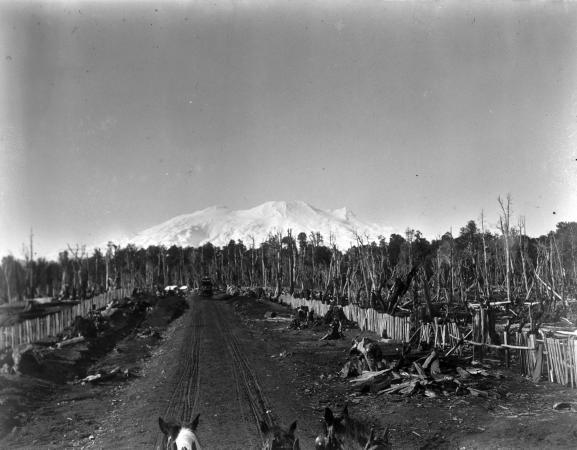
This is just a few miles in the other direction, the main road to Horopito. Photo apparently taken from one stage coach of the other, that shadowy form on the road ahead.
Except for the first shot, the photos are all from the collection at the Alexander Turnbull Library in Wellington, to whom acknowledgement is due.
5.9.05
strolling bones
Spent much of the weekend reading the Greil Marcus book about Like A Rolling Stone and listening to some of the music it's about. Took a break Saturday to meet with an old friend from NZ who was in Sydney to farewell his daughter, off to Europe. Neil's a bass player, an old Red Moler like me. He told me a Dylan story: a friend of his worked on the road crew of The Never Ending Tour for three years. He was told at the beginning to stay out of Bob's way so he did. One day about eighteen months into the gig, backstage he was doing what he was doing when he happened to pass by Bob, just hanging out. Bob said: Hi, I'm Bob. You're doing a good job there. This brief encounter was followed by another eighteen month's silence ... anyway, came home to a telling bone call from another old friend raving about the new Rolling Stones album. Best since Exile on Main Street he said, in the youthful tones of one for whom no time has passed. And I thought, playing yet again a wonderful soul version (don't know yet who by?) of Gotta Serve Somebody off the sound track to Masked and Anonymous, yep, and how lucky are we to have these particular bones to stroll along with?
4.9.05
welladay
It was out west not so very long ago, a blue day, Sunday. We'd been to the jail, then we'd gone into town. There was a fair in the main street, stalls selling all manner of manufactured items as well as natural pieces like little plastic bags of jewels for fifty cents. We had lunch in a hotel called the Fitz and then browsed the market; later we stopped in at a place down the other end of the strip for coffee. It was afterwards, walking past high colonial brick walls towards the muddy river, that I said: You're a dragon, aren't you? and she said No, I'm a snake ... looking at that moment so authentically ophidian my heart turned over inside me, full of wonder and longing. Then we saw behind a dusty window of the museum a taxidermed cobra all dry and raggedy and long-gone coiled up there. Beside the brown river we returned to the car under wattles in bloom and I said it's unlucky to bring wattle into the house and she said well, she wouldn't ever do that again. And, thank you. On the drive back we stopped to buy apples and mandarins and avocados and garlic and zucchinis at a roadside shop. When the trip was over and we were saying goodbye I couldn't hide that I was feeling delirious. At the end of the hallway was the park. A distant sound of children's voices, barred light under a golden sky. Since then, it's been a month of Sundays.
3.9.05
a change gonna come
yeah, what the signs say is high pedestrian activity, with pictures: solo gal, solo guy, coupla kids, old bloke ... hmmm, knew I was high but these others? high on the signs? augurs well ... will look differently hopefully at my fellows when these changes are instituted, monday, 5th. &, it's raining.
2.9.05
the big toughie
Sometime in the mid 1970s I came across, in the Wellington Public Library, Karl Kraus' The Last Days of Mankind, published in Vienna between the wars: a play to be performed on Mars was how Kraus described the 800 page dramatic work which was recently (April, 2004) read in New York. I couldn't make much sense of it so I handed it on to my mentor and friend, Alan Brunton, who must have returned it to the library after he read it, because I never got an overdue notice for it. That was the era of the Red Mole cabarets at Carmen's Balcony so I guess the text was apposite. A few years later we were driving across the United States on a three day speed binge on our way to the Theatre for the New City in Manhattan, where a Red Mole show of the same name was about to open. I say we: a band of musicians travelling as Red Alert; they were music for the Last Daze and I was the lights. Somewhere past Kansas we learned that a major crisis was unfolding at Harrisburg, PA, the nuclear reactor on Three Mile Island was melting down. There was talk of evacuating the Tri-State Area and I recall clearly a voice on the radio saying: It is not possible to evacuate 11 million people, there is nowhere to evacuate them to ... Well, it didn't happen, not then, but it has happened now. Once more we are seeing the future unfold before our eyes. Tautologically again. The tsunami in the Indian Ocean was one thing, this is another; they are harbingers, there is more and worse to come. After that season of the Last Days in New York there was a power blackout in the city that lasted not very long but long enough for a lizard sense of survival of the meanest to slither abroad on Broadway. What is going on on the northern shores of the Gulf of Mexico is in one sense unimaginable but in another has been over-imagined. We know what is happening. We know our agency in all this. We know the consequences, have known for a long time. What we don't know is ... how to stop. Perhaps we can't stop until we are stopped ... ? So strange to walk outside and see Venus and Jupiter on a pas-de-deux in the Prussian blue sky, to smell the sweet scent of the night sweet rising, hear the voices of friends in the street calling Thanks and Goodnight ... the magnolia ... now I think of these lines:
Seen the arrow on the doorpost
Saying: This land is condemned
All the way from New Orleans
To Jerusalem ...
Seen the arrow on the doorpost
Saying: This land is condemned
All the way from New Orleans
To Jerusalem ...
1.9.05
La Intrusa
Among my books there is a slim paperback called Fictions by Jorge Luis Borges. Published by Jupiter Books, an imprint of John Calder Ltd, in London in 1965, it is edited with an introduction by Anthony Kerrigan who made most, though not all, of the translations. The book is in two parts: The Garden of Forking Paths, 8 stories (1941); and Artifices, 9 stories (1944). There's a short prologue by Borges, from the Spanish edition, to each part ... I took this book down from the shelves the other day because I could not remember ever having bought or owned it: my Borges was, I am sure, a Penguin, unaccountably lost somewhere in the labyrinth of the past. Yet this volume has my name on the fly leaf, in a version of writing I recognise as the hand I used in the 1980s, next to the pencilled price of the book: 95 cents, which must be from at least a decade earlier. Of course I sat down to read it because, though Borges is constantly evoked by myself and others, I have not actually read him for a long time ... I had forgotten how rich his writing is, how funny, how beautiful and strange: take the first words of The Circular Ruins: No-one saw him disembark in the unanimous night ... how could you not fall immediately under the spell of such an opening? Yesterday afternoon this book, with its black and white photograph of Borges in profile before a dim shelf of other books on the cover, was lying on the table under the window in the sitting room. Something about the way the light fell across it disclosed hieroglyphic marks impressed into the cardboard. I picked it up and held it slantwise to the declining sun: there, written horizontally across it, in printed capitals, was my mother's name and address at the house where the family lived when I left home early in 1970; and next to it the words: BOOK POST. I recognise the printing as my own, and the era of its use, because I also last week found a box of letters I had sent to my mother and read one, written in late 1970: it was addressed to her in the same style as the impression on this book. Clearly, I bought and sent it to her in that year. Quite when and how it returned to me, I do not know, but that must have been the time I inscribed it with my name ... it would not surprise me if she gave it back, the work could not have been to her taste and she may not even have read more than a few pages. And anyway I would not have given it to her because I thought she would like it, rather, the gift would have been a reflection of my own taste, a proclamation, even a polemic. It is even possible that I took it myself from her shelves on some unremembered later occasion ... I have two other Borges books, a series of lectures he gave over seven consecutive nights in Buenos Aires in 1977, called Seven Nights, and Conversations with Jorge Luis Borges by Richard Burgin, a young American who spoke to the Master at Harvard during his tenure there in 1967-68. Opening the second book at random this morning I came across this passage: ... I wrote it about a year ago and I dedicated it to my mother. She thought the story was a very unpleasant one. She thought it awful. But when it came to the end there was a moment when one of the characters had to say something, then my mother found the words ...
Subscribe to:
Comments (Atom)

