20.7.05
ultra montane
Friday morning I fly to Wellington for five days. To attend the Montana New Zealand Book Awards next Monday night. Chronicle of the Unsung is a finalist in the Biography section (even though it is not a biography) which, I am told, includes Memoir (it is not a memoir either). Selection as a finalist obliges a publisher to transport their author to the ceremony, hence my trip. If I win my category I get a cash prize of $5000.00, almost the exact amount I have gone into (private) debt over the course of this year so far; all category winners get to compete for the Montana Medal for Non-Fiction, which, apart from the gong, carries a cash prize of an addiitonal $10,000. With that money I could also pay off my tax debt and probably live through until Christmas without having to drive a cab. However. I've been to these things before and know it does not do to get your hopes up. The first ceremony I was at I expected nothing and got something; the second I expected something and got nothing; how will I comport myself this time? I don't know ... by trying to defuse consequences perhaps; like driving a taxi, opening myself to the possibilities while at the same time knowing that, most likely, in the words of the Tall Dwarf's song, Nothing's going to happen ...

19.7.05
The Call Up
It's taken a while but I've finally discovered filesharing, specifically LimeWire. Where untold riches are just a click or two away. Now I can go about recovering all the lost songs, as well as finding all those other songsters I never knew about before. Like bluesman Kelly Joe Phelps. Or dread masters Peter Broggs and Ken Boothe. Or the post-Clash work of Joe Strummer with the Mescaleros, which I knew about but had never heard. And The Mekons, whose song Ghosts of American Astronauts has haunted me for years. And much, much more. The only limit is that my provider places on downloads but there will be ways around that, too.
When the bombs went off on the Underground ten days ago I started hearing The Clash anthem London Calling in my head and went online to find it. That led me on to their extraordinary six side, 36 song set Sandinista!, which I used to own on vinyl but, not having a system to play it, let go earlier this year. And from there onto Broggs and Boothe et al. Wonderful. My own little cd factory because I still prefer to play music away from the computer. It is as if I have once again intersected with a parallel life that, while it has never gone away, has for long periods been accessible only in memory, not actual auditory presence. This because of changing formats, accidents of fate (like having my record collection stolen from a party by, reputedly, Hells Angels) and, most of all, by the intermittently vagabond life I've led.
I can still remember the moment music came into my life. I was about twelve. It was a Sunday night, I was in the bathroom of the house we lived in, above and behind a chemist shop in Greytown. The radio was playing and I heard, incredibly, Gerry and the Pacemakers sing How Do You Do What You Do To Me? (I wish I knew ... ). Not the first time I'd heard the radio, but the first time it sang to me. It was clear, so clear. The song was not just about and for me, it was for and about everyone I knew and all the things we suffered and desired and hoped for and loved. And that's stayed true, for my g-g-g-g-g-generation as well as those pre and post ...
Anyway, my revisiting of The Clash has given back one of my favourite songs. I haven't yet learned how to link to music (but I will, I will) so in lieu of that I'll just, because they seem still entirely relevant and resonant, quote the lyrics:
It's up to you not to heed the call up
You must not act the way you were brought up
Who knows the reason why you have grown up
Who knows the plans or why they were drawn up
It's up to you not to heed the call up
I don't want to die
It's up to you not to hear the call up
I don't want to kill
For he who will die is he who will kill
Maybe I want to see the wheatfields
Over Kiev and down to the sea ...
All the young people down the ages
They gladly marched off to die
Proud city fathers used to watch them
Tears in their eyes ...
There is a rose that I want to live for
Although God knows I may not have met her
There is a dance and I should be with her
There is a town unlike any other ...
Refrain
Who gives you work and why should you do it ...
Fifty-five minutes past eleven ...
There is a rose ...
Fade out with refrain and chant:
Hup, two, three, four, I love the Marine Corp ...
17.7.05
New Holland Honeyeater

Was visited the other morning by one of these ... it flew into the jade trees by the front door and pretended to be seeking food until it was sure I had seen it. Then it flew away, only to return quite soon after for another look: the bird looking at me looking back at the bird looking ... Came and perched so close I could almost have reached out a hand to touch it, although I didn't try. I've only ever seen these in the wild before - in the Royal National Park to the south of the City, where they are common in the hilltop scrubland, and, less often, in the bush on the Hope Range behind Pearl Beach: so what was it doing here? With a chirp and a flirt it flew off into the medium sized gum that stands, flowering now, in front of this building and began probing the lemon-yellow sprays with its black shiny beak. I felt appropriately informed. Grateful for the encounter. And lighter too, as if the contemplation of a busy inquisitive bird might mean an increase of potential in the hollow bones of flight.
13.7.05
quardle oodle ardle wardle doodle/the wattle said

Driven half crazy today by my inability to solve a relatively simple writing problem - this can happen after a bad night's sleep, as last night's was - then fully crazy, first by a building inspector who wandered through the flat throwing his biro at the ceiling (apparently a test of structural integrity), then, again, by a prospective owner who seemed aggrievedly unable to comprehend why I didn't want her poking her nose into the bedroom she will probably throw me out of - I gave up and went for a walk. To the 'heritage suburb' of Haberfield, whose matronly or perhaps gentlemanly Federation houses stand in such contrast to the baroque curiosity of Summer Hill's higgledy terraces and piggledy apartment blocks ... apart from its cake shops and its library, I find Haberfield fairly uninteresting; but on the way there I walked under a flowering wattle tree and was transported, as always, back to early childhood.
In all the long time I've lived in Australia, it's always seemed both odd and oddly comforting that two such ubiquitous features of local flora and fauna - the wattle and the magpie - have the power to take me back to a remote mountain village in 1950s New Zealand ... but it is so. I can't remember where the wattles grew, only that they were not anywhere in our large and beautiful garden, of which I have near perfect recall. Out on Burns Street, running wild? Perhaps. Or in Miss Seth-Smith's extravagantly overgrown acre of hillside with the crumbling gothic mansion at the top? More likely. It is said to be unlucky to bring wattle flowers into the house; but I remember looking at the yellow pollen dust and fallen stamens from their puffball flowerets lying on tabletop or sideboard inside. While their scent, so dry and resonant and cheerful outside, drifted wanly to the walls.
The magpies were wild too, though not all of them. Two doors up from us lived two old brothers called Williams, who drove a Model T Ford and kept two magpies in a small apple box and wire netting cage by their letter box. For whatever reason? These poor birds had gone mad with confinement, and would peck viciously at anything, like a child's finger, that came close to the chicken wire they lived dankly behind. So of course we used to tempt them to do just that and sometimes got slashed. Up the back of the mansion was a cottage rented by a woman with two children - a solo mum we would say now - and she also kept a magpie, trained to call on the hour (I think it was four-thirty) her kids had to be back for tea. But mostly I remember the melodic carolling of the wild birds at dawn, at noon, at dusk, a strange, lost sound that still raises the hairs on my neck.
Magpies were not much liked in Ohakune; they were said to peck out the eyes of new born lambs. Wattle was disregarded when not viewed with outright superstition. We had our own native trees and birds, far superior in grace and subtlety and, well, nativity. But I love them both: the black and white parodic military strut of the maggie, the soft yellow down of the wattle; the operatic song of the one, the nostalgic scent of the other. They give me, in my irredeemably dual nature, a sense of being one, if not exactly with myself, then at least with my then and now. And, let's hope, with the whenever.

12.7.05
sun's going to shine in my back door someday
... well, it already does, but it's going to shine some more. Yesterday sitting out on the front step after returning from taking my sons on the train up the coast - always a melancholy ride back - I saw how the sun's coming this way again from its mid-winter pause in the north. That moment when you see the light gaining always comes with an involuntary surge of optimism. It was a clear blue afternoon and, just for an hour or so, warm enough to throw all the windows in the flat wide open to get the air moving through. I went back out later and saw how some kind of bulb - crocus or narcissus - is pushing up half a dozen green spears through the hard dirt between the slabs of bushrock by the door. And that, although the last pink frilly hibiscus bloom lies browning on the path, the first, also pink, flower on the azalea that grows next to it has opened. Later still I saw the new moon with the old moon in its arms, westering, and, halfway between crescent and horizon, Venus and Mercury side by side - the one blazing on the fading azure, the other an unwavering point of light. And, even later, Jupiter, which I've been tracking since its occultation a few weeks ago, also settling in the west. Was taken by a sense of the physical dimension of where we are: the sun just gone, the planets lined up between earth and sun or between earth and the wilder reaches of space, the moon, much closer, too. And remembered how for much of my adult life I sought just this sense of placement in the larger scheme of things. A sense not to be arrived at by analytical study nor obsessive observation but intuitively, the way we often know the hour of day or night. The way, perhaps, someone who lives a long time by the sea can tell without thinking what the tide, and thus the moon, is doing. A truly archaic sense. I can usually reckon the phases of the moon. I recall more or less where to look for the larger constellations and at what time of year they will be rising or setting. But the planets ... are hard to figure, especially in the light polluted skies of a big city. The understanding (standing under) comes and goes. But, when it comes, it's good ... throw your arms around me like a circle around the sun ...
9.7.05
Letter from the New World
My plight is as I've described it. So far, I have wept my own tears. Now let the skies pity me and the earth weep for me! Of worldly goods, I have not so much a mite for the offertory. Of spiritual comforts, here I am in the Indies, bereft as has been said. I am marooned amid this terrible sorrow; sick, waiting day by day for death; surrounded by a million savages, who seethe with cruelty and hostility towards us; and I am so cut off from the sacraments of holy Church, that my soul shall be forgotten if it leaves my body in this place. I implore the tears of all who love charity, truth and justice ...
Colón, stranded on Jamaica, c. 1504
from Fernández-Armesto, op cit; who adds: He had, he says, been to within ten days' journey of the River Ganges; he had seen the gold-bridled horses of the Massagetes, who dwell near the Amazons; he had narrowly evaded bewitchment by their sorcerers; in Veragua he had discovered the mines of Solomon; now he would go on, not only to recover Jerusalem but also to convert the emperor of China to Christianity. He repeated his claim to have discovered the earthly Paradise ...
7.7.05
Letter to the New World
Our Lord knows how much anxiety I have suffered wondering how you are. So these problems, though I may seem to make heavy weather of them, have been far worse in reality: so much so that they made me weary of life because of the great trouble I knew you must be in, in which you should think of me as united with you. Because although, to be sure, I have been away over here, I left and keep my heart over there, without a thought for any other thing, constantly, as our Lord is my witness; nor do I believe you will have any doubt of it in your heart. For besides our ties of blood and great love, the effects of fortune and the nature of danger and hardship in places far removed embolden and oblige man's spirit and sense to endure any trouble that can be imagined - there or in any other place. It would be a thing of great advantage if this suffering were to be endured for a cause which redounded to the service of our Lord, for whom we ought to labour with a joyful mind. Nor would it be other than a help to remember that no great deed can be accomplished except with pain. Again, it is some consolation to believe that whatever is achieved laboriously is treasured and esteemed far sweeter for it. Much could be said to the purpose, but as this is not the first cause for which you have suffered or which I have seen, I shall wait to speak of it with more time to spare, and by word of mouth.
Cristóbal Colón, from Spain, to his brother Bartolmé Colón in Hispaniola, February (?), 1498
in Columbus, Felipe Fernández-Armesto, OUP, 1991
Cristóbal Colón, from Spain, to his brother Bartolmé Colón in Hispaniola, February (?), 1498
in Columbus, Felipe Fernández-Armesto, OUP, 1991
5.7.05
shhhhhhhh
So ... last night I went to a theatre show at the Studio in the Opera House. Took the train to Circular Quay, leaving in plenty of time because of the notorious unreliability of Sydney Rail ... though I have to say I've only rarely had problems. Consequence was, I got to the Quay about seven fifteen and wasn't due to pick up my ticket until eight. I decided to go looking for a café called Bar Luca I've passed while driving. Because of the name. Wasn't sure exactly where it is but I didn't mind that - there's something about walking the streets I drive so often down, seeing up close and personal the places I flash past chasing dollars. I couldn't find the bar, probably it was already closed, since I think it's an early opener. Not really my kind of place anyway, it's usually full of suits. Coming back down the hill I was amused to find that I'd picked up Lenny's Lawyer (see dérives) outside the Justice and Police Musuem, as if he were some kind of escaped exhibit. I continued up Albert Street, turned into Macquarie and there across the road was an assemblage of stones I'd never noticed before. On a soft green rise on the fringes of the Botanic Gardens are strewn maybe a hundred pieces of intricately - or not so intricately - carved pieces of Hawkesbury sandstone. They have been placed, set into the earth, but not in any arrangement I could discern. In fact they seemed deliberately left in such a way as to suggest no arrangement at all, if that isn't a contradiction. Pieces of a building, or buildings, including a couple of beautifully smooth domes like those that used to grace the old Pyrmont Bridge. I recalled my time at the Caledonian Hotel, a squat on the Point, where I used sometimes to go and sit among the pieces of the disassembled Pyrmont Bridge and look out over the Container Port and the CSR Sugar Refinery hissing and screeching across the dark water. Couple of pieces had the date 1924 inscribed on them and one of these also carried the rubric: YWCA. Is this what is gathered here? Bits of the old Y? I passed on, calling briefly into a gallery to look again at a wonderful Roualt print they have for sale (only six grand!) then on to the show. Which was ... well, what was it? A black light puppet show utilising a range of really very well made and operated puppets, written, produced and directed by an ensemble of young people who call themselves Shh. No dialogue, no spoken word at all, but a sophisticated musical/fx soundtrack precisely cued to the visuals. I know one of the directors, Mischa Baka, quite well, have known him for about ten years now, watching him grow into a confident, proficient and always surprising film maker; but I hadn't seen any of his theatre work before. He's been teamed up for a while now with a Polish born livewire called Michal Imieski, an extrovert to Mischa's introvert. The woman who intro-ed the show emphasised it was made up of fragments, that there was no master narrative ... leading obsessives like me to go looking for one throughout the hour's performance. The event began with seven oblong light boxes on the stage, each showing an outline of a human body. When the lights went down, these were turned to show body parts on another face; then removed. A pile of something lying on the floor resurrected as a life-sized, though very skinny, marrionette which danced a kind of skeleton dance, like a superannuated Pierrot. The theme of body parts continued throughout, as did the ensemble's predeliction for attenuated, ghostly marionettes. Two human figures, a Man and a Woman, passed at intervals, the woman evidently lost, the man a picker-up of fragments of bodies (or anything else) that had fallen on the stage. One sequence, where a man in red danced with one of those white, attenuated marionettes strapped to his front, took my breath away: until her arm fell off I hadn't realised it wasn't another human he was guiding through the moves. Another spectacular set piece was a dance of glowing masks, like death masks illuminated within by red-yellow lights. There was more ... but did it cohere? Well, no. It was more a showcase of talents and tricks than an actual theatre work. That's fine - one of the points of the evening was, precisely, to showcase their work for funding bodies, theatre schools, arts bureaucrats in the audience and in this I believe they were entirely successful. These guys showed they could do anything once they know better what they want to do. As of now, they deserve the room to explore what that could be without the pressure of any commercial (or narrative!) imperative bearing in on them. The finale, beautifully conceived though somewhat clumsily executed, showed the extent of their ambition. The Woman and the Man come downstage with their suitcases, which they open. Out come two light puppets, a large female figure and a smaller male, both irresistibly recalling, to me at least, Hans Bellmer's poupées. In the sequence that follows, during which you watch both puppeteers work and puppets play, the male puppet fails to seduce the female puppet, who in turn successfully seduces the male puppeteer and leads away him into the wings. With her ghostly human counterpart guiding them both ... leaving the male puppet lying there glowing centre stage, a bereft homunculus.
4.7.05
visible mysteries
Te Hikioi was also the name of a newspaper published by the Maori King Movement in the Waikato during the lead up to the invasion of that part of the North Island of New Zealand by British Imperial forces and Colonial Militia in the early 1860s. It ran from June, 1862 until May, 1863 and I seem to remember reading somewhere that the lead type used to set the print was then melted down and made into bullets. A rival newspaper called Te Pihoihoi Mokemoke (The sparrow that sits alone) was set up in opposition to Te Hikioi, putting the government point of view, but it only lasted for four issues (Feb-March, 1863) before the press was captured by Kingites, broken up and the pieces returned north. The Tainui Tribal Federation of the Waikato resumed publishing a paper called Te Hikioi in the early years of this century. One source describes te hikioi as a bird of ill omen but it seems more likely it was understood as a powerful, even totemic force, ominous only to those who opposed it. There are even those who think that Sindbad's Roc is a memory of te hikioi.
There was, and is, another legendary bird known to the Tainui, the Korotangi or crying dove. This bird, carved out of green serpentine which has been sourced to the island of Sulawesi, was discovered under the roots of a tree on the west coast of the North Island, near the site of the landfall of the Tainui canoe to which the Waikato tribes trace their origin. Some say the Korotangi came on the Tainui; others suggest it was brought ashore with some prehistoric wreck on that wild shore. Like the Tamil Bell, which is inscribed with characters from that language, the Korotangi seems to hark back to an era of pre Anglo-Dutch voyaging to those parts. Portuguese ships out of Malacca were crewed by all sorts of sailors, including Tamils and, perhaps, Bugis from Sulawesi. It is not impossible that native craft from Indonesia were blown across the Tasman from an Australian shore, as one of Cristoval de Mendonça's caravels may have been in the 1520s. The persistence of a red-haired, pale-skinned type (urukehu) among Maori has been ascribed to the survival ashore of Iberian sailors ... and so on.
Both the Korotangi and the Tamil Bell are held in Te Papa Tongarewa, the National Museum, in Wellington; with the so-called Spanish Helmet, dredged up in Wellington harbour, they make a triumvirate of visible mysteries to trouble the Aotearoan historical imagination.
3.7.05
harpagornis/hokioi

This bird, the Hokioi, was seen by our ancestors. We (of the present day) have not seen it - that bird has disappeared now-a-days. The statement of our ancestors was that it was a powerful bird, a very powerful bird. It was a very large hawk. Its resting place was on the top of mountains; it did not rest on the plains. On the days in which it was on the wing our ancestors saw it; it was not seen every day as its abiding place was on the mountains. Its colour was red and black and white. It was a bird of (black) feathers, tinged with yellow and green; it had a bunch of red feathers on top of its head. It was a large bird, as large as a Moa. Its rival was the Hawk. The Hawk said it could reach the heavens; the Hokioi said it could reach the heavens; there was contention between them. The Hokioi said to the Hawk, "What shall be your sign?" The Hawk replied, "Kei" (the peculiar cry of the hawk). Then the Hawk asked, "What is to be your sign?" The Hokioi replied, "Hokioi-hokioi-hu-u." These were their words. They then flew and approached the heavens. The winds and the clouds came. The Hawk called out "Kei" and descended, it could go no further on account of the winds and the clouds, but the Hokioi disappeared into the heavens. "Kei" is the cry of the Hawk. "Hokioi-hokioi" is the cry of the Hokioi. "Hu-u" is the noise caused by the wings of the Hokioi. It was recognized by the noise of its wings when it descends to earth.
Description of the extinct gigantic bird of prey Hokioi, by a Maori; communicated to Sir G. Grey; Wellington Philosophical Society, 23rd October, 1872. The side illustration shows the Hikioi's claw beside that of its near relative, the Australian Little Eagle
2.7.05
Nine Views of Gotham City
Saturday ... was sunny and blue this morning after a week of rain but now has gone sullen and grey again. Talking to a friend on the phone last night I learned that today was the last day of Tom Carment's latest show over in Danks Street, Waterloo. I haven't missed a show of Tom's for quite a few years now so I'm glad to have got to this one too. He used to exhibit in dealer galleries but now he hires the space himself and hosts it too, so I figured he'd be there today - and he was, along with his partner Jan. Dunno where their kids were, apart from in the portraits on the walls. I wrote three books in a small writing room under Tom and Jan's kitchen where they still live in Womerah Lane, Darlinghurst, in the 1990s. I remember the dust that used to fall across the keyboard of my Amstrad as someone crossed the floor above, the sound of the Playschool theme coming from the television when their eldest boy, Felix, came home in the afternoon, long happy conversations with Tom about books and painting. He had a studio next to my room for a while but he was more likely to be found writing than painting in it - he's always painted en plein air and still does. He told me today, with a characteristic glint of slightly mad enthusiasm in his eye, that he now carries his watercolour pad and paints with him everywhere. In contradistinction to the grandiosity that has afflicted much painting in recent years, Tom's work has stayed small. I find that somehow estimable. Sometimes I think there is more going on in one of his sea or landscapes, his portraits of people or buildings, than in any number of more impressively sized works. Tom's work registers detail nervously as it occurs in front of him. Though not old fashioned, he's a traditionalist and you can see in his work passages of paint that are reminiscent of Australian painters like Arthur Streeton or Fred Williams, as well as more obscure names. These homages, if that's what they are, are accomplished effortlessly, gracefully, they come simply out of Tom's long practice as a painter and his lifetime of looking at both his subjects and the work of his fellows. I enjoyed all the work on show today but my favourites were probably the portraits of Sydney buildings like the nine panels of Adereham Hall, better known as Gotham City, in Elizabeth Bay or the various versions of an unrenovated boarding house in Moore Park.
... for some reason blogger won't link this post to Tom's website so if you want to see what his work looks like, go to:
http://www.tomcarment.com/index.php
... for some reason blogger won't link this post to Tom's website so if you want to see what his work looks like, go to:
http://www.tomcarment.com/index.php
29.6.05

Yesterday
... was the anniversary of the death of Alan Brunton and also of my sister Rachel. But the day began with news of another death, that of Thelma Clairmont. She was 85, or thereabouts. I got to know Thelma quite well while researching and writing a book about her son, Philip, an artist, with whom she was completely obsessed. It's not too much to say she lived only for him and, after his own death in 1984, for his memory. The curious thing about this obsession was that it required her to ignore what his work was actually about. I don't want to go into all that here, suffice to say, perhaps, that although she worshipped his art, in her house she only ever had photocopies of it on her walls. Thelma once tried to make me promise to write my book without mentioned drugs or the police. I said I couldn't do that - both were intrinsic to the story - and at that moment knew the book would end our relationship. So it proved. I received a nine page letter from her after she had read and then burned it (there had been many, many earlier letters) in which she said she would never speak to me again as long as she lived. And she didn't. I had joined the long list of enemies: of art, of promise, most of all of Philip, by which she meant herself. She subscribed absolutely to an heroic, romantic view of the artist as misunderstood genius, whose virtues included purity of heart, greatness of soul, an intellect that was unfathomable to ordinary mortals. She was herself, in this version, the fount of these qualities. Phil spent much of his life deconstructing this heroic myth while remaining in some sense helplessly bound to it. I liked Thelma for her irreverence, her courage, her amazing energy, her commitment; I'm sad to think she's gone and I wish there could have been some reconciliation between us while all the time knowing that such a thing was, as she herself was, impossible.
26.6.05
stranger

Walked out this morning into the garden to see a flock of silver eyes grazing the micro life in the bottle brush bush outside the window of this study. Sometimes they're called wax eyes. A small green bird with a white ring around the eye. You get them in New Zealand too, as well as on many other islands in the Pacific. Their Maori name is tauhou, which means stranger; and thereby hangs a tale. The bird was unknown in Aotearoa until the middle of the 19th century, when a few individuals arrived, apparently blown across from Australia. They are now ubiquitous, to the extent that I was surprised and excited, not long after I arrived here, to find a 'New Zealand bird' in Oz. It was of course the other way round. Hence the name.
I knew other Australian birds for what they were: the magpies that are everywhere there, the kookaburras you find in North Auckland, the caged birds like cockatoos and cockatiels; and after a few years living here I thought I detected similarities between birds that are endemic here and native over there. Some of the Australian honey eaters have cries that resemble the harsher register of their New Zealand equivalents. Some of them have wattles like that strange family of New Zealand wattle birds, which includes the huia, the kokako and the tieke. There are scrub birds down in the Royal National Park south of Sydney which, to the casual eye, look a lot like bellbirds, although they don't sing like the korimako.
And then there are the parrots: the kakapo, the kea, the kaka, the kakaariki, which, except for the last, do not really resemble any of the individual species in the wonderful profusion of Australian parrots; yet that just might mean they were blown across the Tasman Sea a longer time ago than the tauhou, say, or more recent arrivals. Because when I was in Auckland last year, I learned that at least two more strangers have crossed the water. One, the rainbow lorikeet, appear to have been deliberately released over there; the other, the Sydney spotted dove, might too. I don't know.
They could hardly be more different. The lorikeet is brilliantly coloured (it has a purple bill), loud, aggressive and intolerant. The spotted dove is delicately plumed, shy, beautiful, with a pink breast and a black and white checkerboard pattern on the sides of its throat. Yet you always know when they are around because of their insistent, throaty, repetitive call. Temperamentally, you might be tempted to say the lorikeet is typically Aussie, the dove the ideal of what a New Zealander is like. Except that's really nonsense. We only exist, after all, in the exchanges we make with others; what is strange to you is familiar to me; and vice versa.
And in both countries the common owl, bobook here, ruru there, is also called morepork.
25.6.05
the company of birds
For some reason Mark Young's luminous post on augurous birds triggered a childhood memory. A pack of cards we had. I don't know what game was played with these cards; I don't recall what they had on their backs either. But on the front they featured colour pictures of New Zealand birds - the tui, the kereru, the huia, the kokako, the kea, the kakapo, the kiwi and many more. Perhaps it was one of those games where you make pairs? Anyway, these cards were large format, more like a Tarot deck than playing cards, and the illustrations were very high quality, with a soft depth, iridescence and refulgence in the colour that you just don't see any more. I loved these cards. Not to play with, just to look at. I used to spread them out on the floor and gaze at them for timeless hours. Their loss - unlike so much else from that faraway childhood - I still mourn. They were precious. They were also the source or inspiration for my lifelong interest in watching what birds get up to. Not in any obsessive way, I'm not a twitcher, I just have always thought of birds as companions and acknowledged that in my relations with them. This may have something to do with having grown up in Aotearoa/New Zealand.
When humans first arrived in Aotearoa, they found a place without land mammals of any kind, with the exception of two varieties of bat. Polynesians brought with them the kuri, a dog, and the kiore, a rat, both of which were used as food. For some reason two staples of Polynesian life, the chook and the pig, never made it. It didn't matter: those early arrivals found a strange place where most ecological niches had been filled by birds. The top predator was an enormous eagle that preyed upon the top grazer, the moa, a flightless bird a bit like an ostrich which came in all sizes from huge down to merely goose sized. There were carnivorous parrots, ground dwelling parrots, burrowing sea-birds that shared their homes with an ancient suriving dinosaur, the tuatara and many other marvels. Most varieties of bird had developed giant forms and these were quickly hunted to extinction by those early future eaters. The giant eagle died when its prey, the giant moa, was gone. What was left, was, mostly, songbirds. Birds of extreme and subtle beauty of plumage, which I will not even try to describe and, concomitantly, birds who sang beautifully: notably the bellbird, or korimako, whose massed dawn choruses are spoken of with wonder by those who have heard them.

Of the birds that remained after those early extinctions, the one most prized by Maori was the huia, a forest dweller whose white tipped tail feathers were used as insignia by the high-born. The huia is also extinct, but it disappeared almost within living memory, a casualty of shrinking habitat and human profligacy, in this case of European collectors who shot the chiefly bird with insoucient abandon throughout the 19th century, so as to preserve specimens of it. In my youth I used to mourn the huia like I now mourn those lost cards, and fantasise that someday, in some forgotten pocket of bush, a breeding pair would be found again. This seems unlikely. However, among my books is a de luxe edition of Buller's Birds of New Zealand which my mother gave me many years ago. The coloured plates in this book, including a very lovely pair of huia, are as beautiful as those cards in my memory, and I sometimes try to persuade myself that the cards were in fact only a portable version of Buller. But it isn't so; they were different pictures, more homely perhaps and anyway there was something marvellous about the way you could actually handle as well as look at them. And they presaged - what? Hard to say, beyond a lifetime of pleasure in the company of birds.
When humans first arrived in Aotearoa, they found a place without land mammals of any kind, with the exception of two varieties of bat. Polynesians brought with them the kuri, a dog, and the kiore, a rat, both of which were used as food. For some reason two staples of Polynesian life, the chook and the pig, never made it. It didn't matter: those early arrivals found a strange place where most ecological niches had been filled by birds. The top predator was an enormous eagle that preyed upon the top grazer, the moa, a flightless bird a bit like an ostrich which came in all sizes from huge down to merely goose sized. There were carnivorous parrots, ground dwelling parrots, burrowing sea-birds that shared their homes with an ancient suriving dinosaur, the tuatara and many other marvels. Most varieties of bird had developed giant forms and these were quickly hunted to extinction by those early future eaters. The giant eagle died when its prey, the giant moa, was gone. What was left, was, mostly, songbirds. Birds of extreme and subtle beauty of plumage, which I will not even try to describe and, concomitantly, birds who sang beautifully: notably the bellbird, or korimako, whose massed dawn choruses are spoken of with wonder by those who have heard them.
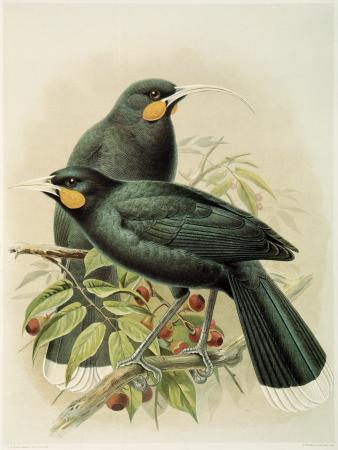
Of the birds that remained after those early extinctions, the one most prized by Maori was the huia, a forest dweller whose white tipped tail feathers were used as insignia by the high-born. The huia is also extinct, but it disappeared almost within living memory, a casualty of shrinking habitat and human profligacy, in this case of European collectors who shot the chiefly bird with insoucient abandon throughout the 19th century, so as to preserve specimens of it. In my youth I used to mourn the huia like I now mourn those lost cards, and fantasise that someday, in some forgotten pocket of bush, a breeding pair would be found again. This seems unlikely. However, among my books is a de luxe edition of Buller's Birds of New Zealand which my mother gave me many years ago. The coloured plates in this book, including a very lovely pair of huia, are as beautiful as those cards in my memory, and I sometimes try to persuade myself that the cards were in fact only a portable version of Buller. But it isn't so; they were different pictures, more homely perhaps and anyway there was something marvellous about the way you could actually handle as well as look at them. And they presaged - what? Hard to say, beyond a lifetime of pleasure in the company of birds.
23.6.05
Ten Questions ... & the Answers
Which are the most numerous, the living or the dead?
The living, because the dead are not at all.
Does the earth or the sea produce the largest beasts?
The earth, for the sea is but a part of it.
Which is the cunningest of beasts?
That which men have not yet found out.
What argument was used to Sabbas to make him revolt?
No other than that he should either live or die nobly.
Which is the eldest, night or day?
Day is eldest, by one day at least.
What should a man do to be exceedingly beloved?
He must be very powerful without making himself too much feared.
How might a man become a god?
By doing that which it is impossible for men to do.
Which is stronger, life or death?
Life, because it supports so many miseries.
How long is it decent for a man to live?
Till death appear more desirable than life.
Then Alexander turned to the tenth man and asked his judgment of these answers.
All I can determine, said he, is that they have every one answered worse than another.
Nay, said the king, then you shall die first, for giving such a sentence.
Not so, O king, replied the gymnosophist, unless you said falsely that he should die first who made the worst answer.
In conclusion he gave them presents and dismissed them.
22.6.05
Alexander's Ragtime Band
There's an aspect to Plutarch's Life of Alexander that suggests a group of young men roistering through the world, as young men in their twenties like to do. This is charming in its way, also shocking, as the casual brutalities unfold. The consciousness of divinity does not belong alone to those fathered by a god, but to anyone experiencing the immortality of youth. The tone changes after he turns back from India, after he does not cross the Ganges but makes the melancholy return to his ungovernable empire. It can be sensed already in his questioning of the Gymnosophists, who each, under pain of death, return elegant paradoxes to his queries: Who are more numerous, the living or the dead? The living, because the dead are not at all ... The Ten Gymnosophists (Indian philosophers) accompany the Emperor on his seven month voyage down the rivers to the sea, after which Alexander returns to Mesopotamia by land while his admiral, Nearchus, goes by sea along the desolate coasts of Sind. After Admiral and Emperor are reunited:
Here his admiral, Nearchus, came to him, and delighted him so with the narrative of his voyage, that he resolved himself to sail out of the mouth of the Euphrates with a great fleet, with which he designed to go round by Arabia and Africa, and so by Hercules's Pillars into the Mediterranean; in order for which he directed all sorts of vessels to be built at Thapsacus, and made great provisions everywhere of seamen and pilots. But the tidings of the difficulties he had gone through on his Indian expedition, the danger of his person among the Mallians, the reported loss of a considerable part of his forces, and a general doubt as to his own safety, had begun to give occasion for revolt among many of the conquered nations, and for acts of great injustice, avarice, and insolence on the part of the satraps and commanders in the provinces, so that there seemed to be an universal fluctuation and disposition to change ...
Which suggests, among other things, that in the 4th century BCE (or at least in the 2nd century CE) people already knew what da Gama would 'prove' a millennia and half later. But that melancholy ... not so much that there were no worlds left to find as that no one, howsoever 'great', can go on forever. What to do? This was his not unparalleled solution:
... he could not refrain from leaving behind him various deceptive memorials of his expedition, to impose on aftertimes, and to exaggerate his glory with posterity, such as arms larger than were really worn, and mangers for horses and bridles above the usual size, which he set up, and distributed in several places ...
21.6.05
Alexander in Babylon
"When once Alexander had given way to fears of supernatural influence, his mind grew so disturbed and so easily alarmed that, if the least unusual or extraordinary thing happened, he thought it a prodigy or a presage, and his court was thronged with diviners and priests whose business was to sacrifice and purify and foretell the future. So miserable a thing is incredulity and contempt of divine power on the one hand, and so miserable, also, superstition on the other, which like water, where the level has been lowered, flowing in and never stopping, fills the mind with slavish fears and follies, as now in Alexander's case. But upon some answers which were brought him from the oracle concerning Hephaestion, he laid aside his sorrow, and fell again to sacrificing and drinking; and having given Nearchus a splendid entertainment, after he had bathed, as was his custom, just as he was going to bed, at Medius's request he went to supper with him. Here he drank all next day and was attacked with a fever ... "
20.6.05
Reading Simon Schama's Hang-Ups, subtitled Essays on Paintings (Mostly), I'm impressed by his perceptive, generous and undogmatic views of artists as various as Vermeer and Chaime Soutine. As you would expect of an historian, his biographical sketches of the painters he reviews are excellent; perhaps less expected is the brilliance of his insights into the works; but the best essay in the collection that I've read so far is about Christopher Columbus. Written for the quincentennial in 1992, this surveys most of the recent literature on the navigator and revises it in terms of another view entirely: not a man with a vision of a New World at all, but a religious maniac obsessed, like the Crusaders, with the recovery of Jerusalem and the re-occupation of the Holy Land. Schama suggests Colón's quest for the riches of the East was never for its own sake but in order to undertake yet another crusade into Palestine. He wanted to re-build the Tomb of Solomon and sought jewels and gold for the specific purpose of adorning the sarcophagus. His religious obsession extended to himself and particularly to his name: he was the Christ seeker, the populator who would bring the heathen into the fold of the Church, and the Dove of Peace foretold in the Bible. He also thought his Voyages would inaugurate the Last Days. As he wrote to Ferdinand and Isabella in 1500, in the Letter which acts as a preface to his Book of Prophecies: I was not aided by intelligence, by mathematics or by maps. It was simply the fulfillment of what Isaiah had prophesied.
There's a resonance here with another book I picked up at the weekend - literally, it was in a pile outside the Summer Hill St. Vincent's de Paul and I was unable to resist taking it, along with a copy of Gray's Anatomy - that is, a Modern Library edition of Plutarch's Lives in a version overseen and perhaps partly translated by Dryden, then revised by the Victorian Arthur Hugh Clough. I turned straight to the Life of Alexander who was, like Colón, convinced he was the instrument of destiny and tended to regard his own acts, self-consciously, as expressions of divine fate. His father, he believed, was not Philip of Macedonia but a god, variously identified as Apollo, Jupiter and Ammon; the snake found sleeping in his mother Olympias's bed was said to be an avatar of this god, thereby abating Philip's passion for his wife. Alexander's famous visit to the Temple of Ammon in Egypt just after he had laid out the City of Alexandria was to ask a direct question about his paternity of the god; and he swore never to divulge the answer he received to anyone but his mother. Because of his early death in Iraq, was it? (I haven't got to that bit yet) I don't think he ever did.
These religious madmen who attempt and sometimes succeed in conquering the world might seem quaint and somehow faraway, if it weren't the case that they are still very much with us ...
18.6.05
... in beautiful dreams
Last night's dream made me remember a book from my parents' library. It was a disintegrating Faber & Faber paperback with an orange cover called An Experiment With Time by J. W. Dunne. Whether the 1927 original edition or, more likely, the 1945 expanded edition, I'm not sure ... it disappeared long ago now, gone to dust. I read it in my mid teens I think and got very excited. Dunne was a British engineer, perhaps an aeronautical engineer, and a mathematician. He travelled a lot, was in South Africa during the Boer War. He was subject to vivid dreams, particularly dreams of disasters - volcanoes exploding, ships sinking, planes crashing - and at some point began noticing correspondences between his dreams and real events. Sometimes these were events that had occurred before his dream of them, but which Dunne himself, usually via a newspaper, only found out about afterwards. Being of a sternly scientific mind, he refused to believe in the possibility of astral travelling and such like, preferring to concentrate his attention upon working out a methodology by which he could study this apparently precognitive phenomenon. He trained himself to remember his dreams and began keeping meticulous records of correspondences, not just with future events, but with past ones too. What he discovered astonished him: that in his and others' dreams (he later extended his inquiries to his family, friends and associates), there was a measurable proportion of dream events with a relationship to real events and that this proportion was the same for both future and past events. His conclusion was that during dreams our consciousness literally expands, so that the present as we perceive it waking, a kind of momentary continuum through which we move, becomes day wide, or week wide, or wide enough to encompass events a year either side of where we are. This stretching of time in dreams, like the widening of a lens, naturally includes the past as well as the future in its ambit. As I recall, the later part of the book became too abstruse and technical for me and I seem to remember Dunne asserting that his theory of regression was itself a mathematical proof of the existence of God; but I've carried with me ever since his notion of the widening consciousness of dreams, not as dogma but as working hypothesis. For that dream last night told me more than I have yet dared to say ...
only in dreams
Last night I revisited an island I have been to before, but only in dreams. This island, which I know quite intimately now, does not correspond to any real place I have ever been. Nor does it appear to be made up syncretically of details of real places I have been. I never know how I come to be on the island, nor how I might leave. The only shores I see are the northern shores, towards which I am always making my way. I did not realise until last night that there are thermal springs there ... on another visit I remember travelling north in fear of wild animals, as if the island were somewhere off the coast of primordial Europe, but last night they were absent; instead, it was a festive time, people celebrating, going to the beach, exploring, eating and drinking. My children were there, friends and, by the end, my whole birth family in a happy ensemble. There is far more detail than this, of course, but I will not relate it because, as we all know, there is nothing more boring than listening to prolonged narrative accounts of other peoples' dreams. This is probably because it is very difficult to convey the emotion(s) of a dream, intensely and entirely idiosyncratic as they are.
No, what intrigues me is the existence of this particular place as an aspect of my consciousness - for what else could it be? The island of the dead? Is that why my father and mother and sister were there? An island of the blest perhaps? So it felt last night, though not always before. And if I think hard about it, the landscape was different, more antipodean perhaps, than on previous occasions; yet the geography, the map if you like, was the same, to the extent that I could choose to take another fork in the road on my journey north, go to another shore than that I visited last time. This because I was looking for my sons, who had gone ahead without us; and I did not think they would have been at that other beach. And I was right too, for we found them soon after, near the estuary. And then went back to the reunion. For this dream always ends with a return.
Now, thinking about it, I want to make that return. But I can't. It is a place to which I can be transported only involuntarily. It will wait there, wherever there is, for weeks, months, years until I am allowed (until I allow myself?) - what? Latitude? Permission? Or is it grace?
16.6.05
A jet flies in front of the sun, darkening my world. I call it Alexander, imagining, in the instant before light returns, that I am a Diogenes. Alexander goes on to occlude other worlds than mine. Later that evening I see the pinpoint that is Jupiter near the convexity of our moon and realise the moment of its occultation has passed without my observation. It will disappear on the dark side, said Dr Lomb. No matter, since it has surely reappeared. Was it then, as sister planet occluded gas giant and worlds seemed to but did not collide, that someone skimmed my bank account of all the little it contained? Was that when the violation occurred? Man’s luck is found in strange places, said Pelsaert to two criminal Dutchmen he marooned on the West Australian shore, circa 1629. When you think that you’ve lost everything/You find out you can always lose a little more … sings Dylan. Premonitory words I’ve been entertaining for a while. If I could have got them out of my head would the disaster (= unfavourable aspect of a star) not have happened? Is it even a disaster? At the bank they are sympathetic but powerless to help. I must report the fraud to the police so as to get a case number for the counter claim. It will take twenty-one days. The policewoman says: Fill out this form. Do you have a pen? I ask. No, she says. She rummages through a drawer and comes up with a green one. I write my stat. dec. in bilious ink. Later, waspishly: We’re only following procedure. Everyone gets treated the same. I know, I reply, knowing it isn’t so. But the stars are indifferent. The planets too … or are they? My horoscope for that yesterday says: Power plays are going on around you and your working life is now in the hands of brokers. Learn the subtle art of manipulation ... Today’s egregious suggestion is that I should try to see the positive in the situation. I’m not sure if I can. I need to be Diogenes for longer than the pause of an Alexander. When power confronts thought, is it always just a passing shadow? When thought encounters power … what? Jupiter hangs now yellowy and pendant to the boneyard moon. Stars glitter in the cold air. Planets shine, I recall, stars pulse. The moon waxes. Then it wanes. I would like to think that there will be a reckoning.
Memory ...
Memory is the only paradise we cannot be expelled from ... ascribed to Jean Luc Godard in the previous post, may not have originated with him. I came across it in Alan Brunton's script Grooves of Glory, published by Bumper Books, with two other performance scripts, in a book of the same title in 2004. But a Google search suggests it was the German writer Johann Paul Friedrich Richter, usually known as Jean Paul, who said it. Alan may have deliberately mis-ascribed the quotation, which occurs in dramatic dialogue. Or Godard may have been quoting Richter, with or without acknowledgment. Provenance aside, what does it mean? It came into my mind, perhaps, because of something David Hilbert wrote: No-one shall expel us from the paradise Cantor has created for us. Both remarks are full of irony. Cantor's mathematical paradise, while certainly fruitful for those who have continued his work, is vertiginous, intoxicating, fearful, enigmatic, in about equal degrees for the lay person. Memory as a paradise may be similarly described. We can be both tortured and exalted by things we recall. And isn't memory itself a record of something already gone, a paradise lost? Isn't it the case that we cannot be expelled from that paradise because we have left it already? Or should we look at it another way, and say that memory is a paradise because it endures in a way that the evanescent events it recalls never can? Another thing that was in my mind as I wrote yesterday was Jean Vengua's site Mnemosyne's Hem where Mnemosyne is currently doing battle, as it were, with Lethe. What if we were to say Forgetting is the only the paradise we cannot be expelled from? I've toyed for years now with a paradoxical description of what writing can be: We remember in order to write but we write to forget. I've wanted to ascribe this insight to its author and quote it as an epigraph to a book, but I haven't worked out yet who said it. I don't think it was Jean Luc or Jean Paul. It might have been one of Pessoa's heteronyms, but which one? Alexander Search? No, it would have to have been said by Bernardo Soares who was, I now recall, only a semi-heteronym. And maybe after all I've misquoted him, maybe what he really said was: We forget in order to write but we write to remember.
15.6.05
Zeno to Cantor
One of the griefs of my education was a choice I had to make at the beginning of my fourth year at secondary school. Although I no longer remember the actual marks, I do recall that, in the nationwide School Certificate examination the previous year (1967) I'd scored equally well in History and Maths. In the Sixth Form, however, which I was entering, these two subjects were mutually exclusive options: you couldn't 'do' both. I tried to work out a way. My father, a former History teacher who was then Headmaster of Huntly College, though leery of showing any favouritism, also tried. There were family discussions. I was going to attempt some kind of alternative study programme during free periods, sport etc. In all of this was an unspoken assumption, which I shared, that, if one of the two subjects was going to have to go, it would be Mathematics. So it proved. And, in the way of such things, a door closed that would never really open again.
Mathematical understanding, like memory, is a muscle: it strengthens with use and atrophies without. But while, as Jean Luc Godard said, memory is the only paradise we can't be expelled from, the subject matter of mathematics, if neglected, quickly turns into unbreakable code. I am as if stalled at age fifteen when it comes to the higher arcana of numbers. This doesn't mean my fascination with some, not all, of the conundrums of the count has faded, only that these puzzles seem forever beyond my reach, not simply to solve but even to formulate. I am like someone trapped in a darkened room, unable even to see the pencil and paper with which I might work out the formula that would show me the way to the door that closed so long ago.
It's the philosophical end of the subject that interests me. And I keep worrying away at those bits I can keep in mind. Among my books there is a two volume Pelican paperback called Men of Mathematics by E. T. Bell. First published in 1937, republished by Penguin in 1953, reprinted in the 1960s, it consists of thirty odd essays that are mostly, though not exclusively, structured around the biographies of notable mathematicians. Bell writes beautifully. He is elegant, concise, witty, knowing and, if not exactly irreverent, certainly never misses an opportunity to burst a bubble or prick some pomposity.
As I read these essays (I have just reached Pascal by way of Descartes and Fermat), there always comes a point where the writing stops making sense and I have to skip forward to where it does again. These are the passages, of course, where history and/or biography recedes to make way for pure mathematics. There's something ineffably frustrating about my inability to understand the figures ... they seem to float just beyond my reach, in a zone that once looked as familiar to me as the garden of the house where I grew up, but is now as strange and threatening as the landscape of an Anselm Kiefer painting, say, or the planets of some other solar system than ours. I sigh, flick forward, and pick up the thread later.
Towards the end of the last essay, Paradise Lost?, about Georg Cantor, Bell writes: We are back once more asking the Sphinx to tell us what a number is ... thus closing the circle that began with Zeno and Pythagoras two and a half millenia before. Cantor's speculations with infinite sets opened the way for, among much else, Mandelbrot's insights. Chaos theory depends partly on what the Russian born German mathematician achieved. I was brought back to Men of Mathematics by a fascination with the so-called Cantor Set which, to my mind at least, is a variation upon Zeno's famous paradoxes of motion. I'll try, with the help of James Gleick, to give a non-mathematical explanation of this:
You take a line and remove the middle third; then remove the middle third of the remaining sections; and so on. The Cantor Set is the dust of points that remains. They are infinitely many, but their total length is zero.
Cantor was a tragic figure who ended his days in a mental asylum in 1918. Much of his later life was consumed by an attempt to prove that the Works of Shakespeare were written by Francis Bacon. Part of his depression originated in the implacable opposition German academic orthodoxy expressed against his work. They felt, in Gauss' 1831 phrase, horror of the actual infinite. Bell divides mathematicians into two classes: those who believe that mathematics is a purely human invention and those who think that it has an independent existence, containing universal truths we can discover. It was not so much horror of the infinite that sent Cantor mad, but rather the horror of the horrified for his work.
As for me, lacking the tools of understanding, I can't decide where I stand. I'm still back there in Egypt, asking the Sphinx to tell me what a number is ...
13.6.05
limbo and/or cyberspace
I had meant to mark a year in the blogosphere with a post last Friday (10.6.05) but in a lather of disorientation I wrote something else entirely. So, belatedly ... a few thoughts. It was Mark Young who suggested I start this site and he who also helped me set it up. By remote control as it were, because at that stage we had corresponded but not met. It was something I approached with quite a deal of trepidation. An obsessive reviser, I was not used to the process of instant publication, as it were, and doubted that I would be able to sustain any long term engagement with what is effectively an electronic diary. In fact I now think of writing here as somehow analogous to what playing every day is for a musician ... a practice, a discipline perhaps, a means of increasing fluency. For a while I used to joke about feeding my blog, as if it were a demand I had to satisfy. I still feel like that, I don't like to let too long pass between posts. On the other hand, I don't always have something to say. I've also noticed, on the odd occasion I've taken something from the site and used it elsewhere, that the writing is more casual, or less rigorous, than I want it to be and must be revised. Sometimes the name bothers me: when I first started I was writing a book under the same title and much of what appeared here was outtakes from, or pieces of research that pertained to, the book. That book was finished earlier this year, though it has not yet found a publisher, and so the overflow from it into this site has ceased. I loved the tone of some of the exotica I was posting last year; now the writing seems more humdrum than I would like. It was to exile the humdrum to another place that I started a companion site, dérives which might paradoxically show more flash and gleam than this one does. Or not. I'm always dissatisfied when I'm not working on a book, which I'm not now, and maybe that's all I mean. I have two folders on my desktop, both with titles I really like, neither with any definite plan. One, I can't decide whether to write as a film or a book, which probably means it should be a film. The other is certainly a book but, although I know what the subject matter is, I still haven't found the voice in which to write it. And, because it is difficult subject matter, I keep shying away from really engaging with it. At the back of my mind is the thought that there might be some other thing that has not yet lurched forward into the light. I feel, I suppose, strangely adrift from my unconscious, or dream life, or whatever ... a state I recognise having been in before. A kind of limbo perhaps. I think of what Keats said about negative capability, to be able to be in a state of suspended disbelief without irritable reaching after fact or reason. (I might be misquoting here). I think of another phrase, the discipline of indiscipline. However. On the other side of the scales, outweighing all introspection and doubt, there is the wonderful, sustaining, always stimulating sense of being a part - however obscure, hesitant or refractory - of a community of writers also engaged in this extraordinary process of extending consciousness to cyberspace.
PS: ... capable of being in uncertainties, mysteries, doubts, without any irritable reaching after fact and reason ...
PS: ... capable of being in uncertainties, mysteries, doubts, without any irritable reaching after fact and reason ...
10.6.05
Hotel Centaur
Have just returned from three days (felt like years) in a swank hotel in Coogee. A marketing seminar hosted by the federal film development funding body for selected project teams working on low budget features. On those odd occasions when I get to stay in hotels of this kind I am unable to get the picture Barton Fink out of my mind. Those lowered ceilings in the corridors, the absolute uniformity of decor and doors, the perhaps sinister absence of anyone else at all, most of all the sense of some kind of ambient music playing just beyond the reach of my hearing ... how many times has this air been breathed, I wonder? Whose lungs was it in before mine? What will I find when I swipe the card through the slot and re-enter my room? Not a murdered Judy Davis? Not, surely, a dead horse head in my bed? Not ... another copy of New Idea? Yes! Michael Jackson is moving to Australia just as soon as his trial is over. Bad Pit is entering a monastry. Princess Anne is dating Camilla Parker-Bowles ex. Lindy Chamberlain will save Chapelle Corby from her doom. Or should that be room? Also staying in the hotel is the NSW State of Origin team. These guys look smaller than they do on TV (which is not saying much - they are massive on screen). They never meet your eye. They do not stand aside if you intersect on the way to the breakfast bar. On the third morning, one of the coaching staff collapses with pancreatitis. I become Barton Fink. I am someone from the East Coast sent down into the West, except the terms are reversed: West is East. It is suggested that this is what we call our currently untitled film: East : West. My mouth moves but no words come out of it. A fat man in the horseshoe of tables is shouting out Virus Marketing! Nobody knows if his girlfriend is a/hypnotised b/transexual c/an android. The components of the Mazda promotional device he has circulated through the room will not go back into their cylinder. It's something to do with Batman. I come to on the beach with a cardboard box in my hands. I know that it contains a severed head, I just don't know whose. After an age of prudence, I open it. It's the horse's head! I don't know who to thank, I only know it isn't god. Then I see the horse itself, headless, natch, galloping along the golden sands. With a salute to those who have accompanied me thus far, I vault onto its palomino back. We ride together into the sunset.
6.6.05
train of thought
The spire ... is just emerging from the morning mist. Looks strangely yellow today.
Hawksmoor, that Peter Ackroyd book about the occult placement of certain London cathedrals.
Actually he got his (psychogeographic) inspiration from Iain Sinclair's Lud Heat, was it?
Lud ... would never say how he got that nickname. Took the knowledge with him to the grave.
The William Golding book of the same name, do I still have it ... yes, a Faber paperback.
& then Alan's poem, also called The Spire, from Messengers in Blackface:
see the light on the flying buttress
surely a visitation from the other
the sailor's beldame you fucked
will see her face on the stone vault
at the crossing of the nave
when she rises from prayers
the boy you loved will hear his voice
in the windlass for a thousand years ...
Golding who in one of his last published pieces said of a bibliography of his works: So now let the book stand on the appointed library shelf in the long, long silence.
Must read The Inheritors one day. About neanderthals, is it? Or ... some extinct branch of us.
Must check on the possibility that the Flores hominin is related not to erectus but to habilis ... journey after journey out of Africa, all dead ends until ours ... which is not to say ...
The main street at Labuanbajo, what was it called? Where every stranger laughed a greeting.
J'ai enfin le droit de saluer des êtres que je ne connais pas ... which Apollinaire poem is that?
The Musician of Saint-Merry.
How brilliant his opening lines are:
You are tired at last of this old world ...
From red to green all the yellows fade ...
Always
we are going further without advancing
and from planet to planet ...
hmmm, this copy is broken backed at Les Fenêtres ... & I've misquoted the first line, it's
The yellow fades from red to green ...
but what does the French say?
Du rouge au vert tout le jaune se muert
I must have quoted another translation than Shattuck's? but whose? my own? The one in Calligrammes says all the yellow dies .... That's literal. I think I prefer fades. But I'm not sure.
The spire ... now buttery brown before the blue & haunted by sulphur-crested cockatoos. Guess I should ... do something ...
1.6.05
the listening room
Tagged by Jill Chan who has a fine interview on Navel Orange called Going Still to Listen. This is a disaster for me – I am far too secretive a person to feel comfortable divulging information of this sort. Anyway ...
The volume of music files on my computer … is unknown. I changed from PC to Mac earlier this year & all the music files I had on the PC refused to come across. So at the moment I just use the CD player. A young film maker I know is going to bring the story boards for his latest short film around sometime soon for me to look at &, as a quid pro quo, give me a tutorial on the finer points of i-tunes.
The last CDs I bought … were a couple of movie soundtracks: of John Sayle’s Lone Star & from a Canadian film called The Hanging Garden, written & directed by Thom Fitzgerald. One is Tex-Mex, the other, Celtic music out of, I think, Nova Scotia. I haven’t seen either movie. But I have just seen Wong Kar Wai’s 2046 & that has an absolutely gorgeous soundtrack to go with the equally gorgeous visuals.
I write listening only to the tap of the keys & the hum of the machinery. But I always have a song in my head & that could be anything. Lately I've been doing battle with Van Morrison's Astral Weeks which will NOT leave me alone.
In the next room … a Jimmy Reed compilation, You Don’t Have To Go; Césaria Évora’s Voz d’Amor; a Brian Eno collaboration with Harold Budd, produced by Daniel Lanois, called The Pearl; Buddhist Chants & Peace Music; and a burn of Chant Down Babylon, Bob Marley songs remixed by his son Steve with invited guests, which, dammit, won’t play.
30.5.05
words on maps (for peter baka)
The map is (not) the journey. The journey is (not) the map.
I once walked all the way from Gad’s Hill along the Hope Range to look out, off Middle Head, over Broken Bay. From Gad to Hope to Middle to Broken: I saw no names along the way, just rocks and trees and birds and the great river running into the sea.
No matter what you call a place – hill, valley, swamp, river-mouth, beach, headland – it will still be there after the name is forgotten.
A map of forgotten names is the country of another time. If you know the names you can call back the country. Sometimes you can hear the country saying its names so that you can learn how to call it back. These voices rise at unexpected times in lonely places. You have to listen tenderly and move your lips slowly. Even so, you will make mistakes.
Every mistake is an absence that cannot be recalled. Each forgotten name is a hole in the sky. But the nameless land endures.
A map is a palimpsest: writing on the land which is rubbed out and overwritten, names obscuring other older names, which themselves hide even older ones, like tattoo fading under tattoo under tattoo. You cannot excavate names, but you cannot wholly obscure them either: fragments will always show through, like skin showing through under a tattoo.
Land is skin; map is tattoo.
You can sometimes walk off a known map into an older time, when the names were different to what they are now. How do you know when you have strayed? By the way the names have changed - from those which are known to those which are unknown. The unknown names are strange, and they afflict you with strangeness: you become a stranger to a place you thought you knew, and you wander. It is possible to be lost like this even when you are walking from one known place to another. Your return to the familiar map is accompanied by feelings of relief mixed with sadness for the unknown country you have strayed into and are now leaving behind, perhaps forever.
You do not need to know the name of a place to go there; but, having been, you are sure to call it by some name or other, adding it to the map of your wanderings.
When I was younger I used sometimes to imagine my life as a tangle of journeys mapping all the places I had ever been, erasing themselves each time they were repeated. You can do the same thing with a day: picture it as a drawing on a map of where you have been. Some days I do not leave the house; yet still leave a snarl of paths.
The map of names. The names of maps. The names are (not) the map.
27.5.05
yellow tailed blacks
A couple of weeks ago I noticed some black cockatoos flying north west in the clear evening sky over Summer Hill. In contrast to the smaller, more raucous and far commoner white sulphur-crested cockatoos, the blacks have a remote and leisurely presence, perfectly expressed in their long loping wing beats and slow alterations of flight trajectory. They seem contemplative birds, with all the time in the world to do what they do, go where they go. I was quite surprised to see these ones in an urban area and wondered where they might be grazing. The three red-tailed blacks who live at Pearl Beach fed in the sheoak trees and, like these ones at Summer Hill, used to flap slowly to their roosts at the crespuscular hour. It was beautiful to spend time beneath one of the sheoaks where they ruminated over the hard cones ... gentle susurrus of beak on wood and a shower of shaved fragments falling softly onto the needle carpet under the tree. And then the loud feathery kerfuffle as one moved to another branch. Anyway, today as I was going into the pool for a swim I heard bird calls from the trees around Leichhardt Oval, a strange, reedy, keee-oww sound, one I had not come across before. I immediately thought bats, but then cancelled that option - bats? in trees? at 10.30 am? No way. Just then about half a dozen black cockatoos flew out of the tree tops, making that call to each other. They were not red-tailed blacks, which anyway have a different, more plaintive, creakier cry, but seemed to have white bars under their tails. However, on consulting the web, I learned that the white-tailed black is found only in south western Australia, and that these ones must have been yellow-tailed blacks. It's odd though - a feature of the yellow-tailed black is a prominent cheek spot, also yellow, and I did not notice that on any of these birds. They could have been young males, which have a smaller spot and lighter barred tails ... they are a bird which has adapted well to exotic plantings, being particularly fond of pine cones. In the Blue Mountains they are accused of spreading pinus radiata because of their habit of carrying half mumbled cones away from the tree then letting them fall to seed elsewhere. Well, what price purity? These ones circled above the pool for a couple of minutes, calling as they organised themselves into a flotilla, then flew away north across the Parramatta River. I went in to do my laps with their cry lingering in my ear, their slow, loping flight marking the rhythm of my strokes.
25.5.05
2 footnotes
Scholarship
Oxyrhynchus is named after the fish that ate the penis of Osiris.
Epitaph for the SoQ
When Robert Lowell … was found dead in the back of a Manhattan taxi in 1977, his fingers were clutching a parcel containing a Lucian Freud painting. It was a portrait of Lowell's wife, and Freud's former wife, Caroline Blackwood. That afternoon, Lowell's heart had given out while being driven along the Van Wyck Expressway from JFK. He had just flown from Dublin after himself splitting up with Blackwood, a woman by then ravaged by years of booze, chain-smoking and personal tragedy. Lowell had brought the painting of his wife to New York not for reasons of nostalgia, but for valuation.
John Cornwell. TimesOnline, May 22, 2005
24.5.05
rentier
Couple of weeks ago the owner of this flat decided to have it valued. Does this means she wants to sell? I asked the real estate agent, who just shrugged and said Maybe. The speed with which they repaired a couple of things I pointed out in the damage report when I moved in six months ago, suggested more than maybe. She - the agent - called up a week or so later to say yes, the owner was selling and would I like to move out immediately? No, thanks, I said. I'll wait and see. A few days silence and then I get a knock on the Other Door, the one I never use. It's the guy from the rival real estate agent who was, coincidentally, the first person to show me a house when I decided to move into the area last year. Course he'd forgotten. Anyway, it turns out the other agency asked too much ($5000.00) for advertising so the owner gave the job to this guy's firm. He seemed surprised at how co-operative I was, as if expecting sullen resistance. My attitude is more (I hope) one of gracious resignation. Emboldened, he asked if he could go and get his camera, take a couple of shots? Sure, I said. I guess I imagined these pictures appearing in some brochure I would never see. I certainly didn't expect what in fact happened: last Friday morning a bloke in a truck came round and erected an enormous sign on the front lawn. The picture on this sign is a picture of my sitting room. Kind of blurry, like a blow-up of a frame from a video, but instantly recognisable, at least to me. There's the twin red velvet armchairs, the blue couch with the blue satin star cushion on it; there's William Watson's The Last of the Templars (a superb novel, by the way) open, face down, on the arm of one of the chairs, the large Allen Maddox drawing, the small oil of Lion Island Peter Baka painted ... and so on. When I saw this image for the first time I felt a sense of utter breach of privacy that lasted all of five seconds; then I laughed. Inside had become outside in a perhaps exemplary manner but, I realised, the violation of my interiority was apparent, not real. Still, it's oddly disconcerting when people stop, look and comment. I heard a kid the other day say: That's a nice house, Daddy! I also feel it's ironic that my way of inhabiting this place should become a selling point for someone who might well then evict me. On the other hand, it is quite as likely that the apartment will be bought as an investment by a rentier who will want me to stay on ... probably, however, with an increased tariff. I like this flat but I'm not wedded to it. And if I do have to move, I'm thinking, I might be able to find somewhere that has advantages this one lacks. I might find a place with a bath.
19.5.05
purling
One of the glories of Sydney is its pools - pronounced purls - I mean swimming pearls. Almost every metropolitan beach has a concrete pool in the rocks at its southern or northern end, sometimes at both ends; every suburb, just about, has its municipal pool; when you fly into Sydney on a clear day it can seem that likewise there is an oblong or crescent of aqua in every backyard.
I grew up swimming in rivers and I still think river swimming is better than any other kind ... the softness of the water, the mysteries of depth and flow, the allure of the other bank ... but I love the sea too, particularly beaches where you can body surf. As kids we used to go to the baths a lot, especially when in the mid-sixties we moved to Greytown in the Wairarapa, where there was a strong swimming culture. One of my sisters became a national champion and we all attended the weekly swimming competitions held on Tuesday nights, not just for the excitement of racing but also because you could sit up the back under a blanket with whoever you wanted to so long as she wanted to sit with you.
After I left school I didn't swim, except very occasionally at the beach, for about twelve years. Just forgot all about it. Spent my time in pubs and theatres and nightclubs, abandoning all forms of exercise, all sport too, which I'd once been passionate about. Until I got to Sydney. Part of it was realising what a twisted wreck my body was becoming, how clotted with tar my lungs were, how sludgy in mind I felt; but a bigger part was my friend Lud. He was the one who inducted me into the Sydney swimming culture, partly by example, partly by subtle exhortation.
In those days he used to swim at the Sydney University pool and told me how to go about getting a badge for myself. Can't remember now how we worked this. Neither of us had any formal connection with the place, apart from the casual work I sometimes did as a stagehand at the Seymour Centre. Anyway, Lud's habit was to start the day with a smoke, usually of black putty, the Afghani hash that was so plentiful then, after which he'd go up to the pool and swim oh, I don't know, 60 laps? A lap is 50 metres, so 60 is what, 3 kilometres? He had a beautiful, languid, powerful stroke and could go, it seemed, for ever. I learned lap-swimming in imitation of him.
We used to speculate on the possibility that the Afghani hash was opiated; what isn't in doubt is that, after about 20 (Lud always said for him it was during the 17th) laps of an Olympic pool, you will get a rush of the body's natural opiate, endorphin. This, along with the near complete aeration of muscular tissue, will have you walking away from the pool after your swim feeling like one of the blessed: ambling across the rocking ground as over a deck above gentle seas, heart pumping large and slow, the sights and smells and sounds of the day entering your senses with a kind of velvety insinuation that is intensely pleasurable.
I got to know other Sydney pools: The Boy Charlton in Woolloomooloo, part salt, part fresh, where all the Gays (used to?) go, the North Sydney pool with its elaborate stucco murals of crustaceans and dolphins and the big face of Luna Park peering over the top, were probably my favourites. Later on, I used to go out to Shark Bay in Neilson Park and swim around the inside perimeter of the shark net there. Once we moved up to Pearl Beach, I became a committed sea swimmer.
Then I lost it ... to me, tobacco and swimming are alternative lung uses and, while I'm doing one, I won't generally be doing the other. And since last year in Auckland, when I became addicted to cigars and then, later, up in S.E. Asia, replaced that addiction with addiction to the kretek, the Indonesian clove cigarette, it's been tobacco tobacco tobacco ... until today. Today I finally dragged myself off to the Leichhardt Aquatic Centre and managed 13 rather halting laps of the Olympic pool there. Not enough to get an endorphin high, but enough to feel physically about 100 percent better. Mentally too perhaps ... I don't know.
Beautiful pool ... might describe it another day. Course it's brought Lud strongly back into my mind. He had one of the best intellects I ever encountered. His bent was philosophic, I guess; multi-talented, he was curiously without ambition. He was a hedonist, though not in any frivolous sense. Formidable chess player. Loved his Scotch. Born in Scotland, raised in the Pacific Islands - Fiji, Samoa, Papua Nuigini - educated in New Zealand, he sometimes seemed like a hybrid pakeha-polynesian. He had a special feeling for the works of Malcolm Lowry. And a vast medical and scientific knowledge gathered from his reading. Was fascinated with how things worked: he used to like taking his cameras and pushbikes apart and putting them back together again. For a brief season he painted, producing rainbow coloured abstracts; then stopped. The last few years of his working life he repaired photocopiers and then fax machines. He made me a fax machine out of bits and pieces cannibalised along the way. If he'd lived he would probably have gone further into computer technology.
Lud was diagnosed with Motor Neuron Disease about, what, five years ago? Maybe more. He died from it late in 2002, in Byron Bay. MND is a cruel disease. It affects all muscular tissues in the body but leaves the mind, the vision and the sexual function intact. The last time I saw Lud, the disease was so advanced he had trouble enunciating. Nevertheless, he was re-reading Gibbon's Decline and Fall of the Roman Empire and was acute enough to correct me when I said presbyoptia instead of presbyopia, a word I learned from him. The night he slipped away the big abstract of his I have, inside a heavy wooden map frame he scored from the GPO while working there, came crashing down off the wall in the hallway.
There's no remedy for the early death of a friend, no answer to the questions you ask about what they might have done if things had turned out differently, or what you might have done differently in the time you had with them. In the face of existential angst, hedonism, at least the way Lud practised it, does have one advantage: it means the life you live, evanescent as it is, is full of pleasures fully indulged. That part of pleasure which invokes memory is perhaps denied the dead, along with all other pleasures; but only once you are dead. Until then, you can lap your way into an endorphin daze as often as you like; and, after today, I intend to do just that.
18.5.05
Rain Dance
It's raining in Sydney, Eastern Standard Time 19.43. It's raining! Rain! Il Pleut ... etcetera. Commuters run home from the station without umbrellas. The sky lours. There's a smell of mould as the long dried spores in the gutters are released into the air. Maybe that patch of scarlet-pink sick that's been glued for weeks to the pavement two doors down in Morris Street will shift? But already the shower is fading ...
On the nightly weather bulletin maps it is usually the case that Australia, the 'island continent', is surrounded by cloud masses, most days it rains over parts (many parts of island Asia, over New Guinea, over the archipelagos of Melanesia, over New Zealand; most days it doesn't rain here, we are as if sequestered behind a cordon sanitaire so far as precipitation is concerned.
That was last night. It didn't rain much after all though the patch of sick has gone. I don't know why thinking about these things makes me wonder if we shouldn't rewrite Australasia as Asiaustralia? Something to do perhaps, not just with the weather, but with our skewed relationship with our near neighbours. The Big Dry can seem emotional as much as meterological ... Australia is like a dessicated fruit, with a green rind and nothing much except dust within.
Now it's a few days later, and it's still raining, off and on. 18th May. The anniversary of my first arrival in Sydney, way back in 1981, full of rock 'n' roll dreams, looking for the way to movie heaven. I couldn't believe how drab were the streets you drive through from the airport into town. We stayed at the Springfield Lodge, a residential hotel in Kings Cross, with a view west over the City. It rained for ten days solid, the red and blue neon appearing and disappearing in the murk, the ragged banners of cloud rent and torn on the towers, the incessant gurgle and laughter of the gutters ...
I had imagined a land of blue and gold, celestial colours, not the dreary wet bedraggled streets through which I walked each day to the taxi training school in Paddington. Now, it is different: I long for rain like I have longed for it in other places I've lived, even San Francisco, not such a dry city, but where it did not rain for the first I don't know how many months I lived there. Are we living on the banks of an extinct river?
The promotion of Asiaustralia as an alternative designation for this part of the world might then be seen as a kind of sympathetic magic, a way of bringing the wet our way, a way out of the dryness of our present state, our Age of Beige. We are as if choking on dust: dust of detention, dust of rationalism, economic or otherwise, dust of the deserts within. Oh, the water ... let it run all over me ...
14.5.05
Window
A completed book will never compensate me for what I destroyed in writing it: namely that experience which if preserved throughout the years of my life might have helped me compose my last book, and which in fact was sufficient only to write the first.
So ends the 1964 preface Italo Calvino wrote for his first book, The Path to the Spider's Nest (1947). The paradox contained in this sentence resonates particularly with me today, the twenty-first anniversary of the death of the artist Philip Clairmont. I spent a greater part of the 1990s trying to reproduce a generous selection of his paintings, prints and drawings within the covers of a book ... to no avail. Ultimately I was thwarted by copyright issues, exacerbated by bureaucratic meddling which was itself rooted in the petty malice which so often inflects small (and larger) art scenes. To this day most of Philip's work remains unrepresented apart from its sheer physical existence, which is in many cases threatened by his deliberate use of fugitive pigments and supports afflicted with inherent vice. The book I did publish sometimes seems to me to have obscured the ouevre it was meant to represent in the same way that Calvino feels his novel of the Resistance destroyed his experience of fighting in the Resistance. Yet my memory of the ouevre remains strong and the catalogue of works I assembled, while incomplete and out of date, does exist as probably the most complete record of what he made during his brief career. Whether Philip's work as a whole will ever get the representation it deserves is most likely out of my hands now, though I would still do everything I could to achieve such a goal. His son, Orlando, is presently putting together a documentary about his father and has further plans for a proper archive and perhaps even a somewhere to house it and the works that remain in the family. I guess time will tell. As to the paradox that ... the minute it (experience) gives shape to a work of literature it withers and dies. The writer, after writing, finds that he is the poorest of men ... there's not much I or anyone else can do about that. Every book both contains and obscures the ghost of the book it might have been; every screen that we compose upon is covered with erasures; every page marked with words that are not the words we wanted to write. Whether or not this is also true of paintings I don't know; it may be. Anyway, enfin, in commemoration of this day, here's an image.
So ends the 1964 preface Italo Calvino wrote for his first book, The Path to the Spider's Nest (1947). The paradox contained in this sentence resonates particularly with me today, the twenty-first anniversary of the death of the artist Philip Clairmont. I spent a greater part of the 1990s trying to reproduce a generous selection of his paintings, prints and drawings within the covers of a book ... to no avail. Ultimately I was thwarted by copyright issues, exacerbated by bureaucratic meddling which was itself rooted in the petty malice which so often inflects small (and larger) art scenes. To this day most of Philip's work remains unrepresented apart from its sheer physical existence, which is in many cases threatened by his deliberate use of fugitive pigments and supports afflicted with inherent vice. The book I did publish sometimes seems to me to have obscured the ouevre it was meant to represent in the same way that Calvino feels his novel of the Resistance destroyed his experience of fighting in the Resistance. Yet my memory of the ouevre remains strong and the catalogue of works I assembled, while incomplete and out of date, does exist as probably the most complete record of what he made during his brief career. Whether Philip's work as a whole will ever get the representation it deserves is most likely out of my hands now, though I would still do everything I could to achieve such a goal. His son, Orlando, is presently putting together a documentary about his father and has further plans for a proper archive and perhaps even a somewhere to house it and the works that remain in the family. I guess time will tell. As to the paradox that ... the minute it (experience) gives shape to a work of literature it withers and dies. The writer, after writing, finds that he is the poorest of men ... there's not much I or anyone else can do about that. Every book both contains and obscures the ghost of the book it might have been; every screen that we compose upon is covered with erasures; every page marked with words that are not the words we wanted to write. Whether or not this is also true of paintings I don't know; it may be. Anyway, enfin, in commemoration of this day, here's an image.
13.5.05
Tears
This is about a painting. Of my sister. Rachel. She died by her own hand in 1975. She was 21. In the early 90s I tried to prepare her diaries for publication. My mother and sisters did not think the plan was appropriate and nor did the one publisher who looked at the manuscript. That was fine, I accepted the decision. In the meantime, a friend, Lexia Murrell, who'd known Rachel in her youth, offered to do a painting for the cover. I gave Lexie some photos to work from. She chose to conflate two images, one the last photo of Rachel, taken a few days before she died, the other, a childhood picture of her with a friend, Sue Brierley, outside on the Brierley's farm in the backblocks of Ohakune sometime in the 1950s. The landscape from the one, the portrait from the other. Our youngest sister, Katherine, just 16, took the photo. Rachel is laughing so hard her eyes are closed, she's just washed her hair which looks kind of fuzzy ... the shot is a little out of focus. No matter. The painting is beautiful, there are bits in it like Monet water-lilies, it has symbolic force too - the stain of red around the shed window, the twiggy branch that makes a Y - but I've always found it hard to look at. And then, about ten years later, it was leaning against a wall in my room, gathering dust, when a painter came to paint the ceiling. John was his name, a decent, kindly, older man, a tradesman of the old fashioned kind. I covered everything with cloths but somehow the cloth over Rachel slipped or was dislodged and some flecks of white paint specked the canvas. This only made me feel worse. I turned it guiltily to the wall. However, when I moved in here, I hung it again, above the table in the sitting room. Often, without thinking, I find myself standing absently before it, as if in mute communciation. The image is life-size, just head and shoulders, her long black hair, her red collar, a sprig of jasmine on her lapel. The dark and light hills behind. The stones before. The shed. The sky. I've never been able to look at John's specks, until tonight. There are seven of them, like tears - I mean tear-shaped, droplet-shaped, rain on a window pane. One fell just below the dark line of the furthest range. Another below the light flushed horizon of the second range. A tiny speck beneath that, between ghostly fence posts. Three together on the clouds over the Y and one more in the blue sky above the shed with its bloody window. Suddenly they make perfect sense, I can see them, serendipitious as they are, as part of the composition. I feel, not so much that the painting has come back, but that it has arrrived.
11.5.05
Marine
They lunched on a beach with the odour of dead birds in their nostrils, an equivocal relish to the soft white Vienna loaf, browning avocado, vintage tasty cheese and quartered hard green apple. Drinking water flavoured with rose geranium leaves. Shoals of tiny crimson spiral shells lay in drifts in sand hollows. Pellucid water, a desultory surf, waves overlapping like the passing minutes. In the tide wrack, the keel of a shearwater, the carapace of a crab. Thirteen godwits flew across the sea: nine adults, four young, landing to graze the beach among piles of weed while they ate, slapping at the stinging flies and feeding them to a golden-flanked lizard. At Wreck Bay, in the odour of dead birds.
+ + +
In the Botanic Gardens they circumambulated a purple lake, in whose darker depths the long-necked lizard lives. A fringe of sand the colour of white ash, specked with black detritus. Red carnivorous plants grew in amongst the cropped grass of lawns where a plaque was set in a boulder. The farm had belonged to a maker of pianos. He had visited only rarely. Stock languished, pasture withered, men ran away into the bush until only an illiterate boy named Riley was left, whose fate is not otherwise recorded. On gravelled paths, sprays of water from circling sprinklers spotted their clothes. They chose their moment and ran laughing through the spangling light. In the pavilion, the ghost of a house they would never live in built itself around them. Outside time, at ease, they watched the agitation of wind in an horizon of trees across the lake, as if on every other evening of their lives together in this place.
+ + +
Another afternoon they parked the car at the end of a road and walked through tunnels of scrub to the ruined lighthouse. The echo of the tower falling still hung in the air. The stones immemorial in their disarray. It had fallen out toward the sea, the highest point landing just inside the cliff-edge fence. A snake coiled in the shade of the keystone. What light had shone in the dome, who tended the fire, who brought the fuel? At the apex of the pile they took turns looking through binoculars at the opposite headland where another lighthouse stood, flashing its beacon at intervals of five-five-five … fifteen … five-five-five … fifteen when shadows turned blue on the moon-coloured sand. A sea eagle passed over the roofless ruin, the graffiti-ed walls, the fire-blackened grate, as if over a temple from which the goddess had departed.
+ + +
Again the odour of dead bird. Surf curling between crumbled headlands, pale lilies sticky with nectar at the margins of the yellow sand, cuttlefish transparent under the hammer of the sun. Sculpted mauve plants in a rock pool, iridescent blue lichens, cockabullies speckled into the camouflage bottom. From one end of the half moon they turned to see a man on the rocks at the other make of his body a Y. The horizon a turbulence of distant swell on salt-scoured eyes. He hurled himself shoreward on a long exhalation of the ocean, roaring, blind, an arrow of flesh up the tremendous beach. While she sat mute in shade near the broken albatross, lily flowers in the black band of her sun hat.
+ + +
At night the walls of the tent were shaken by wind. Rain a faint braille on the nylon. Asleep in the air bed, they built a labyrinth of dreams. In lost corners sand drifted, the shells of days whitened. They heard the tongues of lizards speak a language in which each word was a pebble, each pause the pulse of a heartbeat under scaly skin. The cries of birds skirled halfway round the world to vibrate the delicate bones of their ears. Stars circled and blazed, an intaglio of light on the black. When they found each other, he placed his hands on her neck where the gills had been, feeling her blood sigh within. Her mouth made an O, she bent her head until her lips touched skin. Salt dissolving in saliva, a taste of smoke, eucalypt and dust. It was to remember these things that they had come. Waking, they drifted up into the waters of another day.
+ + +
In the Botanic Gardens they circumambulated a purple lake, in whose darker depths the long-necked lizard lives. A fringe of sand the colour of white ash, specked with black detritus. Red carnivorous plants grew in amongst the cropped grass of lawns where a plaque was set in a boulder. The farm had belonged to a maker of pianos. He had visited only rarely. Stock languished, pasture withered, men ran away into the bush until only an illiterate boy named Riley was left, whose fate is not otherwise recorded. On gravelled paths, sprays of water from circling sprinklers spotted their clothes. They chose their moment and ran laughing through the spangling light. In the pavilion, the ghost of a house they would never live in built itself around them. Outside time, at ease, they watched the agitation of wind in an horizon of trees across the lake, as if on every other evening of their lives together in this place.
+ + +
Another afternoon they parked the car at the end of a road and walked through tunnels of scrub to the ruined lighthouse. The echo of the tower falling still hung in the air. The stones immemorial in their disarray. It had fallen out toward the sea, the highest point landing just inside the cliff-edge fence. A snake coiled in the shade of the keystone. What light had shone in the dome, who tended the fire, who brought the fuel? At the apex of the pile they took turns looking through binoculars at the opposite headland where another lighthouse stood, flashing its beacon at intervals of five-five-five … fifteen … five-five-five … fifteen when shadows turned blue on the moon-coloured sand. A sea eagle passed over the roofless ruin, the graffiti-ed walls, the fire-blackened grate, as if over a temple from which the goddess had departed.
+ + +
Again the odour of dead bird. Surf curling between crumbled headlands, pale lilies sticky with nectar at the margins of the yellow sand, cuttlefish transparent under the hammer of the sun. Sculpted mauve plants in a rock pool, iridescent blue lichens, cockabullies speckled into the camouflage bottom. From one end of the half moon they turned to see a man on the rocks at the other make of his body a Y. The horizon a turbulence of distant swell on salt-scoured eyes. He hurled himself shoreward on a long exhalation of the ocean, roaring, blind, an arrow of flesh up the tremendous beach. While she sat mute in shade near the broken albatross, lily flowers in the black band of her sun hat.
+ + +
At night the walls of the tent were shaken by wind. Rain a faint braille on the nylon. Asleep in the air bed, they built a labyrinth of dreams. In lost corners sand drifted, the shells of days whitened. They heard the tongues of lizards speak a language in which each word was a pebble, each pause the pulse of a heartbeat under scaly skin. The cries of birds skirled halfway round the world to vibrate the delicate bones of their ears. Stars circled and blazed, an intaglio of light on the black. When they found each other, he placed his hands on her neck where the gills had been, feeling her blood sigh within. Her mouth made an O, she bent her head until her lips touched skin. Salt dissolving in saliva, a taste of smoke, eucalypt and dust. It was to remember these things that they had come. Waking, they drifted up into the waters of another day.
9.5.05
pandora's box
The National Library of Australia, now in collaboration with nine other libraries and cultural collecting organisations, has since 1996 been collecting and archiving Australian online publications. Not everything, like in some parts of Scandinavia, but a lot. The name of the project, PANDORA, is an acronym: Preserving and Accessing Networked Documentary Resources of Australia. You can find out more about this enterprise here.
7.5.05
... favourite Dylan songs? Tardy I know but how hard is it to choose? Like excerpting from the soundtrack of our unconscious, we of a certain age. Earlier (much earlier I recall nominating Blind Willie McTell as perhaps his greatest song. But favourite ... ? I've played Time out of Mind so many times the sprockets have all fallen out of the inside of the CD case. Other favourite albums ... World Gone Wrong, Oh Mercy, Blood on the Tracks, Pat Garrett & Billy the Kid, John Wesley Harding, Highway 61 Revisited. Like a Rolling Stone is the greatest whatever of all time I read the other day. Maybe it is a song off that record, maybe It Takes a Lot to Laugh, It Takes a Train to Cry, not just for the title, for the groove. And the words ... well, perhaps not. Boots of Spanish Leather? Visions of Joanna? Shelter from the Storm? How's about ... hell, I don't know. So many of his songs recall other songs, so many of his lines are actually from other songs, that's probably why we feel like they're common property.
Anyway, tonight, when I'm feeling melancholy and it's VE day, my parents' wedding anniversary, and the Salvation Army Band is playing down at the Summer Hill shops, it's this I remember:
He hears the ticking of the clocks
Walks along with a parrot that talks
Hunts her down by the waterfront docks
Where the sailors all come in
Maybe she'll pick him out again
How long must he wait
Once more for a simple twist of fate ...
Subscribe to:
Posts (Atom)


